
Ever wondered why triangles and quadrilaterals are everywhere around you?...
 Mathematics4 閲覧数·更新日 Jun 5, 2026·8 ページ
Understanding Triangles and Quadrilaterals
1 / 8
1
of 8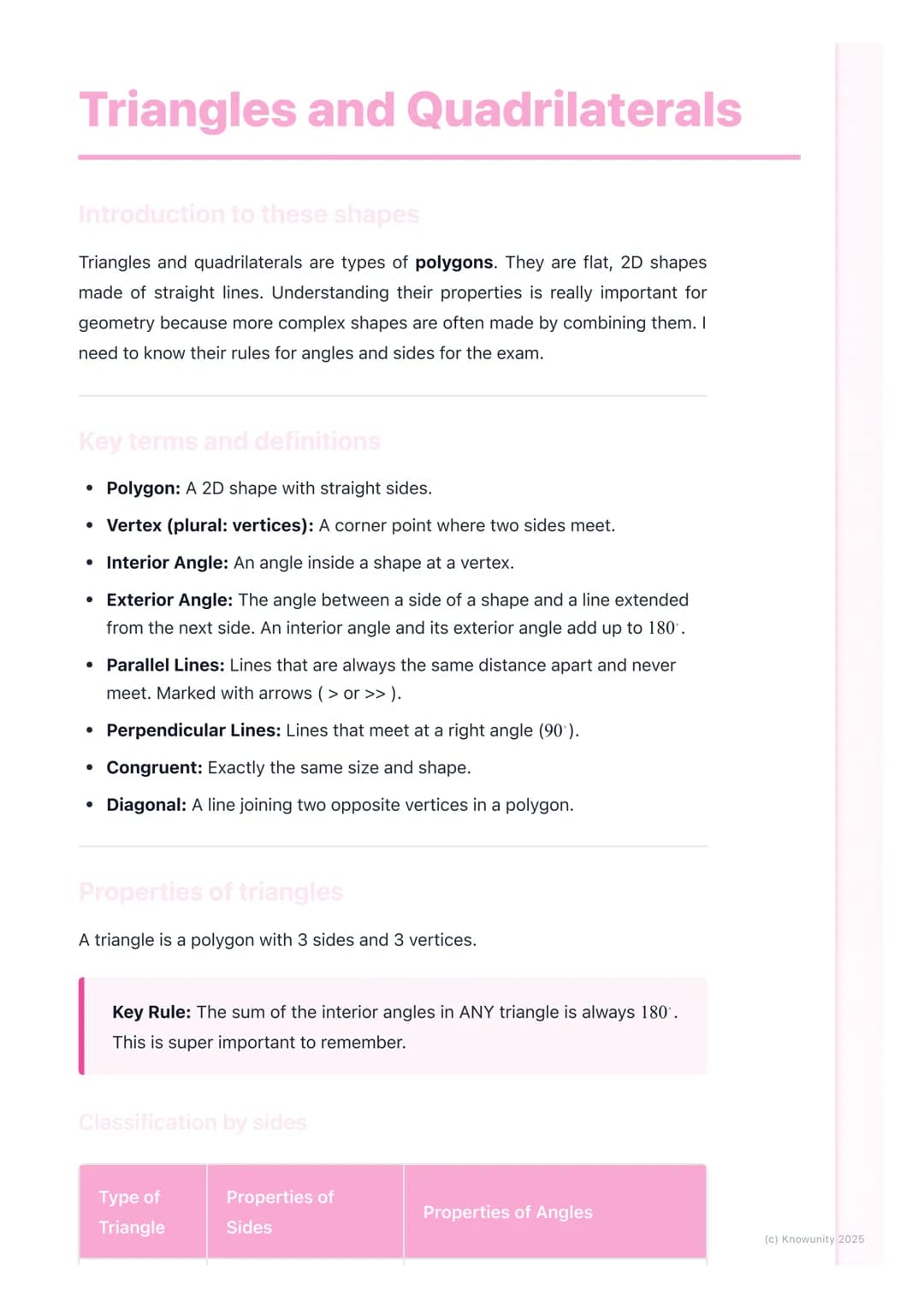
Introduction to Polygons and Key Terms
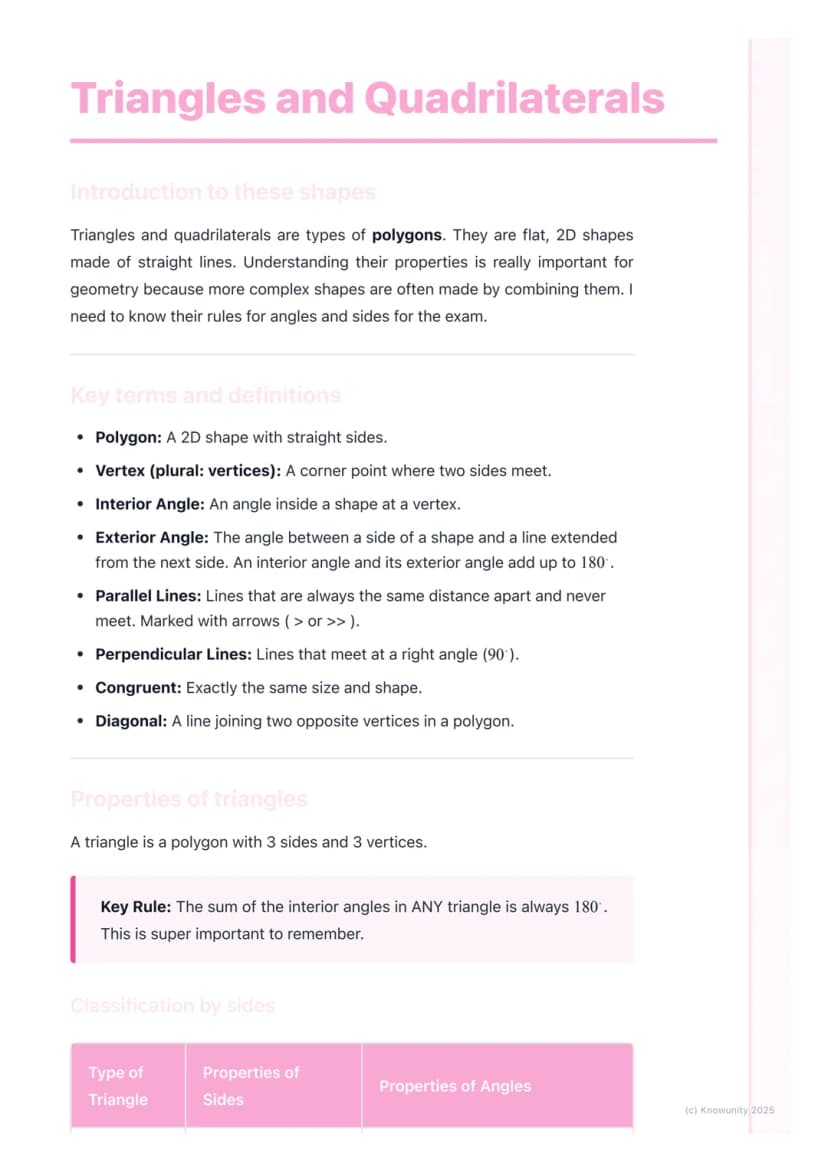
Understanding polygons is like learning the alphabet of geometry - once you know these basics, everything else makes sense. A polygon is simply a flat, 2D shape made of straight lines, and triangles and quadrilaterals are the most important ones you'll encounter.
The key terms you absolutely need to know include vertices (corner points), interior angles (angles inside the shape), and exterior angles (formed when you extend a side). Remember that an interior angle and its exterior angle always add up to 180°.
Parallel lines never meet and are marked with arrows, whilst perpendicular lines meet at 90°. When shapes are congruent, they're exactly the same size and shape - think of identical twins!
Quick Tip: Master these definitions first - they're the foundation for everything else in geometry and will save you marks in exams.
2
of 8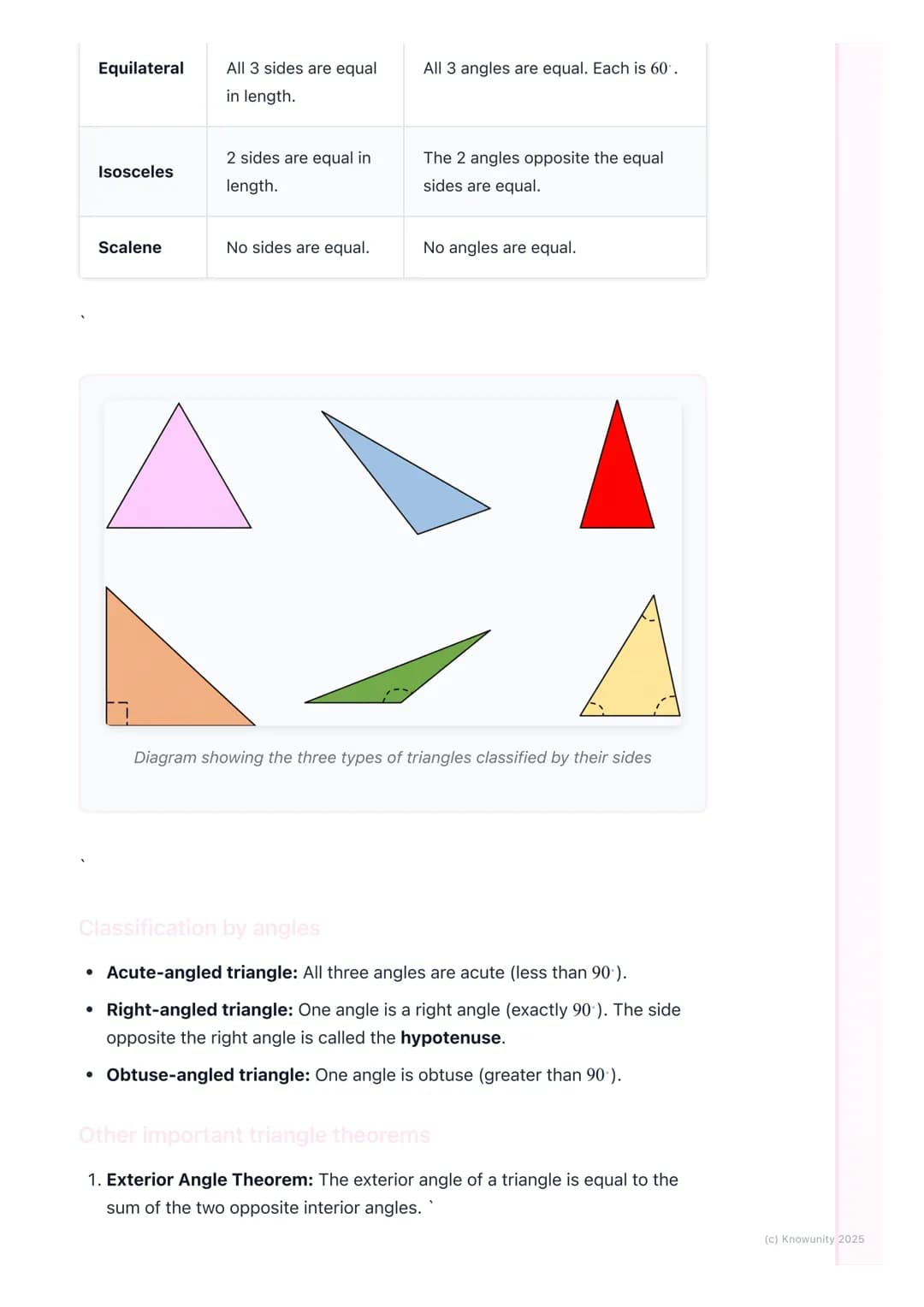
Triangle Properties and Classifications
Here's the golden rule that'll save you in every triangle question: the sum of interior angles in ANY triangle is always 180°. This works whether your triangle is huge or tiny, wonky or perfect.
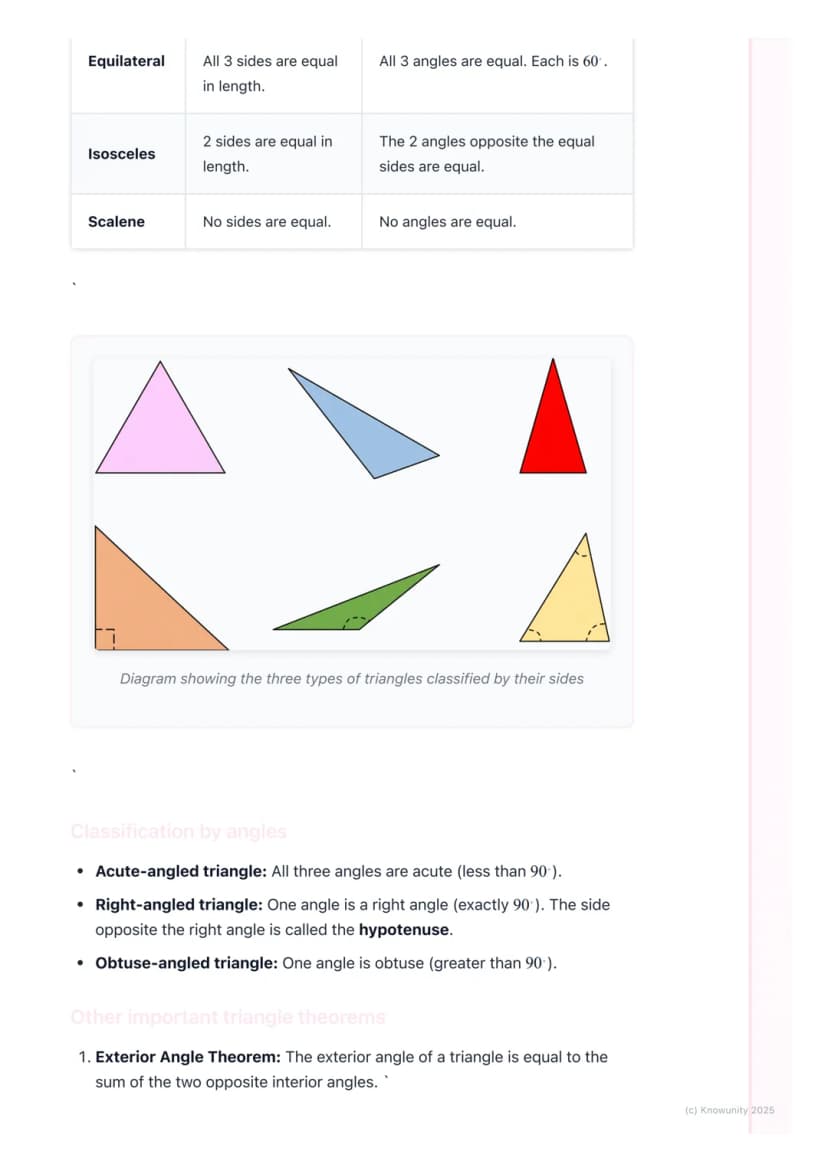
Triangles get sorted by their sides in three ways. Equilateral triangles have all sides equal and all angles are exactly 60°. Isosceles triangles have two equal sides, and the angles opposite those equal sides are also equal. Scalene triangles are the rebels - no sides or angles are equal.
You can also classify triangles by their angles. Acute triangles have all angles less than 90°, right-angled triangles have exactly one 90° angle, and obtuse triangles have one angle greater than 90°.
Exam Gold: In right-angled triangles, the longest side opposite the right angle is called the hypotenuse - you'll need this for Pythagoras' theorem!
3
of 8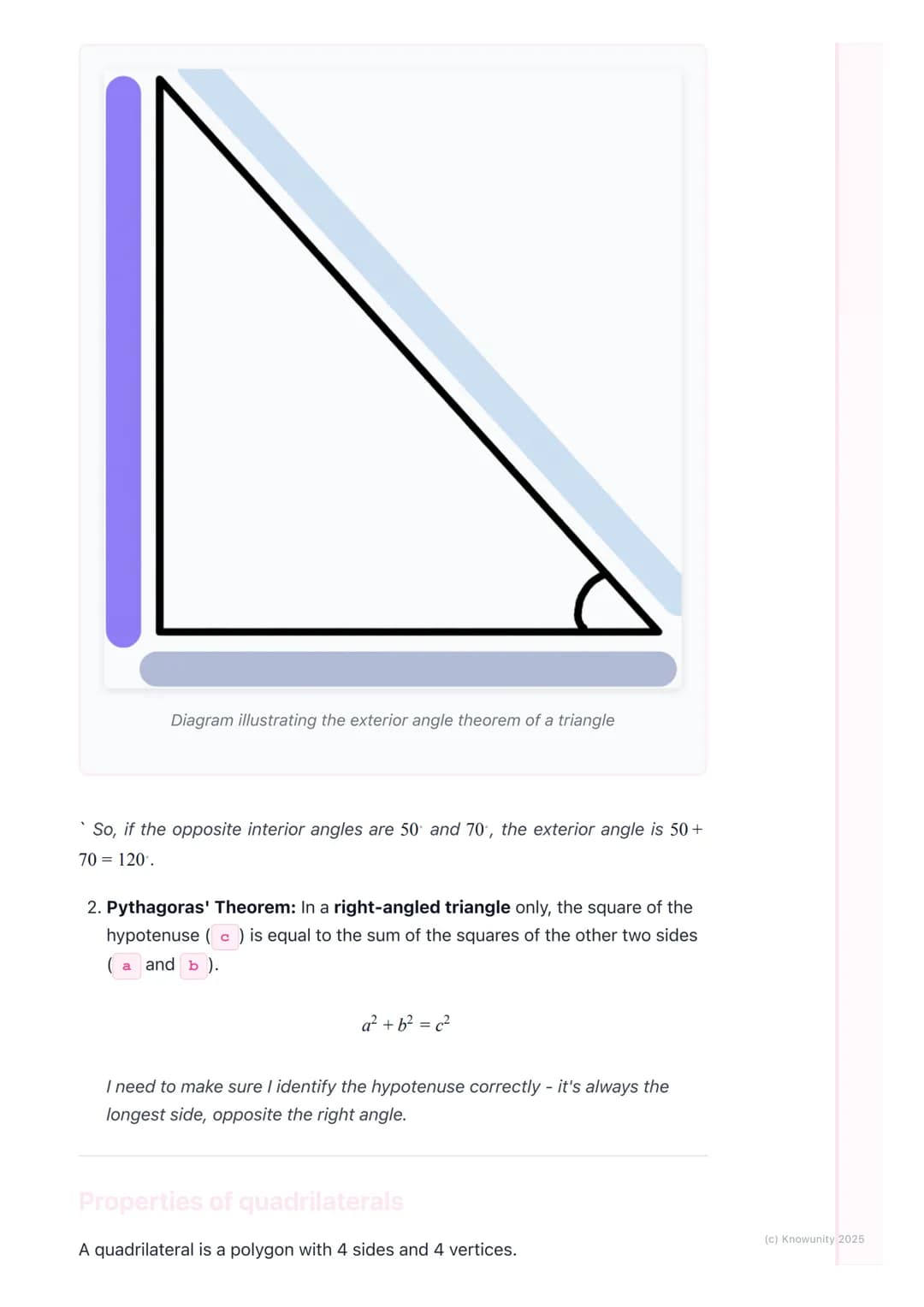
Important Triangle Theorems
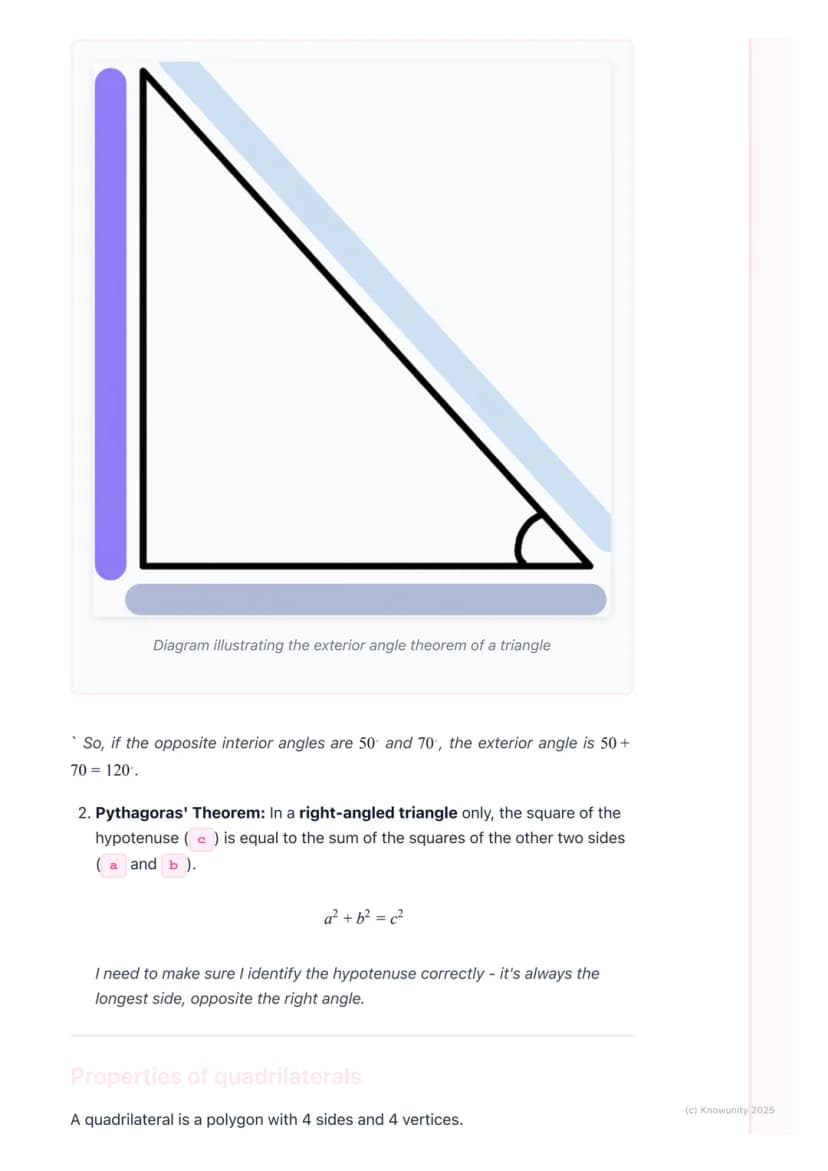
The Exterior Angle Theorem is brilliantly simple: any exterior angle of a triangle equals the sum of the two opposite interior angles. So if those opposite angles are 50° and 70°, your exterior angle is 120°. Easy!
Pythagoras' Theorem only works for right-angled triangles, but it's incredibly useful: a² + b² = c². The key is identifying the hypotenuse correctly - it's always the longest side, opposite the right angle.
These theorems aren't just random rules - they're your problem-solving toolkit. When you're stuck on a triangle question, ask yourself: "Can I use the 180° rule? Is there an exterior angle? Is this a right triangle where Pythagoras applies?"
Memory Trick: Think of Pythagoras like a recipe - you need the right ingredients for it to work!
4
of 8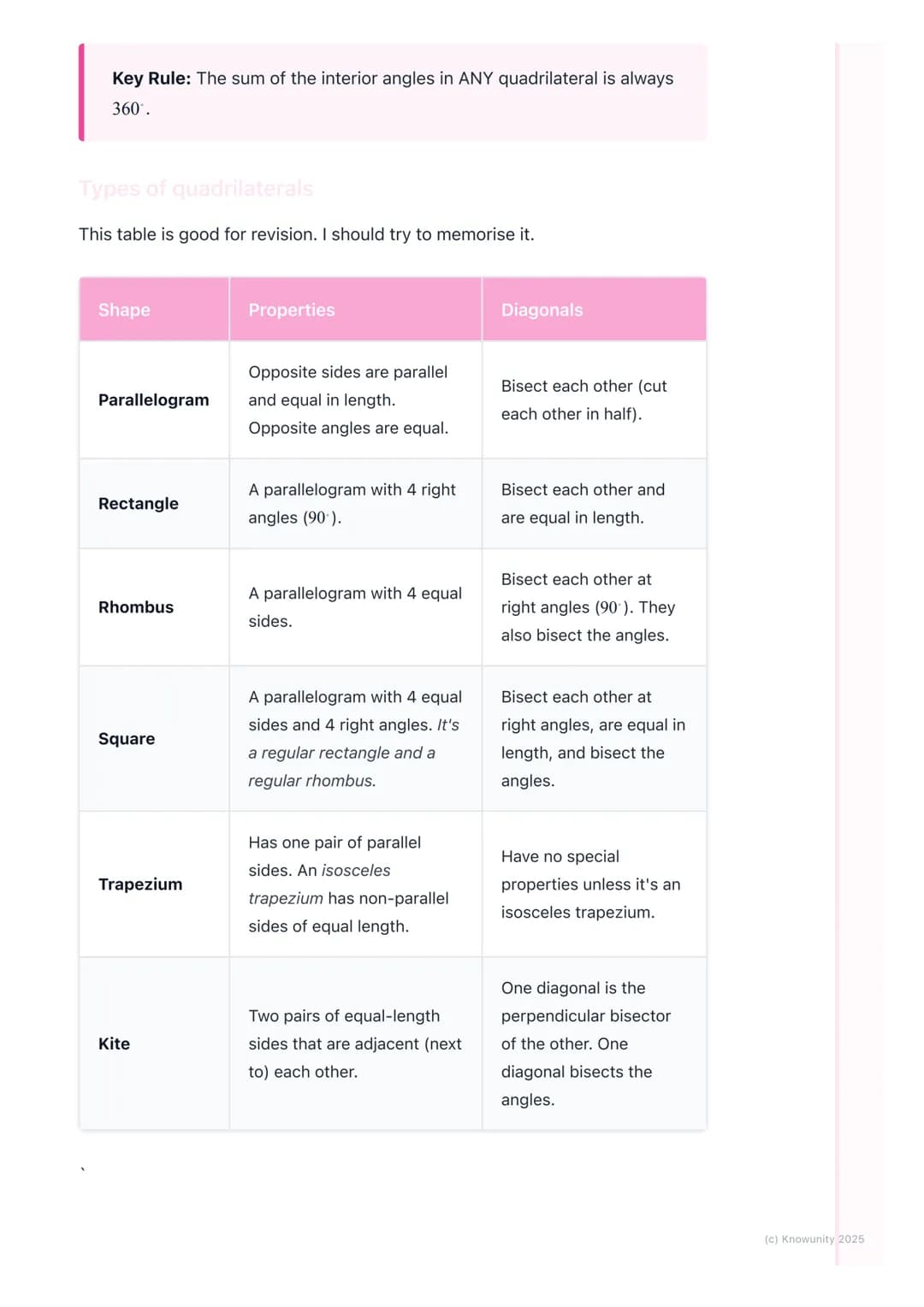
Quadrilateral Properties and Types
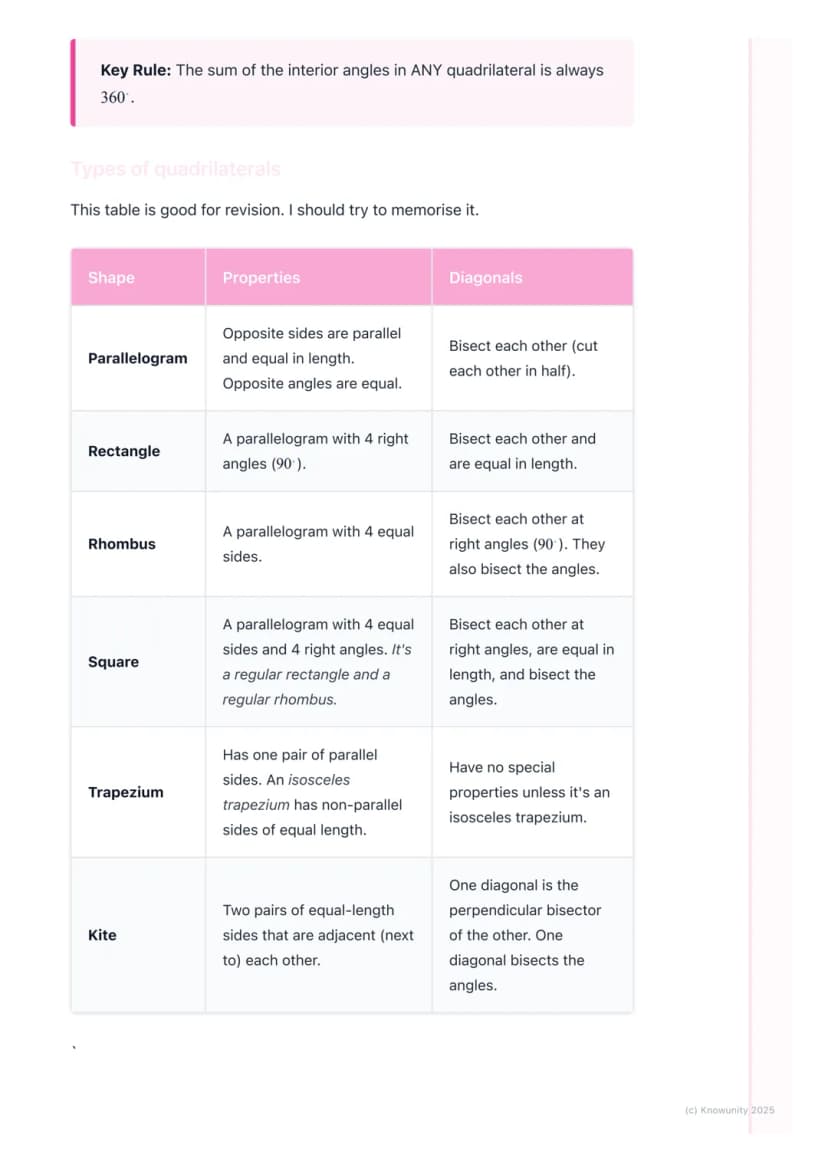
Quadrilaterals are four-sided shapes, and here's your second golden rule: the sum of interior angles in ANY quadrilateral is always 360°. Whether it's a square, rectangle, or weird wonky shape, the angles always add up to 360°.
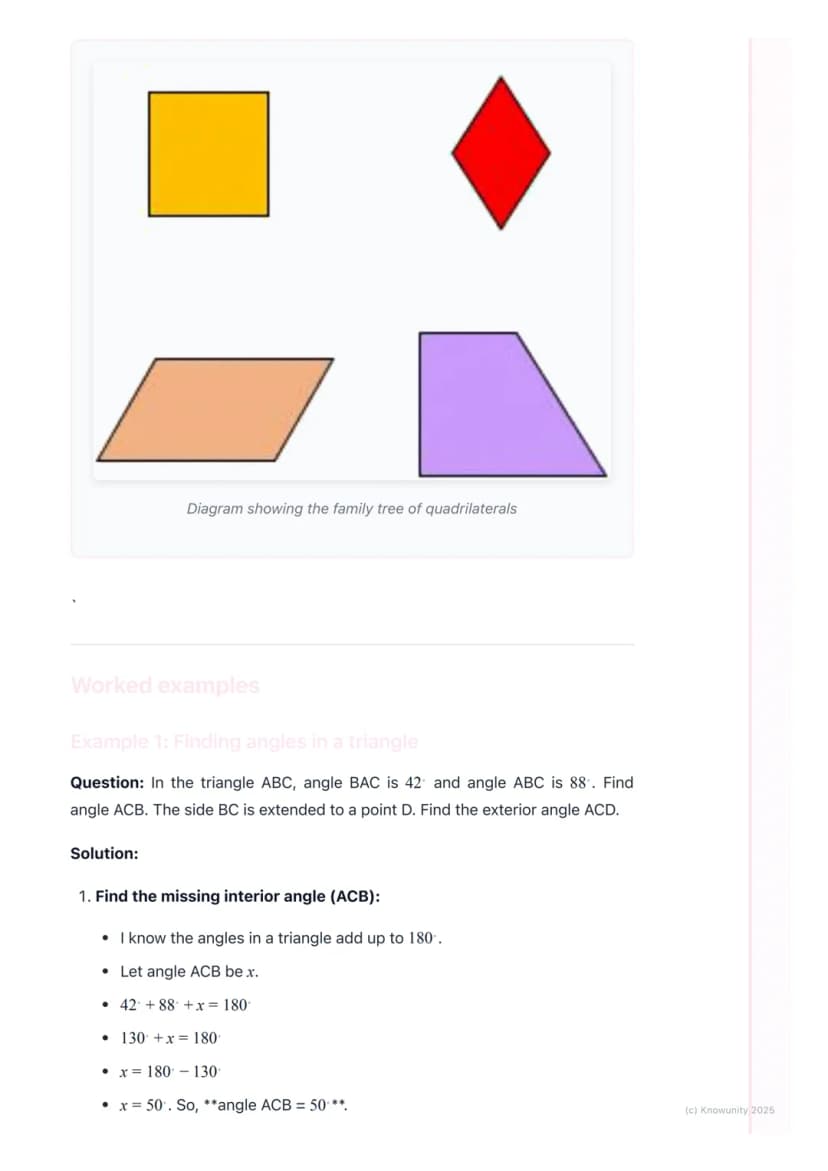
The quadrilateral family tree starts with the basic parallelogram (opposite sides parallel and equal, opposite angles equal). From there, you get rectangles (parallelograms with four right angles), rhombuses (parallelograms with four equal sides), and squares (both rectangle AND rhombus).
Don't forget about trapeziums (one pair of parallel sides) and kites (two pairs of adjacent equal sides). Each shape has its own special properties, but they all follow that 360° rule.
Exam Strategy: When tackling quadrilateral problems, always start by identifying what type of shape you're dealing with - this tells you which properties you can use!
5
of 8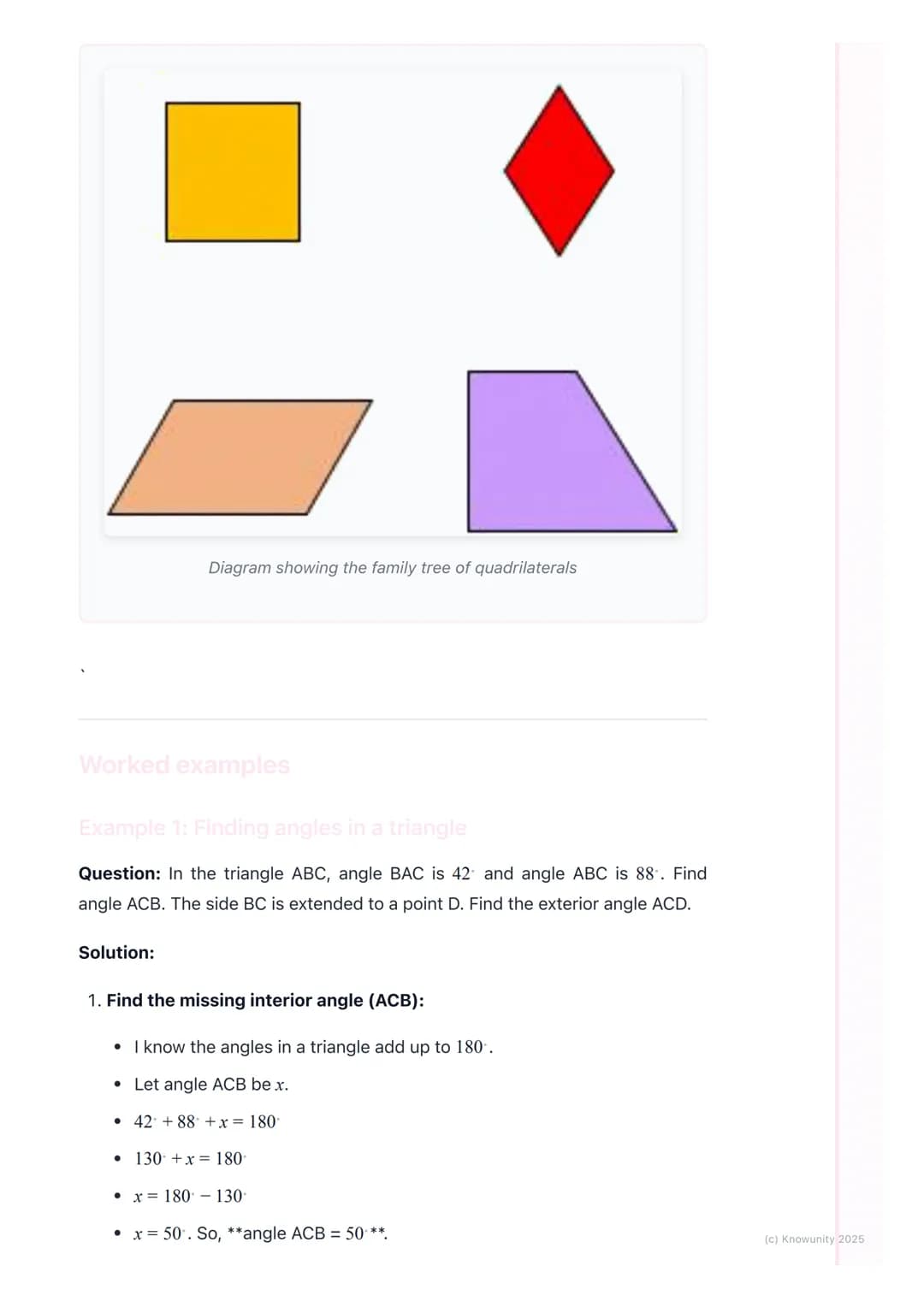
Worked Examples - Finding Triangle Angles
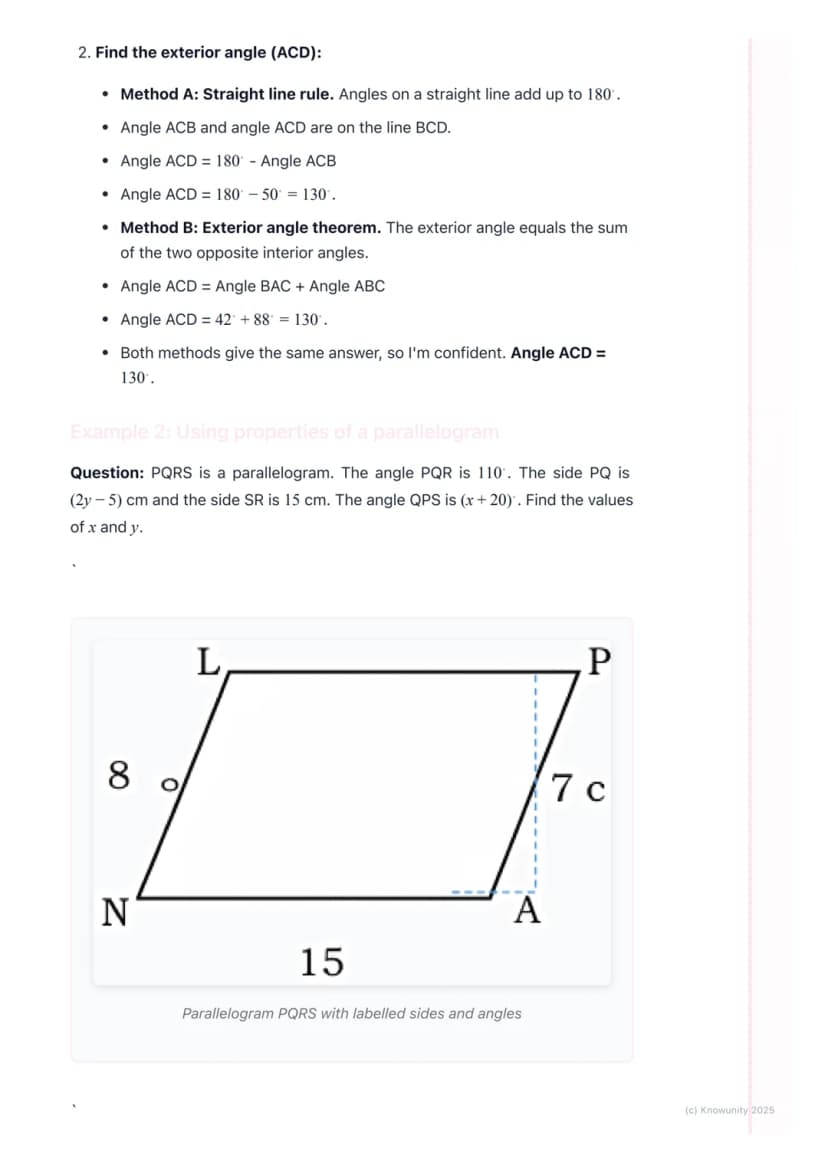
Let's tackle a real problem! If angle BAC is 42° and angle ABC is 88°, finding angle ACB is straightforward using the 180° rule: 42° + 88° + x = 180°, so x = 50°.
For the exterior angle ACD, you've got two methods. Method A uses the straight line rule , so ACD = 180° - 50° = 130°. Method B uses the exterior angle theorem: ACD = 42° + 88° = 130°.
Both methods give the same answer, which is brilliant for checking your work! This double-checking technique can save you marks in exams when you're unsure.
Pro Tip: Always try to solve angle problems using two different methods when possible - if you get the same answer, you know you're right!
6
of 8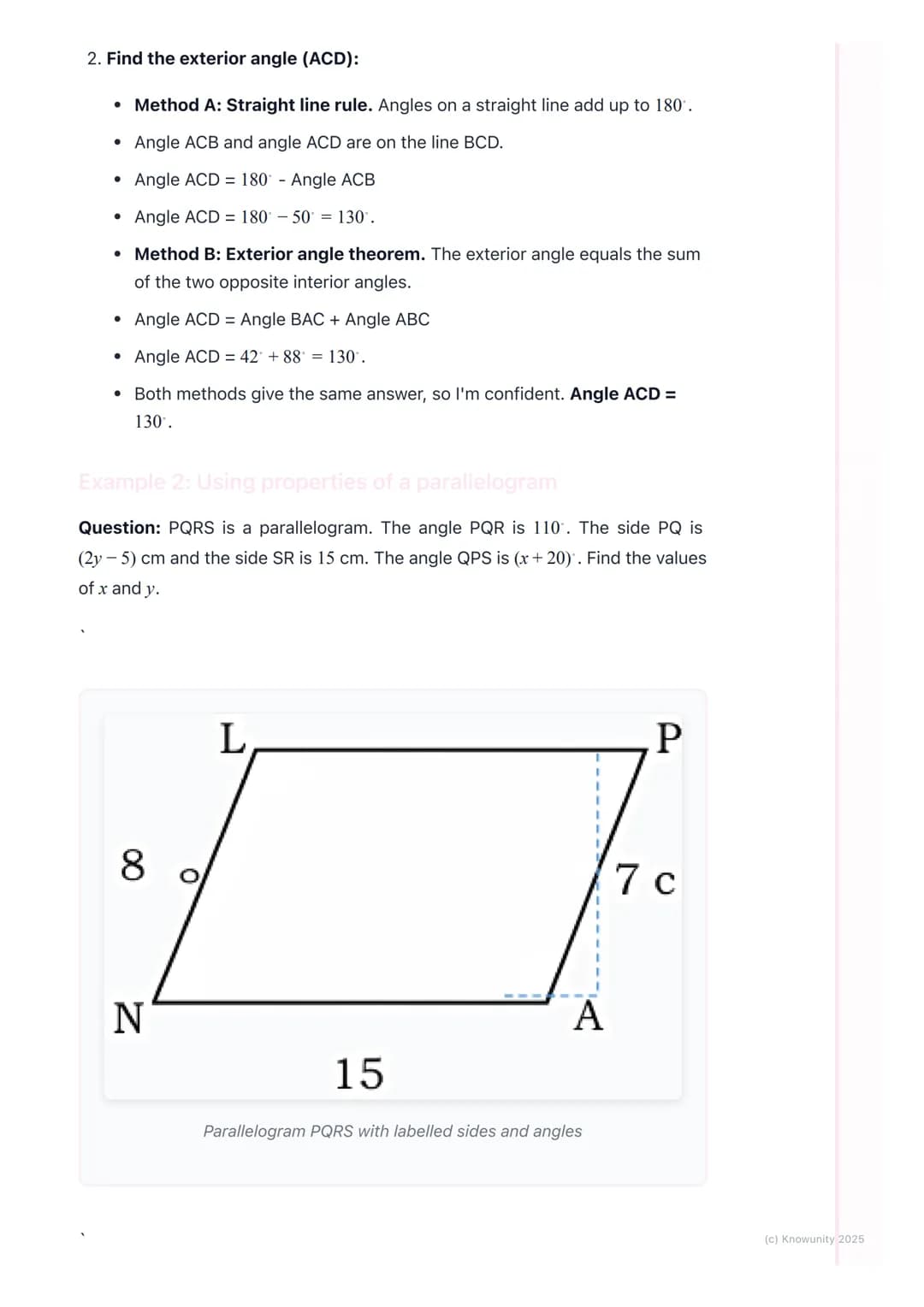
Worked Examples - Parallelogram Properties
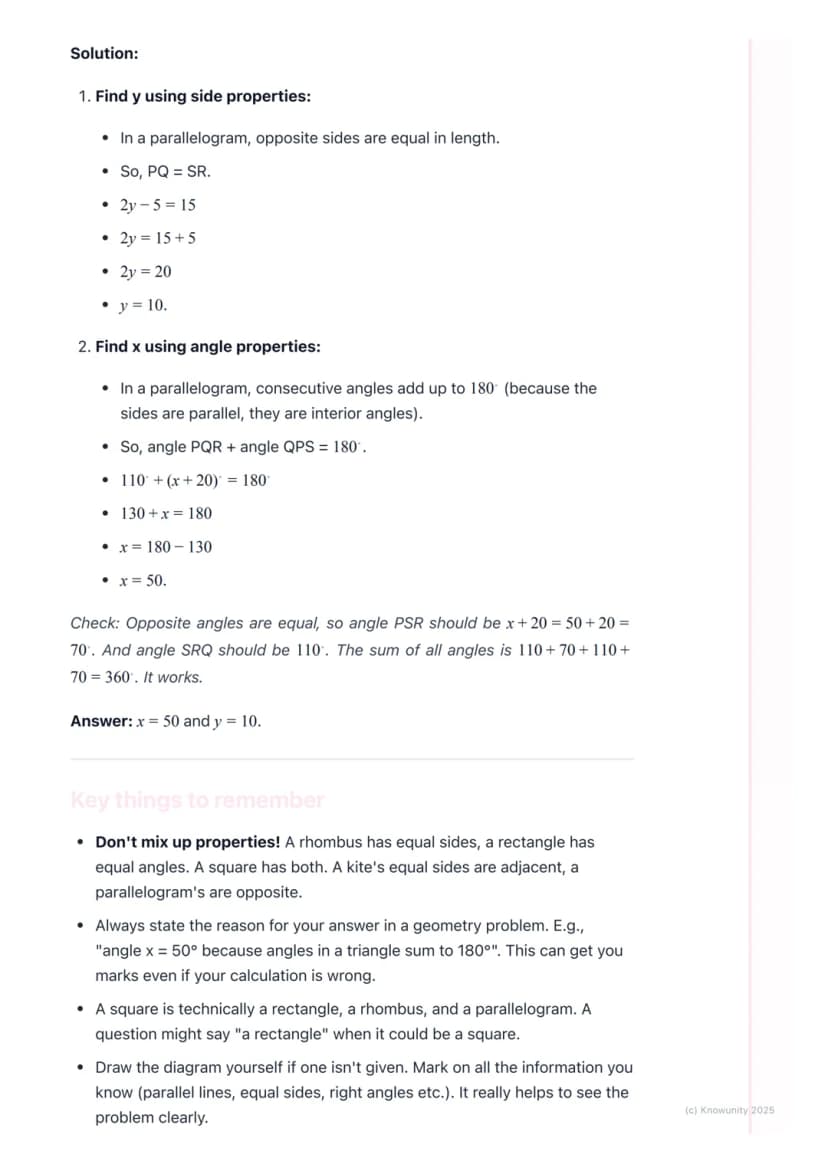
Here's a parallelogram problem that combines algebra with geometry. If PQ = cm and the opposite side SR = 15 cm, you can find y because opposite sides in parallelograms are equal.
So 2y - 5 = 15, which gives us 2y = 20, therefore y = 10. Simple algebra meets geometry!
For finding angle x, remember that consecutive angles in parallelograms add up to 180° (because the sides are parallel). If angle PQR = 110° and angle QPS = °, then 110° + ° = 180°, giving us x = 50°.
Key Insight: Parallelogram problems often mix algebra and geometry - use the shape's properties to set up equations, then solve with algebra!
7
of 8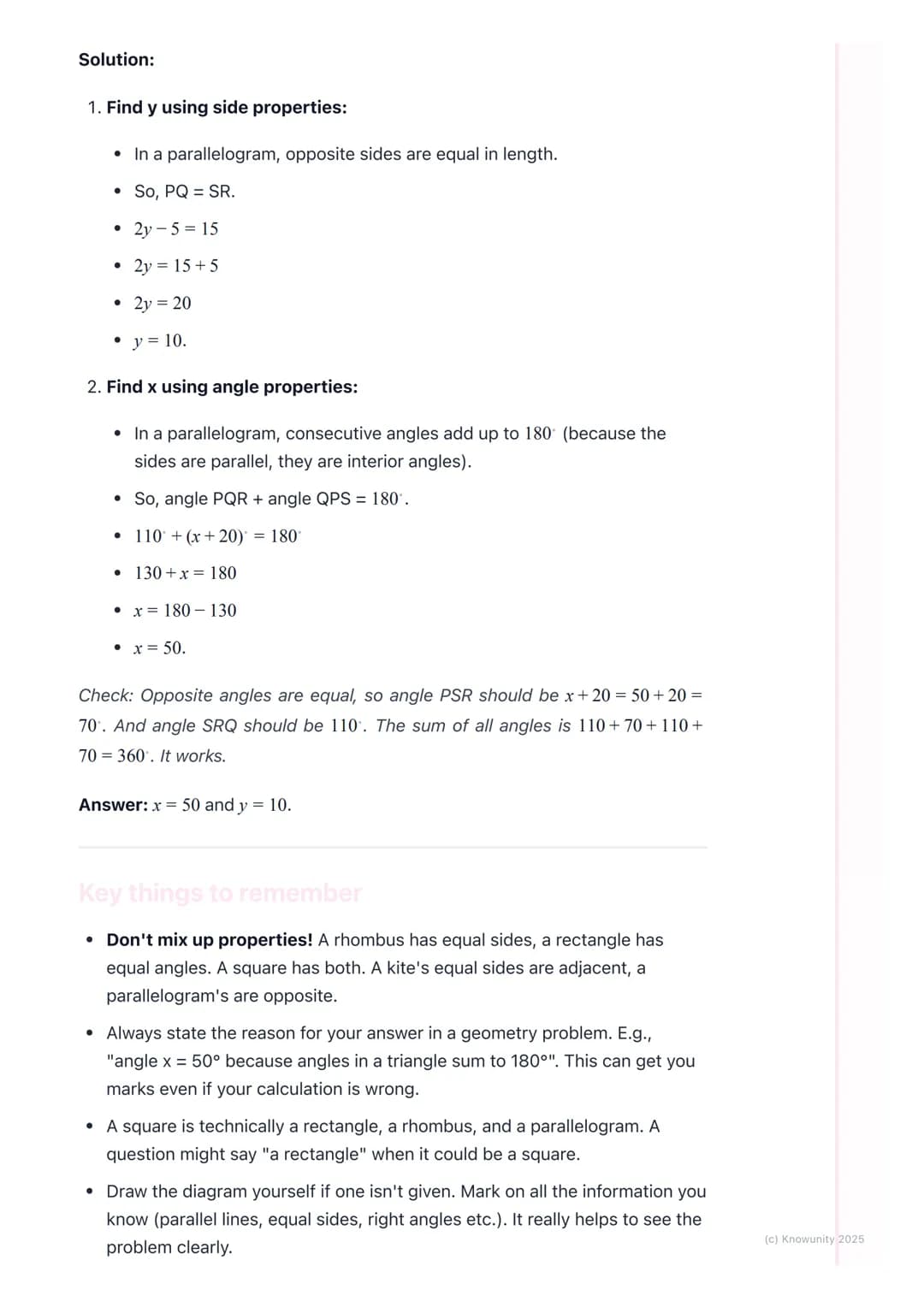
Essential Exam Tips and Common Mistakes
Don't mix up properties! A rhombus has equal sides, a rectangle has right angles, and a square has both. It's like remembering that a square is the overachiever of the quadrilateral family.
Always state your reasoning in geometry problems. Writing "angle x = 50° because angles in a triangle sum to 180°" can earn you marks even if your calculation goes wrong. Examiners love to see your thinking process.
Draw diagrams when they're not provided, and mark everything you know - parallel lines, equal sides, right angles. Visual information makes problems much clearer and prevents silly mistakes.
Exam Success: Remember that a square is technically a rectangle, rhombus, AND parallelogram - so questions about "rectangles" might actually involve squares!
8
of 8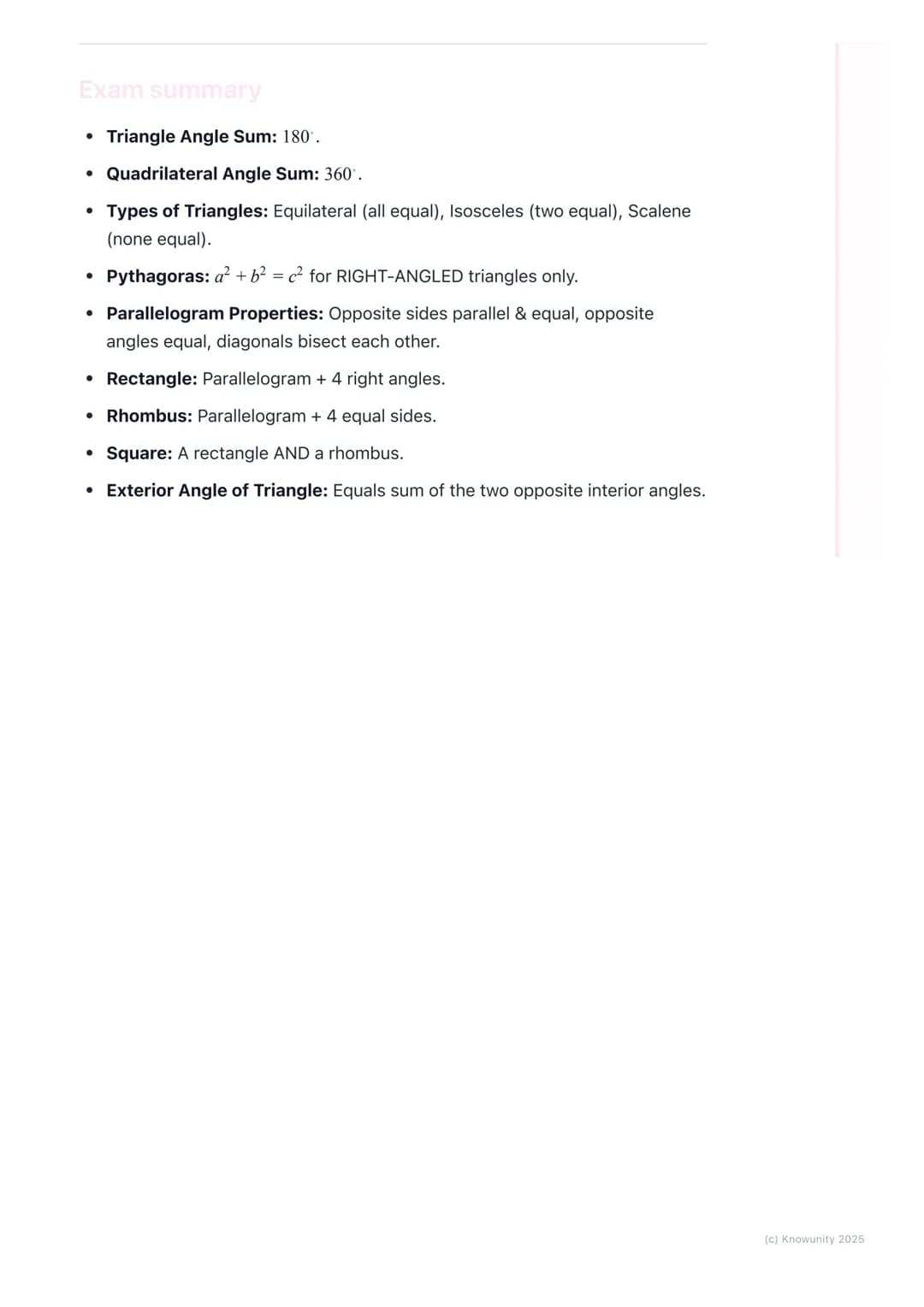
Quick Revision Summary
Here's your exam cheat sheet! Triangle angles sum to 180°, quadrilateral angles sum to 360°. Know your triangle types: equilateral (all equal), isosceles (two equal), scalene (none equal).
Pythagoras' theorem only works for right-angled triangles - don't try using it on other triangles! The exterior angle of a triangle equals the sum of the two opposite interior angles.
For quadrilaterals, start with parallelograms (opposite sides parallel and equal, opposite angles equal). Add right angles to get rectangles, add equal sides to get rhombuses, add both to get squares. Master these basics and you're sorted for most geometry questions!
Final Reminder: Practice identifying shape types quickly - once you know what you're dealing with, the properties follow naturally!
そんなこと聞いてくれるのを待ってたよ...
KnowunityのAIコンパニオンとは?
KnowunityのAIコンパニオンは学生向けに設計されたAIツールで、単なる答えを提供するだけではありません。数百万のKnowunityリソースを基に構築され、関連する情報、個別の学習プラン、クイズ、コンテンツをチャット内で直接提供し、あなたの個別の学習過程に適応します。
Knowunityアプリはどこでダウンロードできますか?
Google Play StoreとApple App Storeからアプリをダウンロードできます。
Knowunityは本当に無料ですか?
その通り!学習コンテンツへの無料アクセス、仲間の学生とのつながり、そして即座のサポートを手のひらで楽しもう。
Mathematicsの人気コンテンツ
8人気コンテンツ
9探しているものが見つからない?他の教科も見てみよう。
生徒たちが愛用中 — あなたもきっと気に入るはず。
4.6/5App Store
4.7/5Google Play
このアプリはとても使いやすくて、デザインも良いです。今のところ探していたものは全て見つかったし、プレゼン資料からもたくさん学べました!絶対に課題でも使いたいと思います!もちろん、アイデアを得るのにもすごく役立ちます。
Stefan SiOSユーザー
このアプリは本当に素晴らしいです。学習ノートやサポート資料がとても豊富で[...]。例えば、私の苦手科目はフランス語なんですが、このアプリにはサポートオプションがたくさんあります。このアプリのおかげでフランス語が上達しました。誰にでもおすすめしたいです。
Samantha KlichAndroidユーザー
すごい、本当に驚いた。広告で何度も見かけたからアプリを試してみたら、めちゃくちゃ感動した。このアプリは学校で欲しかった「まさにこれ!」って感じのサポートで、特に練習問題や要点まとめみたいな機能がたくさんあって、個人的にすごく助かってる。
AnnaiOSユーザー
Mathematics4 閲覧数·更新日 Jun 5, 2026·8 ページUnderstanding Triangles and Quadrilaterals
Ever wondered why triangles and quadrilaterals are everywhere around you? From the roof of your house to your phone screen, these basic shapes are the building blocks of geometry and appear constantly in your maths exams!
1
of 8
サインアップしてコンテンツを見よう。無料だよ!
- 全ドキュメントへのアクセス
- 成績アップ
- 数百万人の学生と一緒に学習
Introduction to Polygons and Key Terms
Understanding polygons is like learning the alphabet of geometry - once you know these basics, everything else makes sense. A polygon is simply a flat, 2D shape made of straight lines, and triangles and quadrilaterals are the most important ones you'll encounter.
The key terms you absolutely need to know include vertices (corner points), interior angles (angles inside the shape), and exterior angles (formed when you extend a side). Remember that an interior angle and its exterior angle always add up to 180°.
Parallel lines never meet and are marked with arrows, whilst perpendicular lines meet at 90°. When shapes are congruent, they're exactly the same size and shape - think of identical twins!
Quick Tip: Master these definitions first - they're the foundation for everything else in geometry and will save you marks in exams.
2
of 8サインアップしてコンテンツを見よう。無料だよ!
- 全ドキュメントへのアクセス
- 成績アップ
- 数百万人の学生と一緒に学習
Triangle Properties and Classifications
Here's the golden rule that'll save you in every triangle question: the sum of interior angles in ANY triangle is always 180°. This works whether your triangle is huge or tiny, wonky or perfect.
Triangles get sorted by their sides in three ways. Equilateral triangles have all sides equal and all angles are exactly 60°. Isosceles triangles have two equal sides, and the angles opposite those equal sides are also equal. Scalene triangles are the rebels - no sides or angles are equal.
You can also classify triangles by their angles. Acute triangles have all angles less than 90°, right-angled triangles have exactly one 90° angle, and obtuse triangles have one angle greater than 90°.
Exam Gold: In right-angled triangles, the longest side opposite the right angle is called the hypotenuse - you'll need this for Pythagoras' theorem!
3
of 8サインアップしてコンテンツを見よう。無料だよ!
- 全ドキュメントへのアクセス
- 成績アップ
- 数百万人の学生と一緒に学習
Important Triangle Theorems
The Exterior Angle Theorem is brilliantly simple: any exterior angle of a triangle equals the sum of the two opposite interior angles. So if those opposite angles are 50° and 70°, your exterior angle is 120°. Easy!
Pythagoras' Theorem only works for right-angled triangles, but it's incredibly useful: a² + b² = c². The key is identifying the hypotenuse correctly - it's always the longest side, opposite the right angle.
These theorems aren't just random rules - they're your problem-solving toolkit. When you're stuck on a triangle question, ask yourself: "Can I use the 180° rule? Is there an exterior angle? Is this a right triangle where Pythagoras applies?"
Memory Trick: Think of Pythagoras like a recipe - you need the right ingredients for it to work!
4
of 8サインアップしてコンテンツを見よう。無料だよ!
- 全ドキュメントへのアクセス
- 成績アップ
- 数百万人の学生と一緒に学習
Quadrilateral Properties and Types
Quadrilaterals are four-sided shapes, and here's your second golden rule: the sum of interior angles in ANY quadrilateral is always 360°. Whether it's a square, rectangle, or weird wonky shape, the angles always add up to 360°.
The quadrilateral family tree starts with the basic parallelogram (opposite sides parallel and equal, opposite angles equal). From there, you get rectangles (parallelograms with four right angles), rhombuses (parallelograms with four equal sides), and squares (both rectangle AND rhombus).
Don't forget about trapeziums (one pair of parallel sides) and kites (two pairs of adjacent equal sides). Each shape has its own special properties, but they all follow that 360° rule.
Exam Strategy: When tackling quadrilateral problems, always start by identifying what type of shape you're dealing with - this tells you which properties you can use!
5
of 8サインアップしてコンテンツを見よう。無料だよ!
- 全ドキュメントへのアクセス
- 成績アップ
- 数百万人の学生と一緒に学習
Worked Examples - Finding Triangle Angles
Let's tackle a real problem! If angle BAC is 42° and angle ABC is 88°, finding angle ACB is straightforward using the 180° rule: 42° + 88° + x = 180°, so x = 50°.
For the exterior angle ACD, you've got two methods. Method A uses the straight line rule , so ACD = 180° - 50° = 130°. Method B uses the exterior angle theorem: ACD = 42° + 88° = 130°.
Both methods give the same answer, which is brilliant for checking your work! This double-checking technique can save you marks in exams when you're unsure.
Pro Tip: Always try to solve angle problems using two different methods when possible - if you get the same answer, you know you're right!
6
of 8サインアップしてコンテンツを見よう。無料だよ!
- 全ドキュメントへのアクセス
- 成績アップ
- 数百万人の学生と一緒に学習
Worked Examples - Parallelogram Properties
Here's a parallelogram problem that combines algebra with geometry. If PQ = cm and the opposite side SR = 15 cm, you can find y because opposite sides in parallelograms are equal.
So 2y - 5 = 15, which gives us 2y = 20, therefore y = 10. Simple algebra meets geometry!
For finding angle x, remember that consecutive angles in parallelograms add up to 180° (because the sides are parallel). If angle PQR = 110° and angle QPS = °, then 110° + ° = 180°, giving us x = 50°.
Key Insight: Parallelogram problems often mix algebra and geometry - use the shape's properties to set up equations, then solve with algebra!
7
of 8サインアップしてコンテンツを見よう。無料だよ!
- 全ドキュメントへのアクセス
- 成績アップ
- 数百万人の学生と一緒に学習
Essential Exam Tips and Common Mistakes
Don't mix up properties! A rhombus has equal sides, a rectangle has right angles, and a square has both. It's like remembering that a square is the overachiever of the quadrilateral family.
Always state your reasoning in geometry problems. Writing "angle x = 50° because angles in a triangle sum to 180°" can earn you marks even if your calculation goes wrong. Examiners love to see your thinking process.
Draw diagrams when they're not provided, and mark everything you know - parallel lines, equal sides, right angles. Visual information makes problems much clearer and prevents silly mistakes.
Exam Success: Remember that a square is technically a rectangle, rhombus, AND parallelogram - so questions about "rectangles" might actually involve squares!
8
of 8サインアップしてコンテンツを見よう。無料だよ!
- 全ドキュメントへのアクセス
- 成績アップ
- 数百万人の学生と一緒に学習
Quick Revision Summary
Here's your exam cheat sheet! Triangle angles sum to 180°, quadrilateral angles sum to 360°. Know your triangle types: equilateral (all equal), isosceles (two equal), scalene (none equal).
Pythagoras' theorem only works for right-angled triangles - don't try using it on other triangles! The exterior angle of a triangle equals the sum of the two opposite interior angles.
For quadrilaterals, start with parallelograms (opposite sides parallel and equal, opposite angles equal). Add right angles to get rectangles, add equal sides to get rhombuses, add both to get squares. Master these basics and you're sorted for most geometry questions!
Final Reminder: Practice identifying shape types quickly - once you know what you're dealing with, the properties follow naturally!
そんなこと聞いてくれるのを待ってたよ...
KnowunityのAIコンパニオンとは?
KnowunityのAIコンパニオンは学生向けに設計されたAIツールで、単なる答えを提供するだけではありません。数百万のKnowunityリソースを基に構築され、関連する情報、個別の学習プラン、クイズ、コンテンツをチャット内で直接提供し、あなたの個別の学習過程に適応します。
Knowunityアプリはどこでダウンロードできますか?
Google Play StoreとApple App Storeからアプリをダウンロードできます。
Knowunityは本当に無料ですか?
その通り!学習コンテンツへの無料アクセス、仲間の学生とのつながり、そして即座のサポートを手のひらで楽しもう。
Mathematicsの人気コンテンツ
8人気コンテンツ
9探しているものが見つからない?他の教科も見てみよう。
生徒たちが愛用中 — あなたもきっと気に入るはず。
4.6/5App Store
4.7/5Google Play
このアプリはとても使いやすくて、デザインも良いです。今のところ探していたものは全て見つかったし、プレゼン資料からもたくさん学べました!絶対に課題でも使いたいと思います!もちろん、アイデアを得るのにもすごく役立ちます。
Stefan SiOSユーザー
このアプリは本当に素晴らしいです。学習ノートやサポート資料がとても豊富で[...]。例えば、私の苦手科目はフランス語なんですが、このアプリにはサポートオプションがたくさんあります。このアプリのおかげでフランス語が上達しました。誰にでもおすすめしたいです。
Samantha KlichAndroidユーザー
すごい、本当に驚いた。広告で何度も見かけたからアプリを試してみたら、めちゃくちゃ感動した。このアプリは学校で欲しかった「まさにこれ!」って感じのサポートで、特に練習問題や要点まとめみたいな機能がたくさんあって、個人的にすごく助かってる。
AnnaiOSユーザー