
Ever wondered why some algebra equations seem trickier than others? ...
 Mathematics3 閲覧数·更新日 Jun 8, 2026·5 ページ
Mastering Quadratic Equations: Factorization and Formula Techniques
1 / 5
1
of 5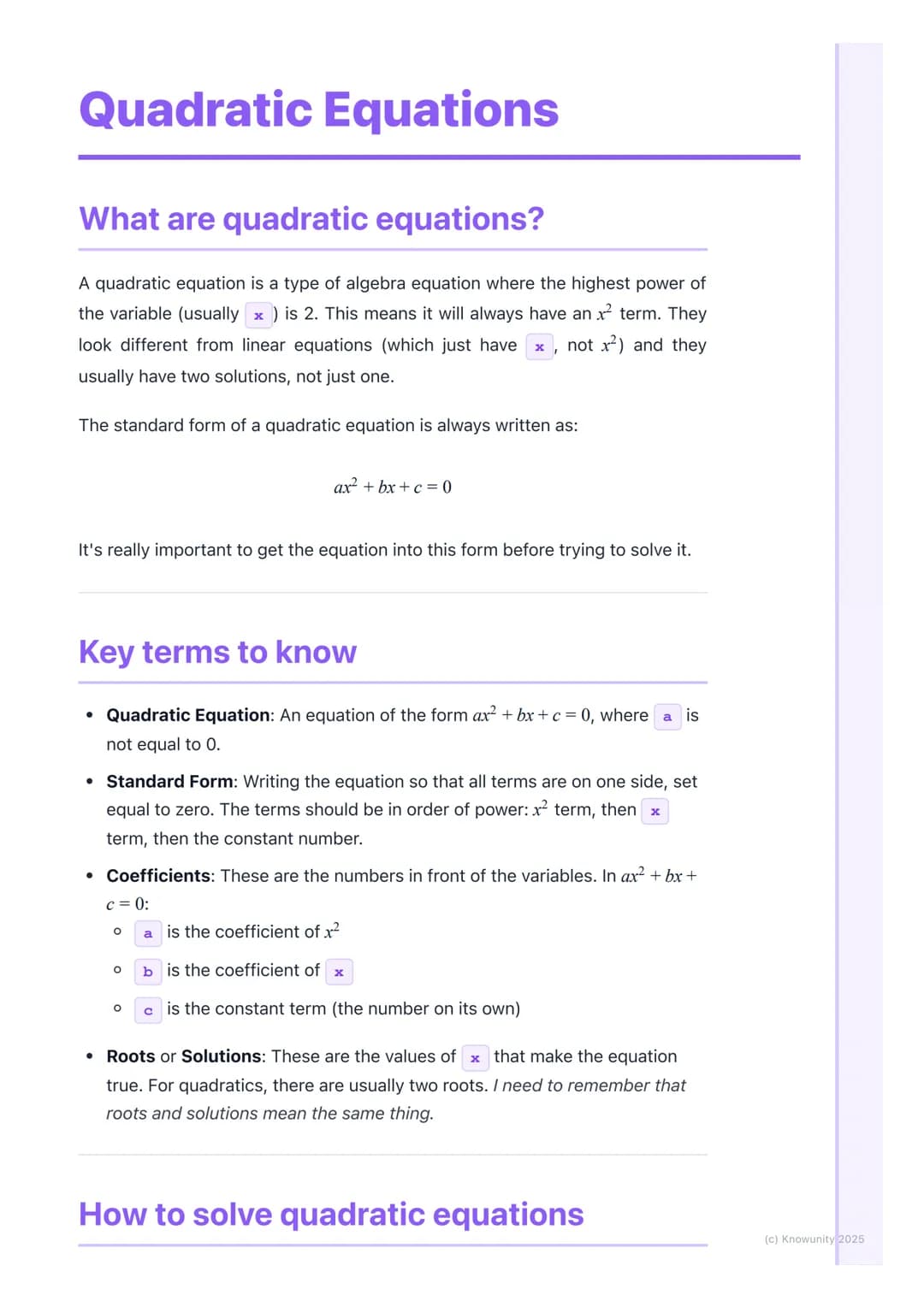
What Are Quadratic Equations?
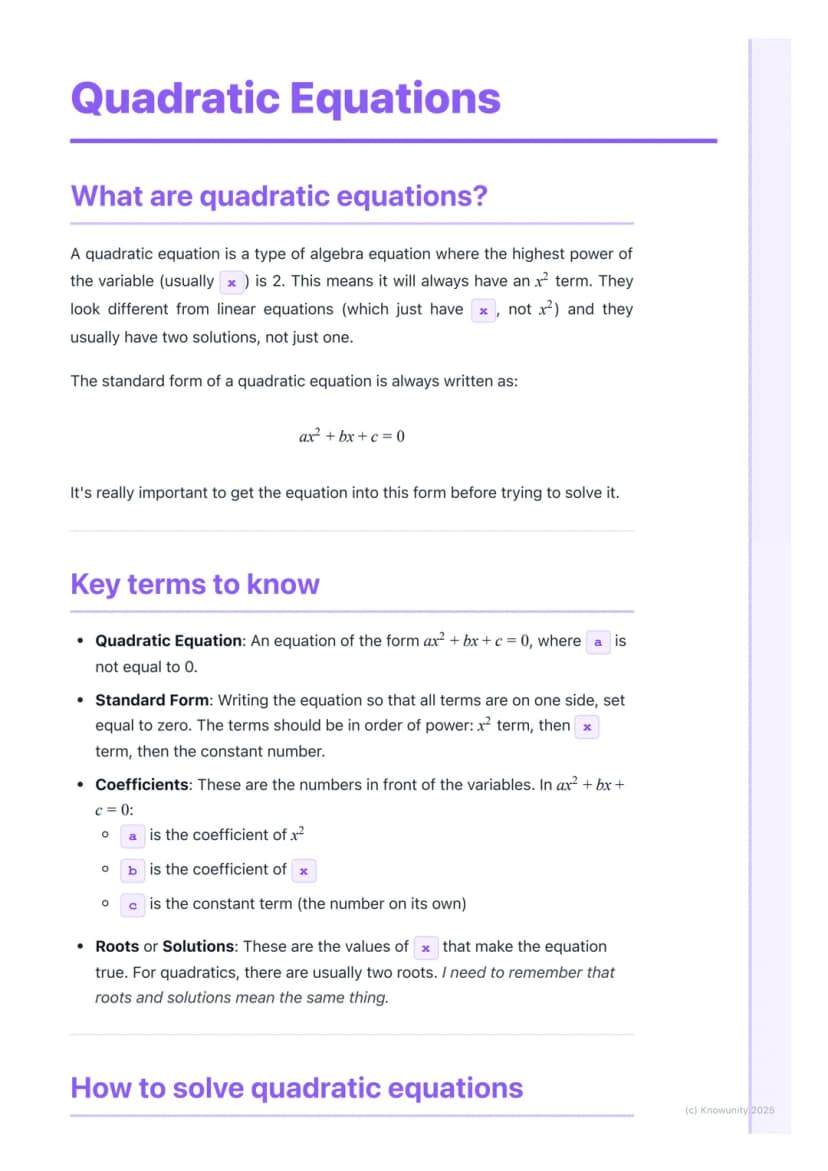
Think of quadratic equations as algebra's next level challenge. Unlike simple linear equations that only have x, these always include an x² term, making them more interesting to solve. The highest power is always 2, which is what makes them "quadratic".
Every quadratic equation follows the same pattern: ax² + bx + c = 0. Getting your equation into this standard form is absolutely crucial before you start solving - it's like organising your desk before starting homework.
The letters a, b, and c are called coefficients - they're just the numbers in front of each term. Remember that 'a' can never be zero (otherwise it wouldn't be quadratic anymore!). Most quadratics have two solutions called roots, which are the x-values that make the equation true.
Quick tip: Roots and solutions mean exactly the same thing - don't let different terminology throw you off in exams!
2
of 5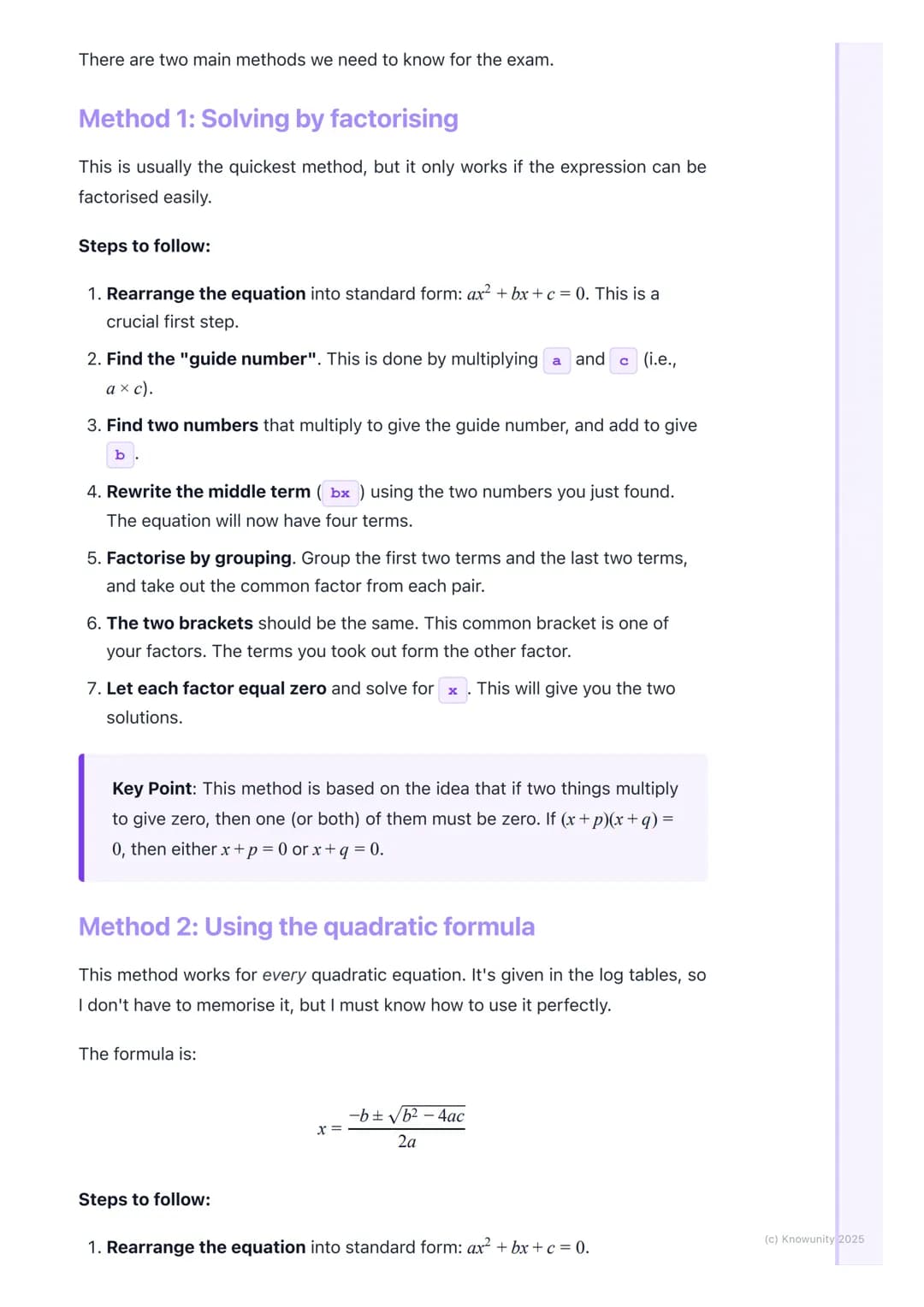
Method 1: Solving by Factorising
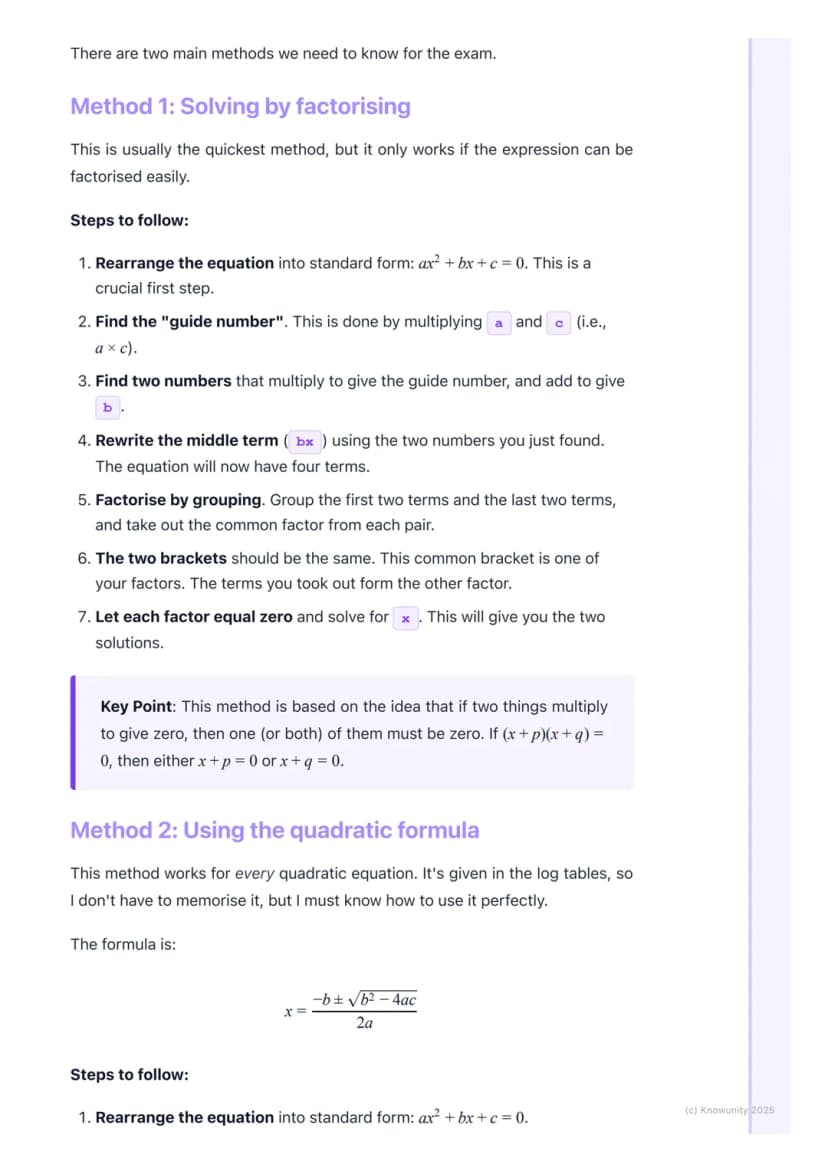
This is often the fastest method, but only works when the quadratic can be factorised neatly. Think of it like breaking down a complex problem into smaller, manageable pieces.
Start by rearranging into standard form, then find the "guide number" by multiplying a and c together. You need two numbers that multiply to give this guide number AND add up to give b. Once you find them, rewrite the middle term using these numbers.
Now comes the clever bit: factorising by grouping. Group the first two terms and last two terms separately, take out common factors from each pair, and you should end up with matching brackets. Set each factor equal to zero and solve - that's your two solutions!
The key principle here is simple: if two things multiply to give zero, then one (or both) must be zero. So if = 0, then either x + 3 = 0 or x - 2 = 0.
Remember: This method is based on the zero product property - if the product equals zero, at least one factor must be zero.
3
of 5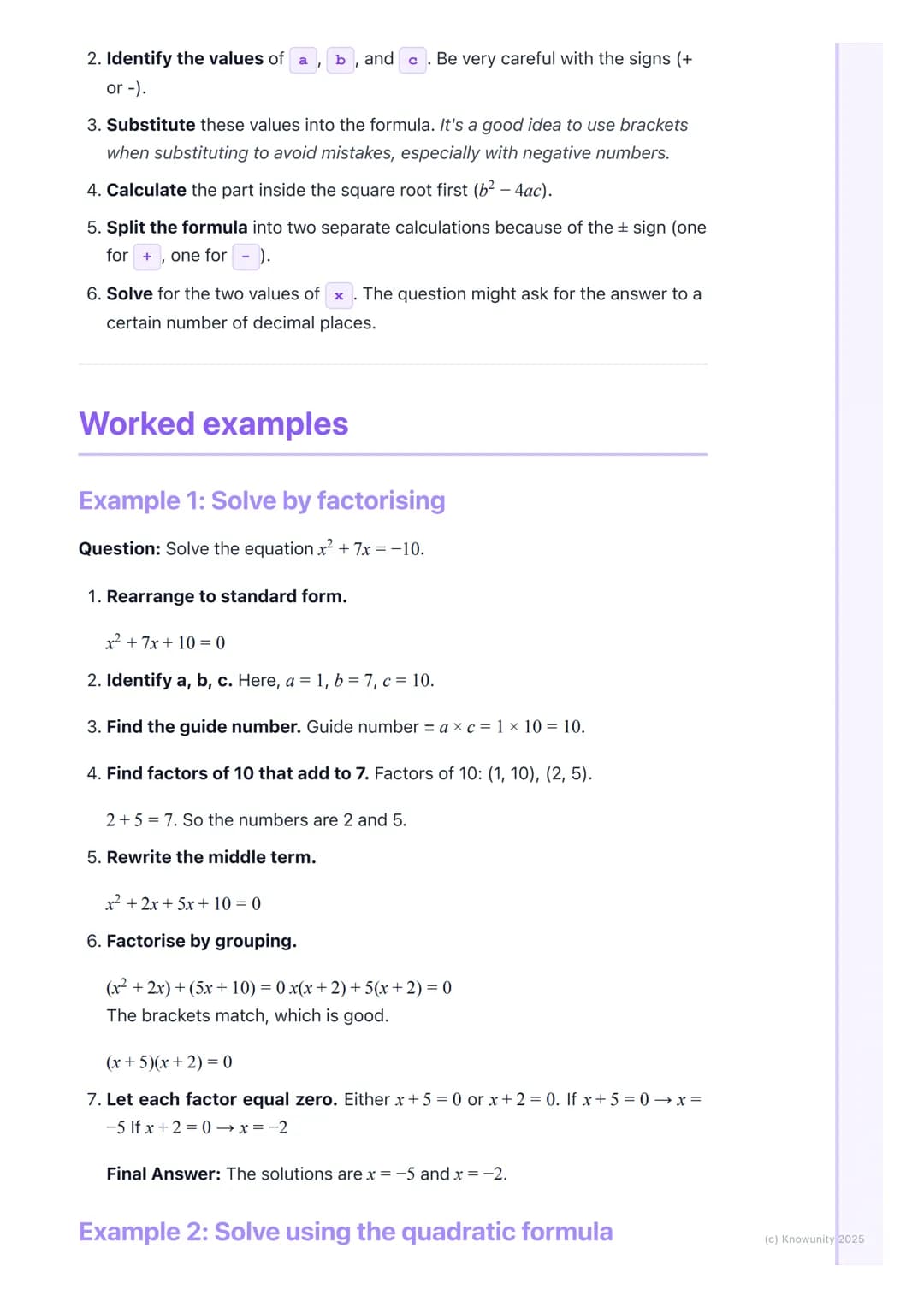
Method 2: The Quadratic Formula
When factorising gets messy or impossible, the quadratic formula is your reliable backup. It works for every single quadratic equation, no exceptions. The best part? It's in your log tables, so you don't need to memorise it!
The formula is: x = / 2a. First, identify your a, b, and c values carefully - negative signs are especially tricky here. Substitute these into the formula using brackets to avoid sign errors.
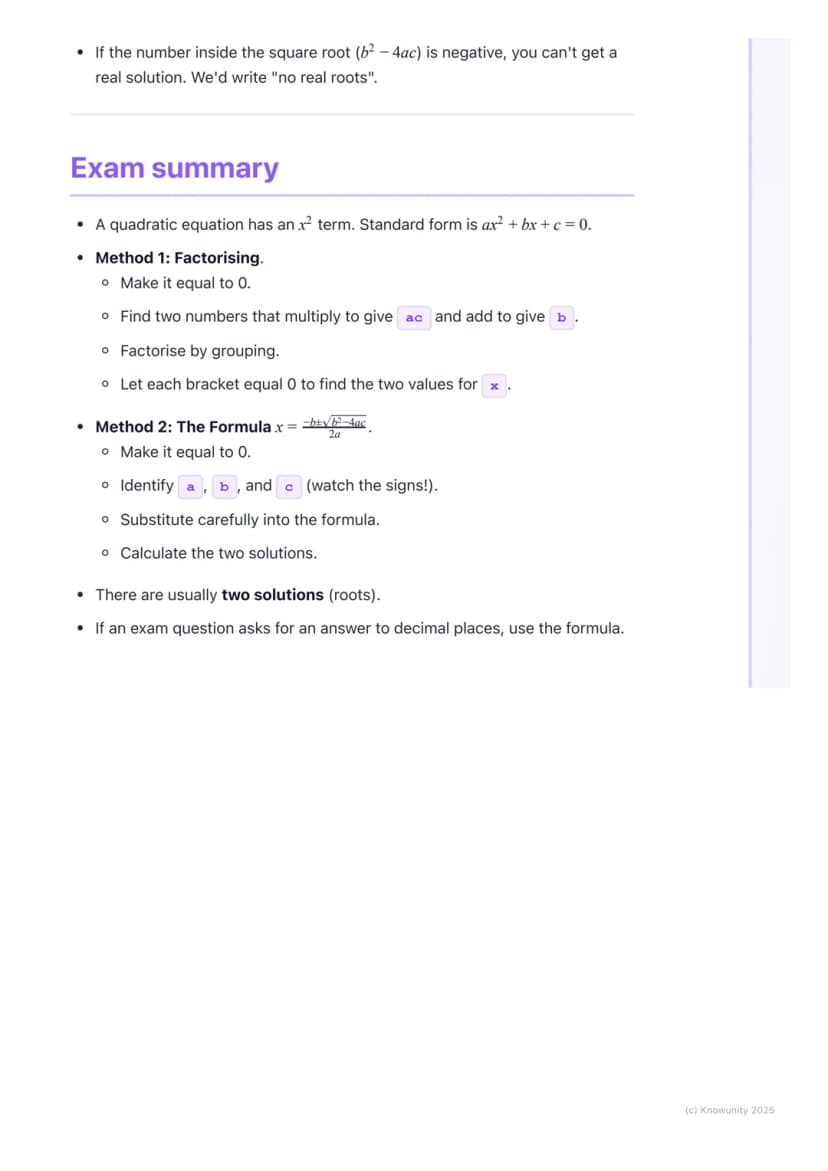
Calculate the bit under the square root first, then split the calculation because of the ± symbol. You'll get two separate answers, which gives you both solutions. Watch out for questions asking for decimal places - that's usually a hint to use the formula!
The part under the square root is quite important. If it's negative, you can't find real solutions, so you'd write "no real roots" as your answer.
Exam tip: If a question asks for decimal places, it's almost always telling you to use the formula rather than factorising.
4
of 5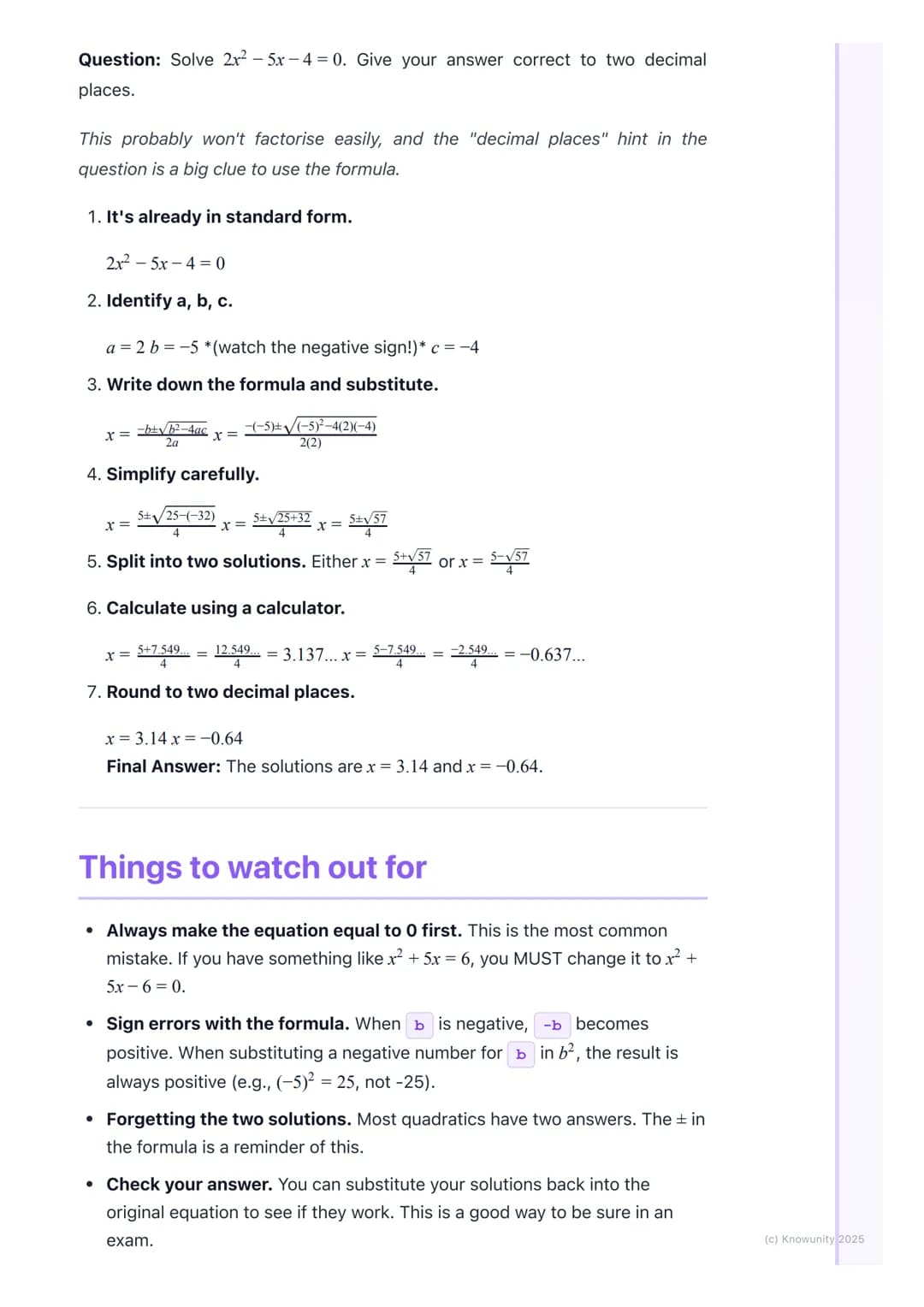
Worked Examples in Action
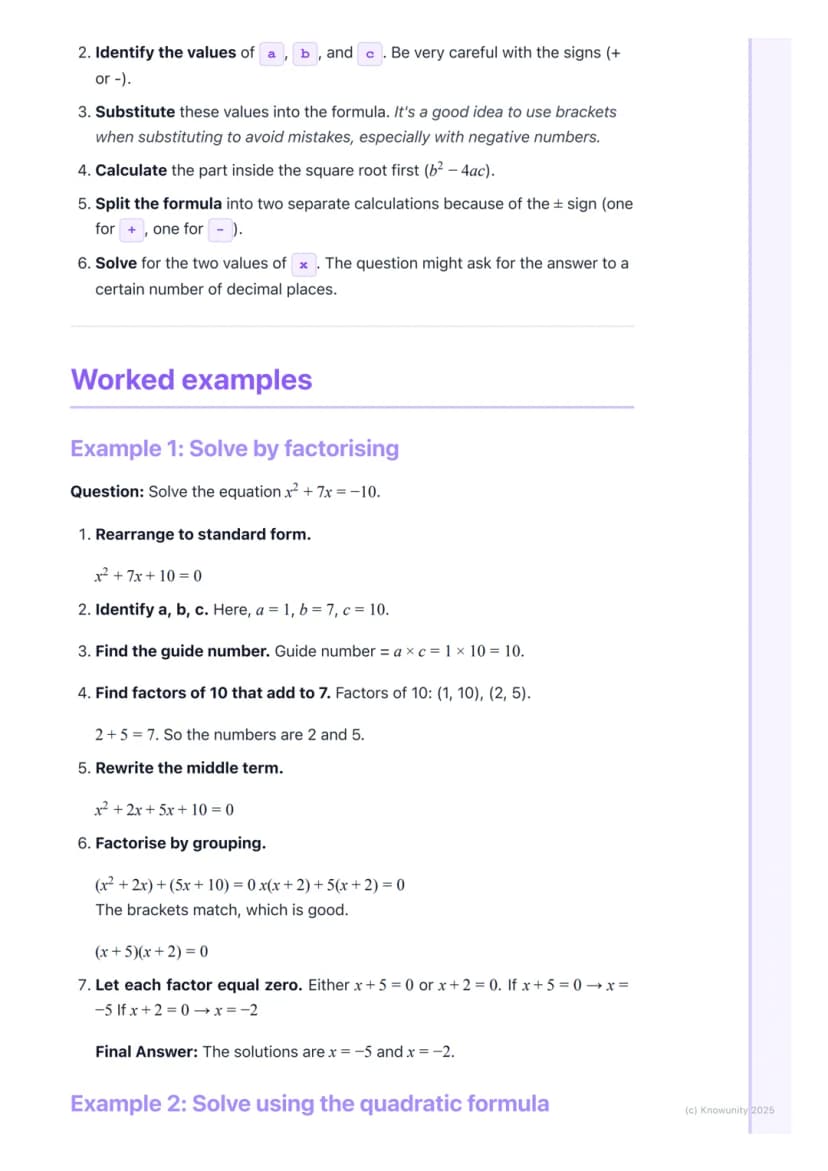
Let's see these methods in practice with real examples you might face in exams. For x² + 7x = -10, first rearrange to get x² + 7x + 10 = 0. The guide number is 1 × 10 = 10, and we need factors that add to 7.
Since 2 + 5 = 7 and 2 × 5 = 10, we rewrite as x² + 2x + 5x + 10 = 0. Grouping gives us x + 5 = 0, which factors to = 0. So x = -5 or x = -2.
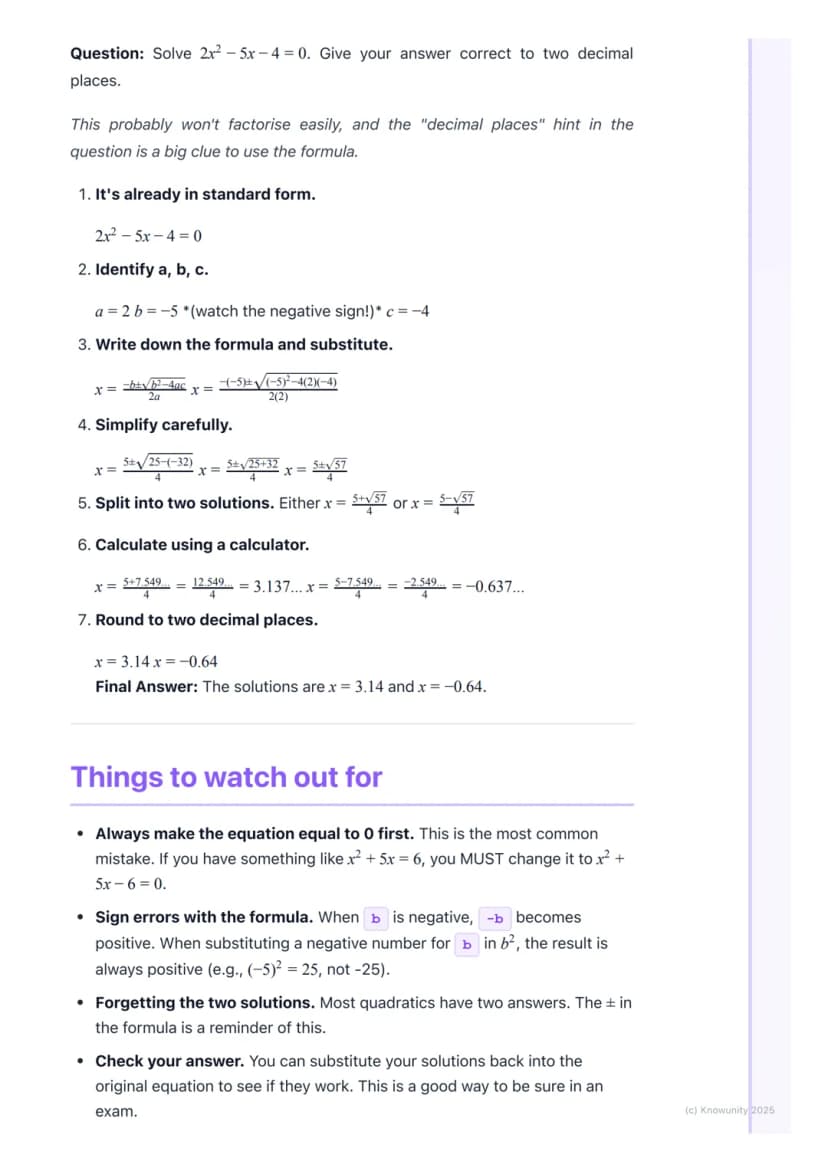
For 2x² - 5x - 4 = 0, the decimal places hint tells us to use the formula. With a = 2, b = -5, c = -4, we substitute carefully: x = (5 ± √(25 + 32)) / 4 = (5 ± √57) / 4.
This gives us x = 3.14 and x = -0.64 (to two decimal places). Notice how the formula handles the messy numbers that would make factorising nearly impossible.
Pro tip: Always substitute your answers back into the original equation to check they work - it's a great way to catch mistakes!
5
of 5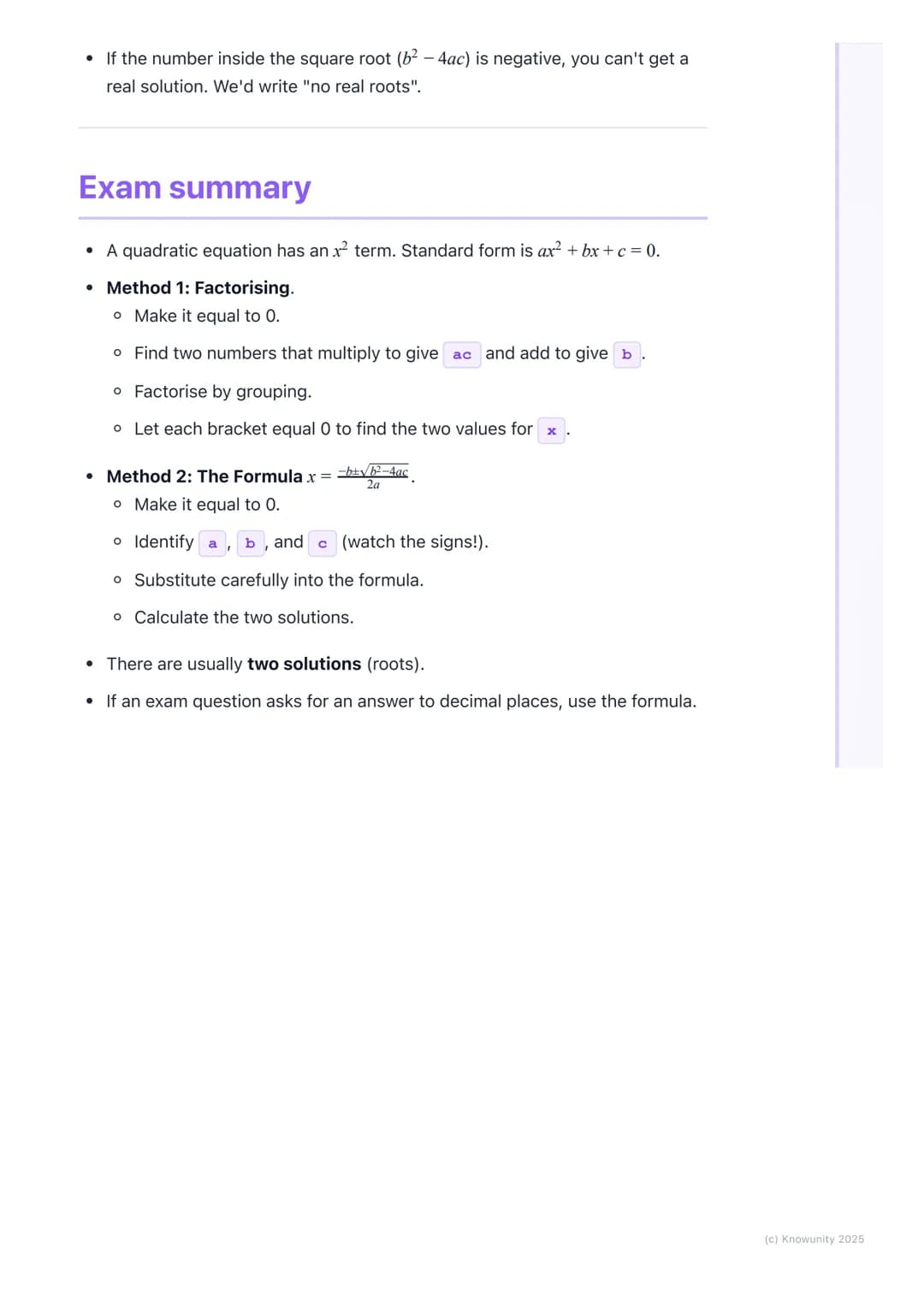
Common Mistakes and Exam Strategy
The biggest mistake? Forgetting to rearrange to standard form first. If you see x² + 5x = 6, you MUST change it to x² + 5x - 6 = 0 before doing anything else. This trips up loads of students in exams.
Sign errors are another classic problem, especially with the formula. When b is negative, -b becomes positive. And remember (-5)² = 25, not -25! Take your time with substitution and use brackets to stay organised.
Don't forget that most quadratics have two solutions. The ± in the formula is there for a reason, and factorising should give you two brackets to solve. Missing a solution loses you marks.
Choose your method wisely: if the question asks for decimal places, use the formula. If the numbers look neat and simple, try factorising first. You can always switch methods if one isn't working out.
Final reminder: Check your answers by substituting back into the original equation - it only takes a minute and could save you valuable marks!
そんなこと聞いてくれるのを待ってたよ...
KnowunityのAIコンパニオンとは?
KnowunityのAIコンパニオンは学生向けに設計されたAIツールで、単なる答えを提供するだけではありません。数百万のKnowunityリソースを基に構築され、関連する情報、個別の学習プラン、クイズ、コンテンツをチャット内で直接提供し、あなたの個別の学習過程に適応します。
Knowunityアプリはどこでダウンロードできますか?
Google Play StoreとApple App Storeからアプリをダウンロードできます。
Knowunityは本当に無料ですか?
その通り!学習コンテンツへの無料アクセス、仲間の学生とのつながり、そして即座のサポートを手のひらで楽しもう。
Mathematicsの人気コンテンツ
8人気コンテンツ
9探しているものが見つからない?他の教科も見てみよう。
生徒たちが愛用中 — あなたもきっと気に入るはず。
4.6/5App Store
4.7/5Google Play
このアプリはとても使いやすくて、デザインも良いです。今のところ探していたものは全て見つかったし、プレゼン資料からもたくさん学べました!絶対に課題でも使いたいと思います!もちろん、アイデアを得るのにもすごく役立ちます。
Stefan SiOSユーザー
このアプリは本当に素晴らしいです。学習ノートやサポート資料がとても豊富で[...]。例えば、私の苦手科目はフランス語なんですが、このアプリにはサポートオプションがたくさんあります。このアプリのおかげでフランス語が上達しました。誰にでもおすすめしたいです。
Samantha KlichAndroidユーザー
すごい、本当に驚いた。広告で何度も見かけたからアプリを試してみたら、めちゃくちゃ感動した。このアプリは学校で欲しかった「まさにこれ!」って感じのサポートで、特に練習問題や要点まとめみたいな機能がたくさんあって、個人的にすごく助かってる。
AnnaiOSユーザー
Mathematics3 閲覧数·更新日 Jun 8, 2026·5 ページMastering Quadratic Equations: Factorization and Formula Techniques
Ever wondered why some algebra equations seem trickier than others? Quadratic equationsare the next step up from linear equations - they include an x² term and usually have two solutions instead of just one. Master these and you'll be...
1
of 5
サインアップしてコンテンツを見よう。無料だよ!
- 全ドキュメントへのアクセス
- 成績アップ
- 数百万人の学生と一緒に学習
What Are Quadratic Equations?
Think of quadratic equations as algebra's next level challenge. Unlike simple linear equations that only have x, these always include an x² term, making them more interesting to solve. The highest power is always 2, which is what makes them "quadratic".
Every quadratic equation follows the same pattern: ax² + bx + c = 0. Getting your equation into this standard form is absolutely crucial before you start solving - it's like organising your desk before starting homework.
The letters a, b, and c are called coefficients - they're just the numbers in front of each term. Remember that 'a' can never be zero (otherwise it wouldn't be quadratic anymore!). Most quadratics have two solutions called roots, which are the x-values that make the equation true.
Quick tip: Roots and solutions mean exactly the same thing - don't let different terminology throw you off in exams!
2
of 5サインアップしてコンテンツを見よう。無料だよ!
- 全ドキュメントへのアクセス
- 成績アップ
- 数百万人の学生と一緒に学習
Method 1: Solving by Factorising
This is often the fastest method, but only works when the quadratic can be factorised neatly. Think of it like breaking down a complex problem into smaller, manageable pieces.
Start by rearranging into standard form, then find the "guide number" by multiplying a and c together. You need two numbers that multiply to give this guide number AND add up to give b. Once you find them, rewrite the middle term using these numbers.
Now comes the clever bit: factorising by grouping. Group the first two terms and last two terms separately, take out common factors from each pair, and you should end up with matching brackets. Set each factor equal to zero and solve - that's your two solutions!
The key principle here is simple: if two things multiply to give zero, then one (or both) must be zero. So if = 0, then either x + 3 = 0 or x - 2 = 0.
Remember: This method is based on the zero product property - if the product equals zero, at least one factor must be zero.
3
of 5サインアップしてコンテンツを見よう。無料だよ!
- 全ドキュメントへのアクセス
- 成績アップ
- 数百万人の学生と一緒に学習
Method 2: The Quadratic Formula
When factorising gets messy or impossible, the quadratic formula is your reliable backup. It works for every single quadratic equation, no exceptions. The best part? It's in your log tables, so you don't need to memorise it!
The formula is: x = / 2a. First, identify your a, b, and c values carefully - negative signs are especially tricky here. Substitute these into the formula using brackets to avoid sign errors.
Calculate the bit under the square root first, then split the calculation because of the ± symbol. You'll get two separate answers, which gives you both solutions. Watch out for questions asking for decimal places - that's usually a hint to use the formula!
The part under the square root is quite important. If it's negative, you can't find real solutions, so you'd write "no real roots" as your answer.
Exam tip: If a question asks for decimal places, it's almost always telling you to use the formula rather than factorising.
4
of 5サインアップしてコンテンツを見よう。無料だよ!
- 全ドキュメントへのアクセス
- 成績アップ
- 数百万人の学生と一緒に学習
Worked Examples in Action
Let's see these methods in practice with real examples you might face in exams. For x² + 7x = -10, first rearrange to get x² + 7x + 10 = 0. The guide number is 1 × 10 = 10, and we need factors that add to 7.
Since 2 + 5 = 7 and 2 × 5 = 10, we rewrite as x² + 2x + 5x + 10 = 0. Grouping gives us x + 5 = 0, which factors to = 0. So x = -5 or x = -2.
For 2x² - 5x - 4 = 0, the decimal places hint tells us to use the formula. With a = 2, b = -5, c = -4, we substitute carefully: x = (5 ± √(25 + 32)) / 4 = (5 ± √57) / 4.
This gives us x = 3.14 and x = -0.64 (to two decimal places). Notice how the formula handles the messy numbers that would make factorising nearly impossible.
Pro tip: Always substitute your answers back into the original equation to check they work - it's a great way to catch mistakes!
5
of 5サインアップしてコンテンツを見よう。無料だよ!
- 全ドキュメントへのアクセス
- 成績アップ
- 数百万人の学生と一緒に学習
Common Mistakes and Exam Strategy
The biggest mistake? Forgetting to rearrange to standard form first. If you see x² + 5x = 6, you MUST change it to x² + 5x - 6 = 0 before doing anything else. This trips up loads of students in exams.
Sign errors are another classic problem, especially with the formula. When b is negative, -b becomes positive. And remember (-5)² = 25, not -25! Take your time with substitution and use brackets to stay organised.
Don't forget that most quadratics have two solutions. The ± in the formula is there for a reason, and factorising should give you two brackets to solve. Missing a solution loses you marks.
Choose your method wisely: if the question asks for decimal places, use the formula. If the numbers look neat and simple, try factorising first. You can always switch methods if one isn't working out.
Final reminder: Check your answers by substituting back into the original equation - it only takes a minute and could save you valuable marks!
そんなこと聞いてくれるのを待ってたよ...
KnowunityのAIコンパニオンとは?
KnowunityのAIコンパニオンは学生向けに設計されたAIツールで、単なる答えを提供するだけではありません。数百万のKnowunityリソースを基に構築され、関連する情報、個別の学習プラン、クイズ、コンテンツをチャット内で直接提供し、あなたの個別の学習過程に適応します。
Knowunityアプリはどこでダウンロードできますか?
Google Play StoreとApple App Storeからアプリをダウンロードできます。
Knowunityは本当に無料ですか?
その通り!学習コンテンツへの無料アクセス、仲間の学生とのつながり、そして即座のサポートを手のひらで楽しもう。
Mathematicsの人気コンテンツ
8人気コンテンツ
9探しているものが見つからない?他の教科も見てみよう。
生徒たちが愛用中 — あなたもきっと気に入るはず。
4.6/5App Store
4.7/5Google Play
このアプリはとても使いやすくて、デザインも良いです。今のところ探していたものは全て見つかったし、プレゼン資料からもたくさん学べました!絶対に課題でも使いたいと思います!もちろん、アイデアを得るのにもすごく役立ちます。
Stefan SiOSユーザー
このアプリは本当に素晴らしいです。学習ノートやサポート資料がとても豊富で[...]。例えば、私の苦手科目はフランス語なんですが、このアプリにはサポートオプションがたくさんあります。このアプリのおかげでフランス語が上達しました。誰にでもおすすめしたいです。
Samantha KlichAndroidユーザー
すごい、本当に驚いた。広告で何度も見かけたからアプリを試してみたら、めちゃくちゃ感動した。このアプリは学校で欲しかった「まさにこれ!」って感じのサポートで、特に練習問題や要点まとめみたいな機能がたくさんあって、個人的にすごく助かってる。
AnnaiOSユーザー