
Ever wondered how to talk about your school day in...
 Irish4 閲覧数·更新日 Jun 11, 2026·5 ページ
Amchlár agus Gnáthaimh Laethúla na Scoile
1 / 5
1
of 5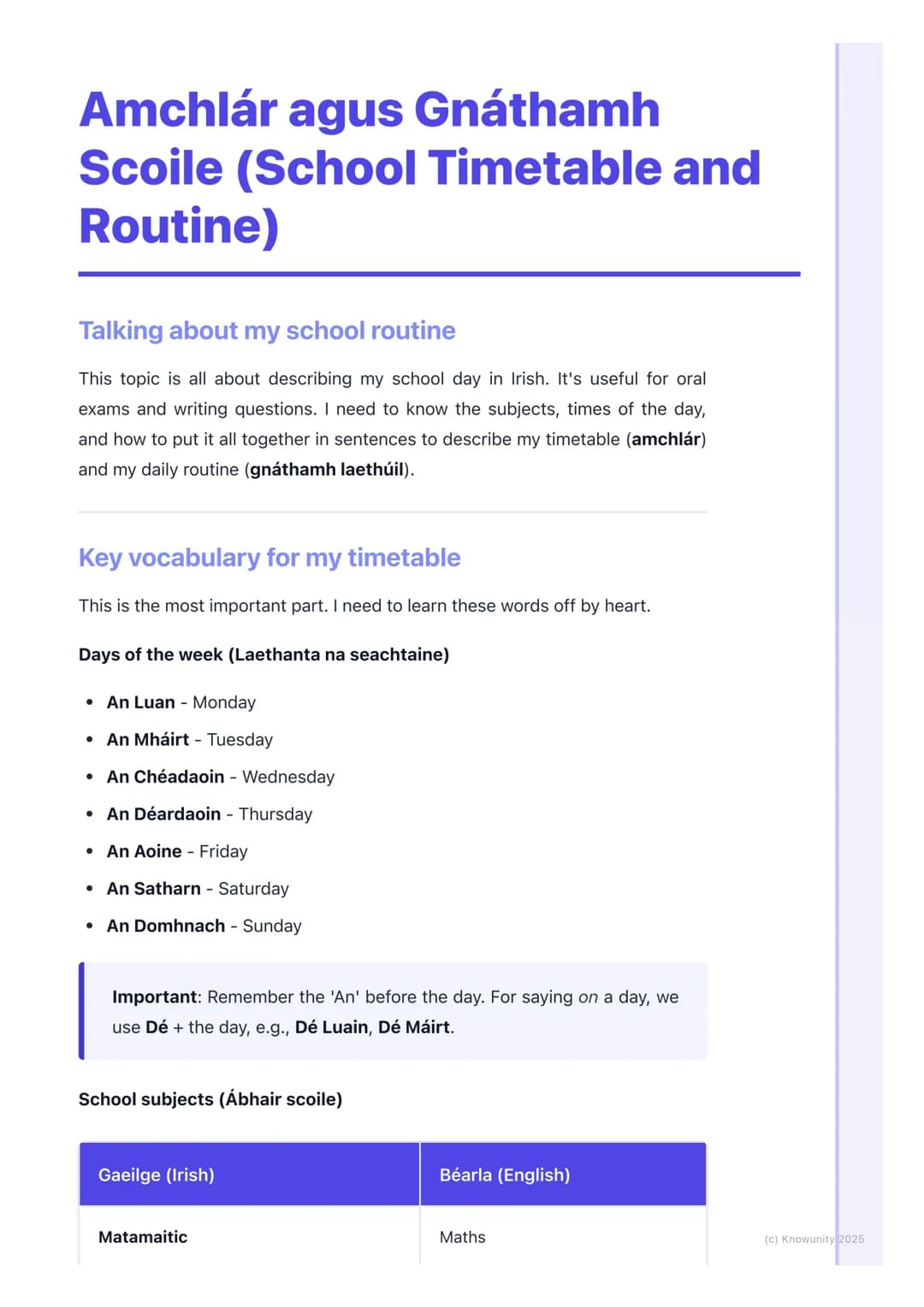
School Timetable and Routine Basics
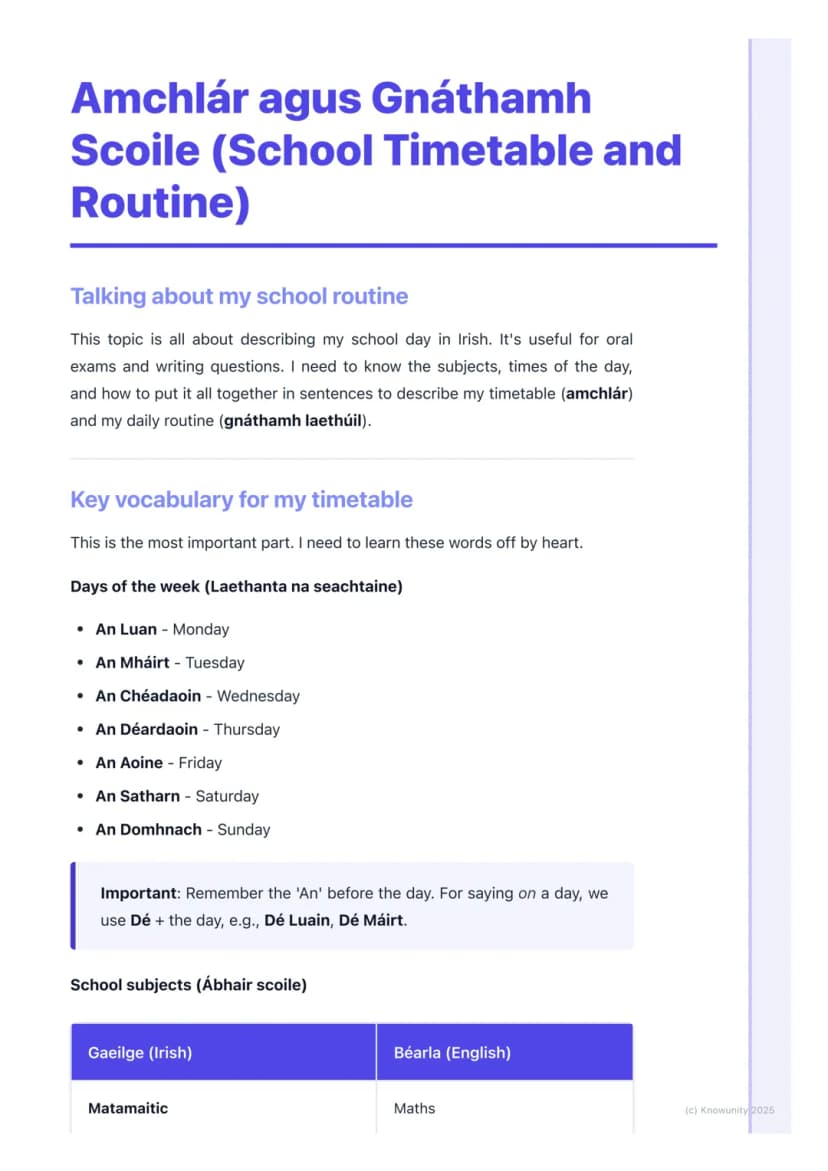
Learning to describe your school day in Irish is actually quite straightforward once you get the hang of it. You'll need this for both oral exams and written work, so it's definitely worth mastering.
The key is building up your vocabulary first - days of the week and school subjects are absolutely essential. Without these basic words, you'll struggle to put together proper sentences about your routine.
Days of the week always have 'An' in front of them normally, but when you're saying "on Monday", you use Dé Luain, Dé Máirt, and so on. It's a bit different from English, but you'll get used to it.
Quick Tip: Practice saying the days with 'Dé' - this is how you'll actually use them when describing your timetable!
2
of 5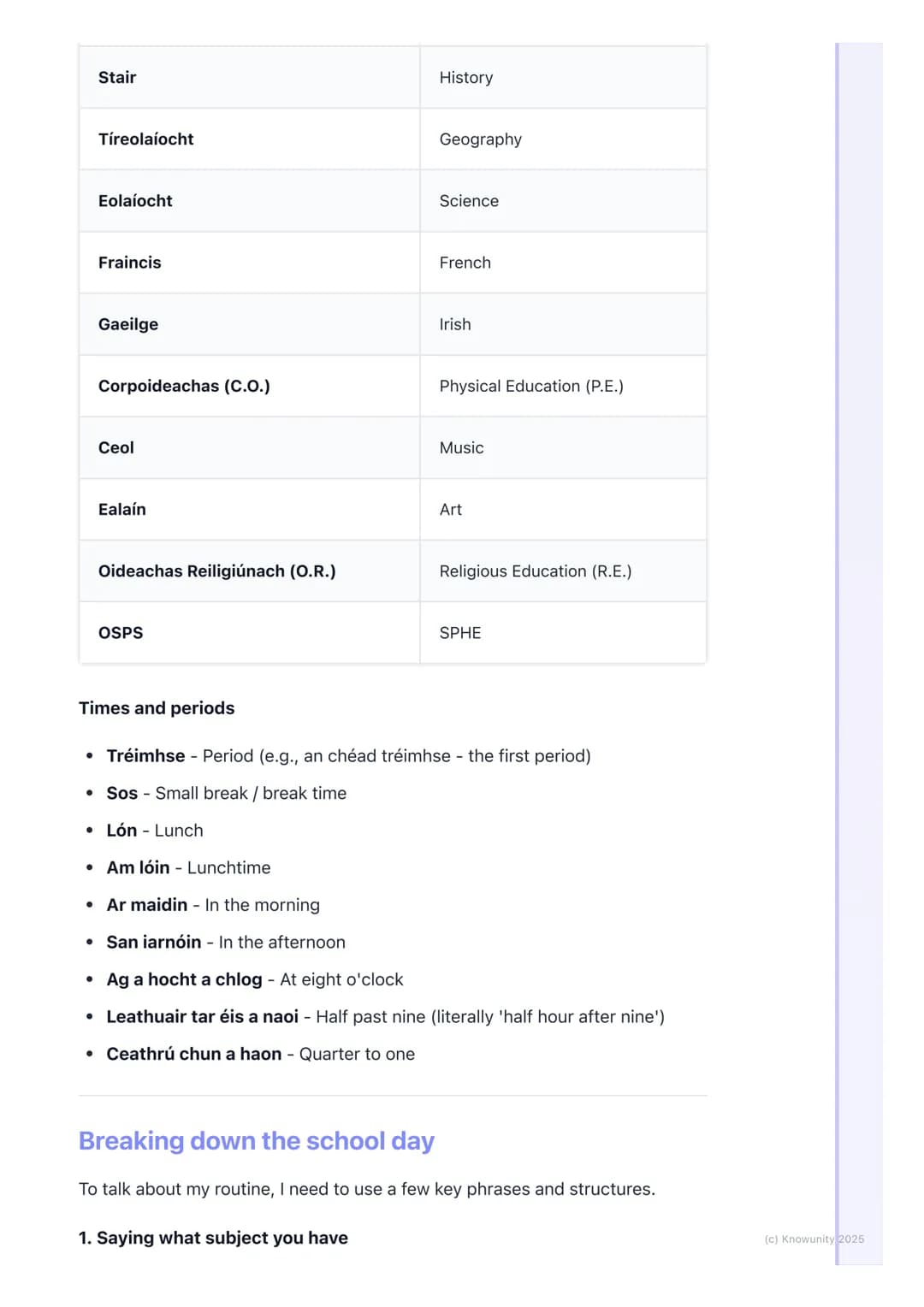
Essential School Vocabulary
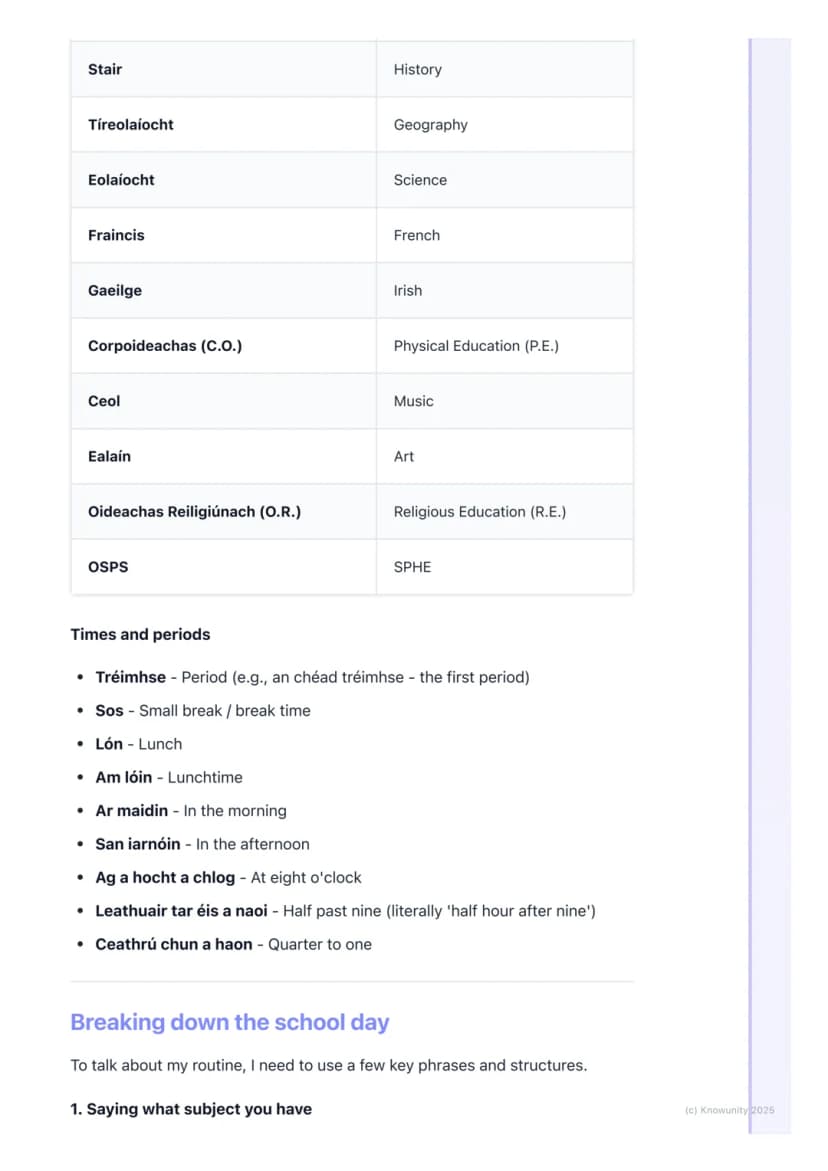
Right, here's where the real work begins - memorising your school subjects and time expressions. You absolutely must know these off by heart for any exam.
Key subjects include Matamaitic (Maths), Stair (History), Tíreolaíocht (Geography), and Eolaíocht (Science). Don't forget Corpoideachas (P.E.) and Oideachas Reiligiúnach (R.E.) - these come up loads in exam questions.
For talking about periods and times, you'll need tréimhse (period), sos (break), and lón (lunch). Time expressions like ag a hocht a chlog (at eight o'clock) and leathuair tar éis a naoi (half past nine) are crucial for describing your daily routine.
Remember: The structure "ag a [number] a chlog" is your go-to for telling time - don't try to translate directly from English!
3
of 5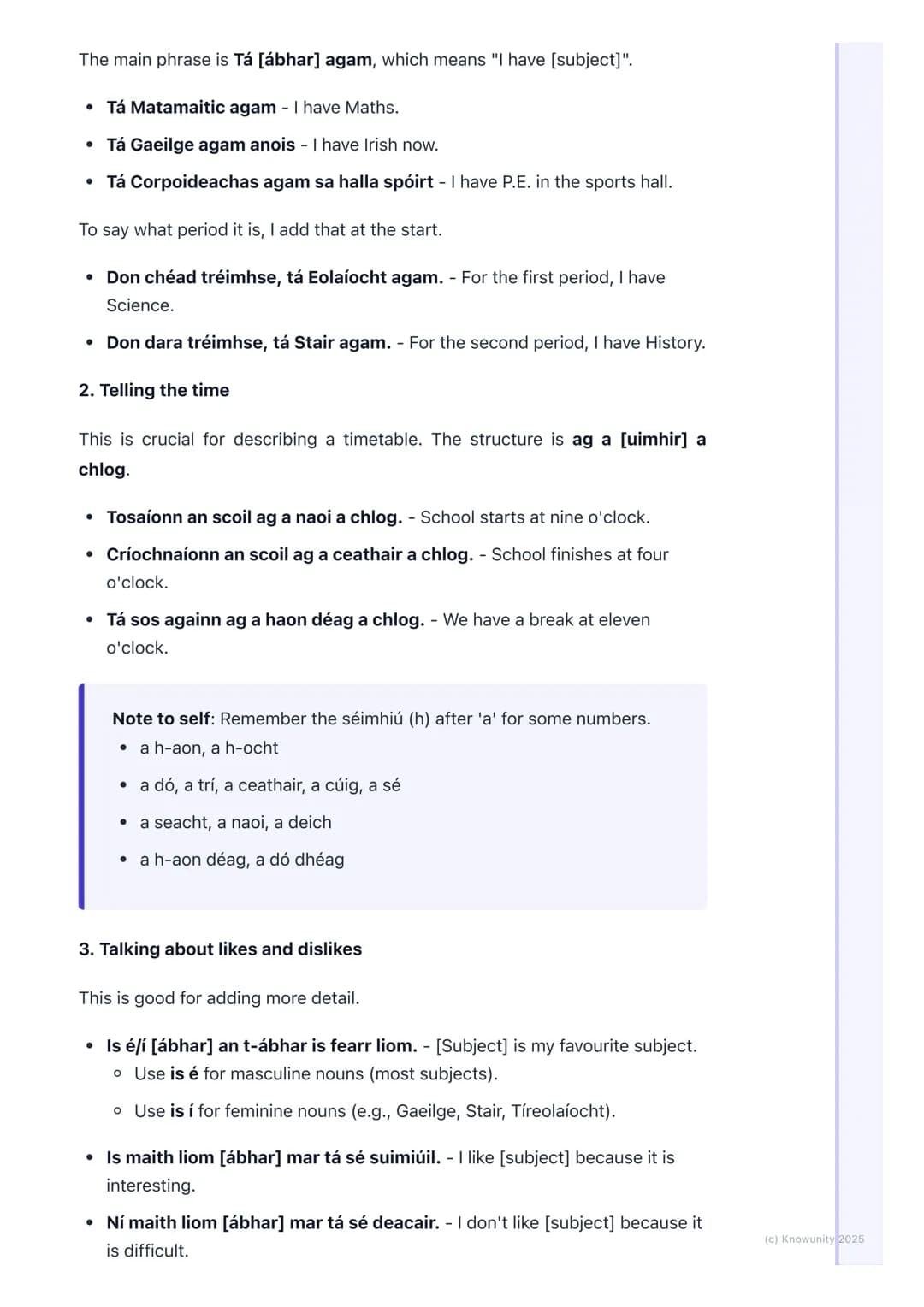
Building Your School Day Description
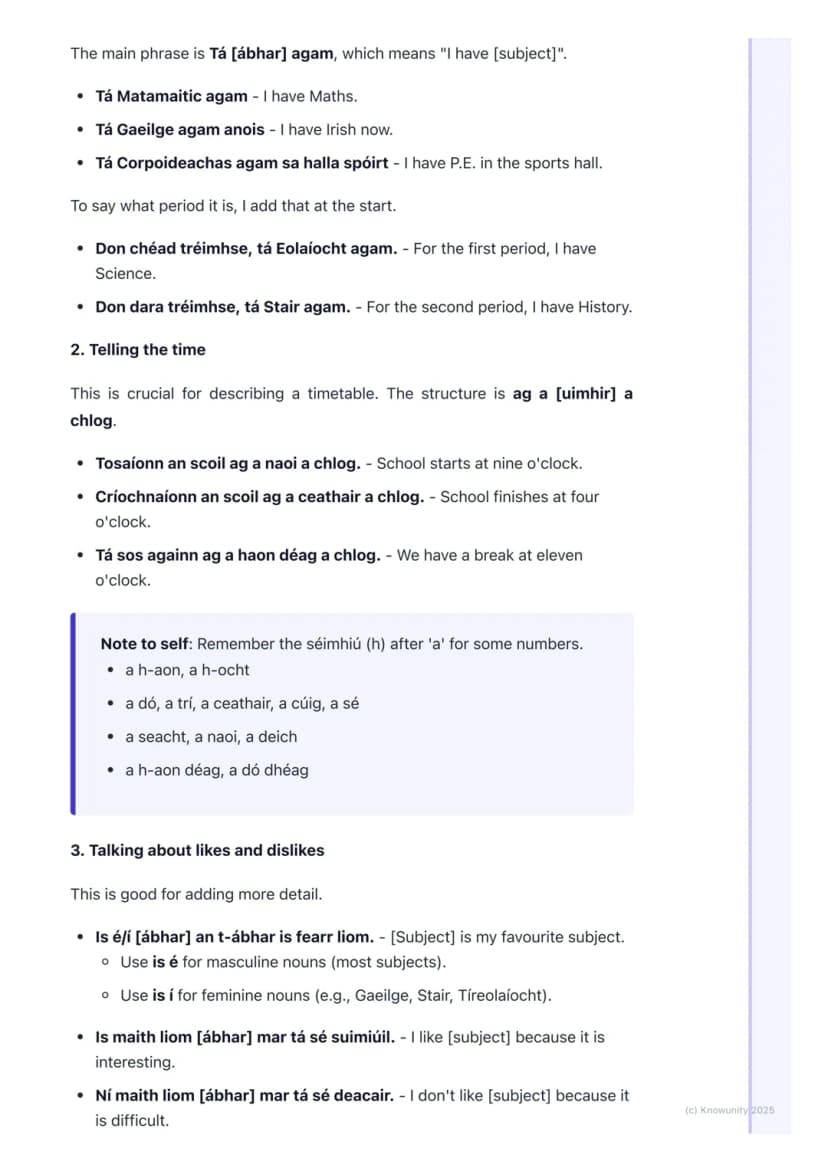
Now you can start putting proper sentences together! The magic phrase is Tá [ábhar] agam, which means "I have [subject]". It's not a direct translation from English, but it's the correct Irish way to say it.
For describing your timetable structure, use phrases like "Don chéad tréimhse" (for the first period) and "Don dara tréimhse" (for the second period). This makes your Irish sound much more natural and structured.
Time expressions follow the pattern "ag a [number] a chlog" - but watch out for the séimhiú (the 'h' sound) after 'a' with certain numbers. For example, it's "a h-aon" (one o'clock) and "a h-ocht" (eight o'clock).
Adding opinions about subjects will boost your marks significantly. Use "Is maith liom" (I like) or "Ní maith liom" (I don't like) followed by reasons like "mar tá sé suimiúil" (because it's interesting).
Pro Tip: Connect your sentences with words like "ar dtús" (firstly), "ansin" (then), and "faoi dheireadh" (finally) to make your description flow better!
4
of 5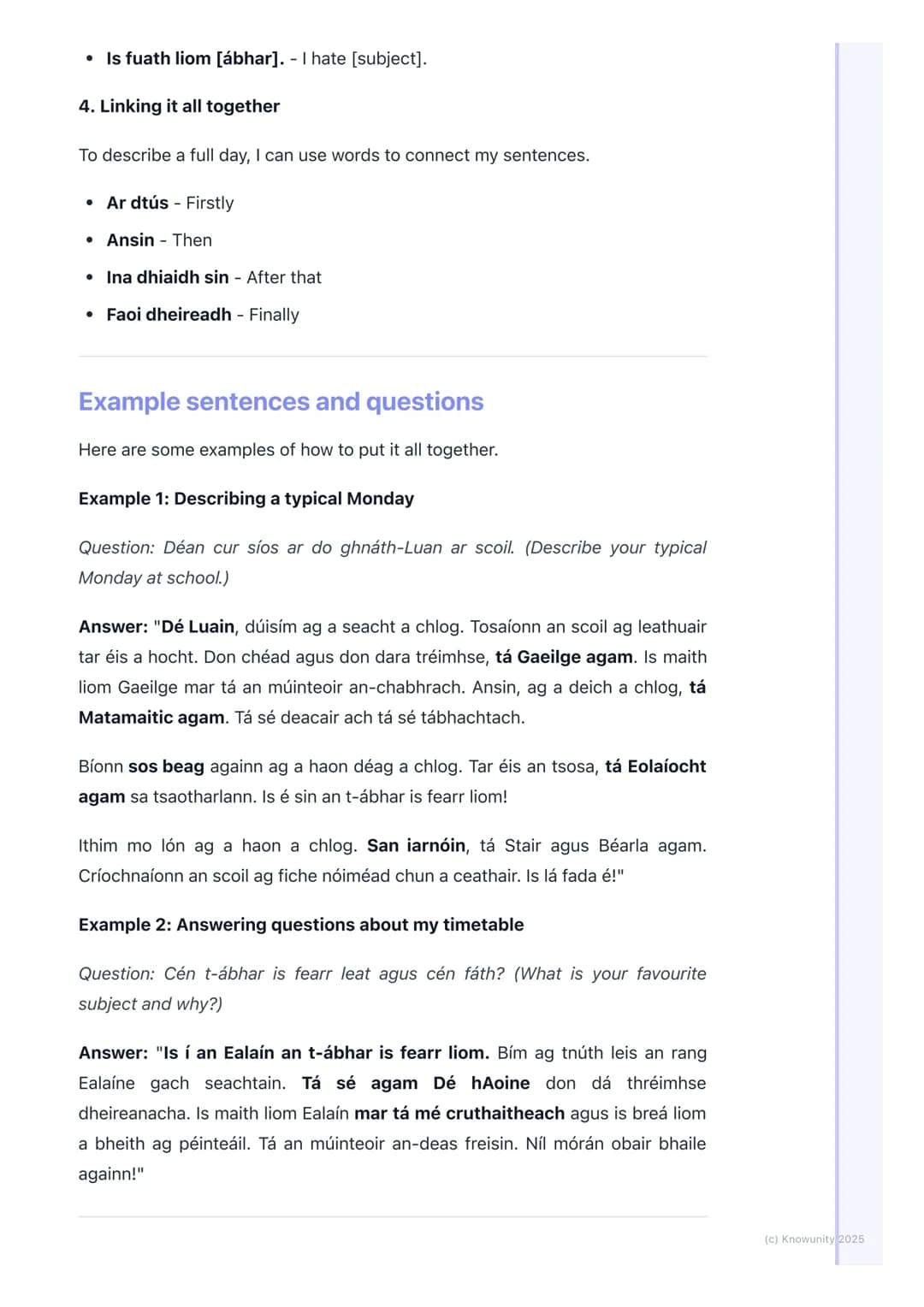
Sample Answers and Exam Techniques
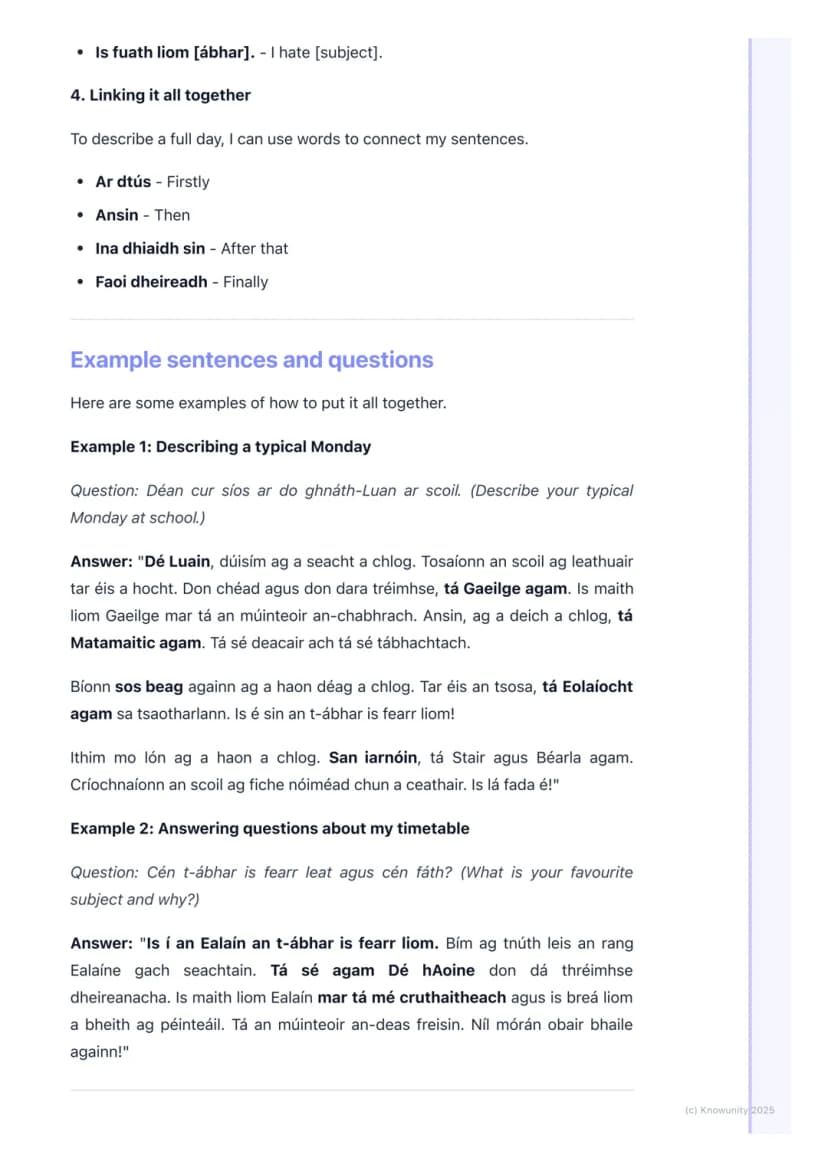
Here's where it all comes together - creating full routine descriptions that will impress examiners. Start with when you wake up, then work through your school day systematically.
A strong answer includes specific times, subject names, and personal opinions. For example: "Dé Luain, tá Gaeilge agam don chéad tréimhse. Is maith liom Gaeilge mar tá an múinteoir an-chabhrach." This shows vocabulary, structure, and personal engagement.
When talking about your favourite subject, remember the gender rules - "Is é" for masculine subjects (most of them) and "Is í" for feminine ones like Gaeilge and Stair. If you're unsure, "Is é" is usually your safest bet.
Question types you'll face include describing typical school days, explaining your favourite subjects, and discussing your weekly timetable. Practice these formats until they become second nature.
Exam Strategy: Always add reasons for your opinions using "mar" (because) - it shows deeper thinking and gets you extra marks!
5
of 5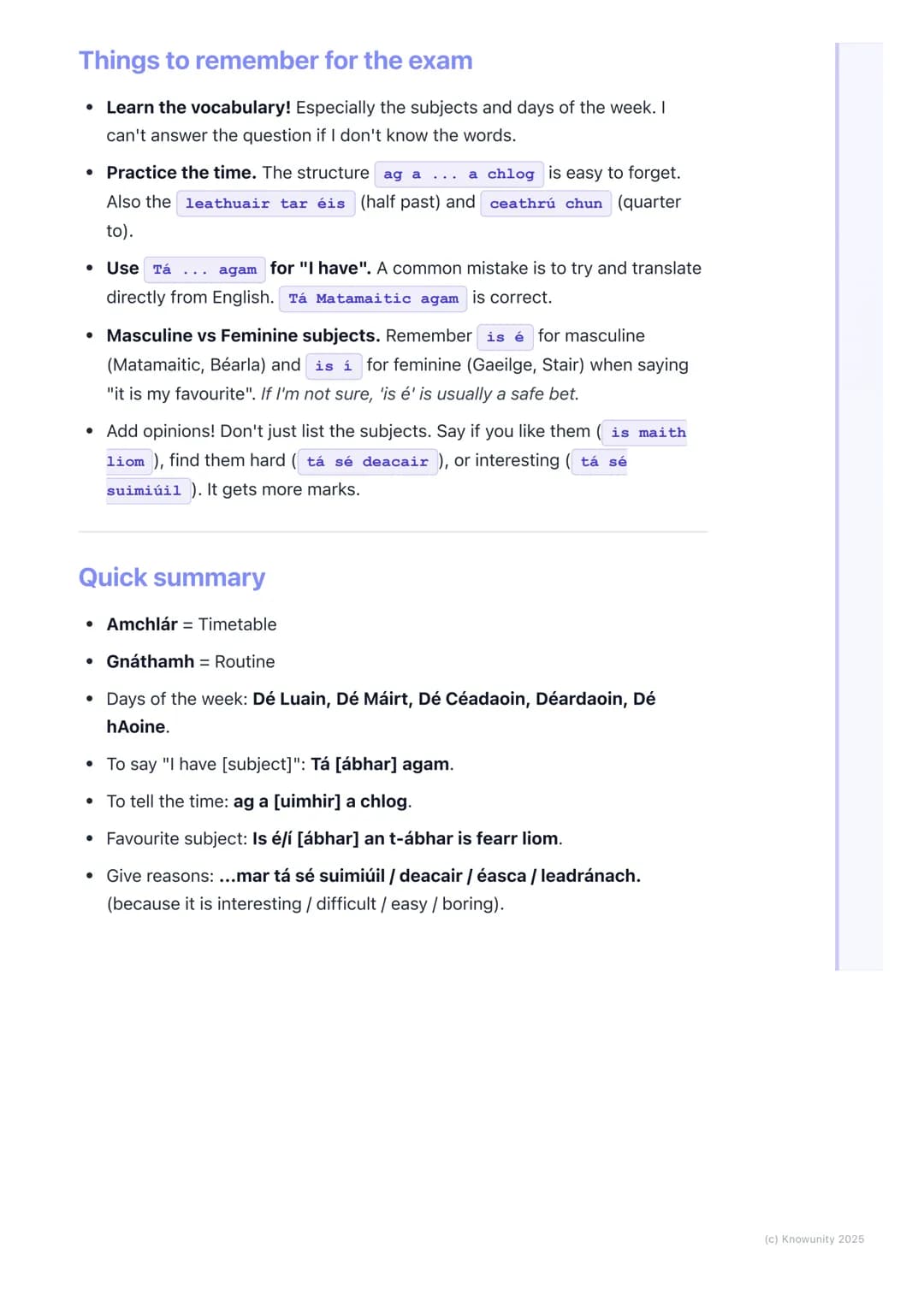
Key Points for Success
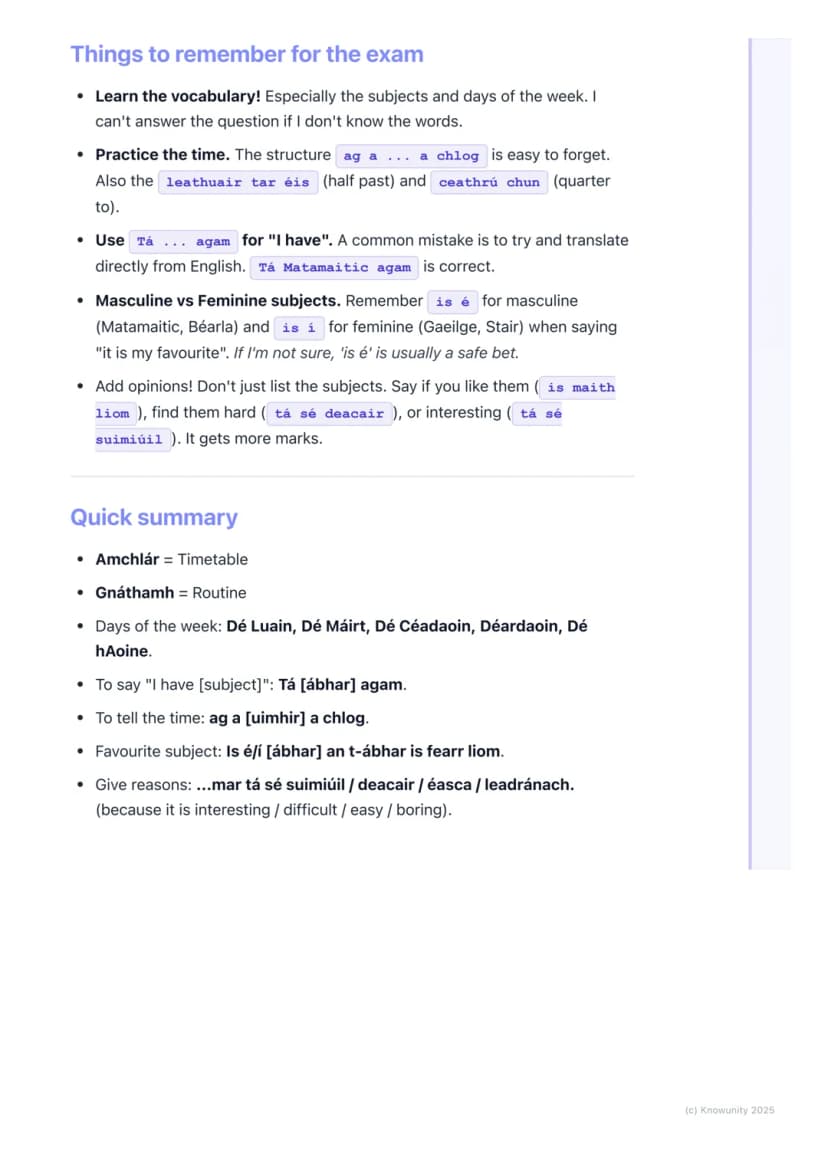
Vocabulary mastery is non-negotiable - you simply can't wing this topic without knowing your subjects and days of the week. Make flashcards and test yourself regularly until they're automatic.
The time structure "ag a ... a chlog" trips up loads of students, so practice it loads. Don't forget expressions like "leathuair tar éis" (half past) and "ceathrú chun" (quarter to) for more natural-sounding Irish.
Grammar accuracy matters - use "Tá ... agam" for "I have" rather than trying to translate word-for-word from English. This construction is fundamental to describing your routine properly.
Remember to include personal opinions and reasons in every answer. Phrases like "tá sé suimiúil" (it's interesting), "tá sé deacair" (it's difficult), and "tá sé leadránach" (it's boring) will make your Irish much more engaging and exam-ready.
Final Reminder: Practice describing different days of the week - don't just memorise one day's routine, as exam questions can ask about any day!
そんなこと聞いてくれるのを待ってたよ...
KnowunityのAIコンパニオンとは?
KnowunityのAIコンパニオンは学生向けに設計されたAIツールで、単なる答えを提供するだけではありません。数百万のKnowunityリソースを基に構築され、関連する情報、個別の学習プラン、クイズ、コンテンツをチャット内で直接提供し、あなたの個別の学習過程に適応します。
Knowunityアプリはどこでダウンロードできますか?
Google Play StoreとApple App Storeからアプリをダウンロードできます。
Knowunityは本当に無料ですか?
その通り!学習コンテンツへの無料アクセス、仲間の学生とのつながり、そして即座のサポートを手のひらで楽しもう。
Irishの人気コンテンツ
9IrishIrish oral questions and answers
Questions and answers for the leaving cert oral
5th Year4264
IrishIrish oral questions
Outline of oral questions
5th Year2055
IrishIrish poetry 2027
Iníon + Dínit an Bhróin
5th Year1133
IrishIníon- le hÁine Durkin
Aine Durkin’s poem, Iníon: Themes & summary
5th Year850
IrishLC HL notes- Iníon (poem)
Includes poem in English and Irish, theme, key words & phrases
5th Year2284
IrishMo Ghrá-sa (Idir Lúibíní)
Notes on mo ghrá-sa
5th Year380
IrishGaeilge Grammar Office
All the basics you need to know on Irish grammar.
6th Year1063
IrishAn Gaeilge Aiste
Irish Language essay
6th Year1320
IrishMé Féin & Mo Chlann (Myself & My Family)
Students will learn vocabulary to describe themselves, their family members, and daily routines. This helps in personal introductions and discussions.
TY291
人気コンテンツ
9IrishIrish oral questions and answers
Questions and answers for the leaving cert oral
5th Year4264
 English
Key Quotes : Sive
Key Quotes and explanations: Sive
6th Year2842
IrishIrish oral questions
Outline of oral questions
5th Year2055
IrishIníon- le hÁine Durkin
Aine Durkin’s poem, Iníon: Themes & summary
5th Year850
IrishIrish poetry 2027
Iníon + Dínit an Bhróin
5th Year1133
IrishLC HL notes- Iníon (poem)
Includes poem in English and Irish, theme, key words & phrases
5th Year2284
EnglishCultural Context : Shawshank Redemption : Sive : Small Things Like These
Comparative Study : Cultural Context : Shawshank Redemption, Sive and Small Things Like These
6th Year1430
IrishMo Ghrá-sa (Idir Lúibíní)
Notes on mo ghrá-sa
5th Year380
IrishAn Gaeilge Aiste
Irish Language essay
6th Year1320
探しているものが見つからない?他の教科も見てみよう。
生徒たちが愛用中 — あなたもきっと気に入るはず。
4.6/5App Store
4.7/5Google Play
このアプリはとても使いやすくて、デザインも良いです。今のところ探していたものは全て見つかったし、プレゼン資料からもたくさん学べました!絶対に課題でも使いたいと思います!もちろん、アイデアを得るのにもすごく役立ちます。
Stefan SiOSユーザー
このアプリは本当に素晴らしいです。学習ノートやサポート資料がとても豊富で[...]。例えば、私の苦手科目はフランス語なんですが、このアプリにはサポートオプションがたくさんあります。このアプリのおかげでフランス語が上達しました。誰にでもおすすめしたいです。
Samantha KlichAndroidユーザー
すごい、本当に驚いた。広告で何度も見かけたからアプリを試してみたら、めちゃくちゃ感動した。このアプリは学校で欲しかった「まさにこれ!」って感じのサポートで、特に練習問題や要点まとめみたいな機能がたくさんあって、個人的にすごく助かってる。
AnnaiOSユーザー
Irish4 閲覧数·更新日 Jun 11, 2026·5 ページAmchlár agus Gnáthaimh Laethúla na Scoile
Ever wondered how to talk about your school day in Irish? This topic covers everything you need to describe your timetable (amchlár) and daily routine (gnáthamh laethúil) - perfect for oral exams and writing tasks.
1
of 5
サインアップしてコンテンツを見よう。無料だよ!
- 全ドキュメントへのアクセス
- 成績アップ
- 数百万人の学生と一緒に学習
School Timetable and Routine Basics
Learning to describe your school day in Irish is actually quite straightforward once you get the hang of it. You'll need this for both oral exams and written work, so it's definitely worth mastering.
The key is building up your vocabulary first - days of the week and school subjects are absolutely essential. Without these basic words, you'll struggle to put together proper sentences about your routine.
Days of the week always have 'An' in front of them normally, but when you're saying "on Monday", you use Dé Luain, Dé Máirt, and so on. It's a bit different from English, but you'll get used to it.
Quick Tip: Practice saying the days with 'Dé' - this is how you'll actually use them when describing your timetable!
2
of 5サインアップしてコンテンツを見よう。無料だよ!
- 全ドキュメントへのアクセス
- 成績アップ
- 数百万人の学生と一緒に学習
Essential School Vocabulary
Right, here's where the real work begins - memorising your school subjects and time expressions. You absolutely must know these off by heart for any exam.
Key subjects include Matamaitic (Maths), Stair (History), Tíreolaíocht (Geography), and Eolaíocht (Science). Don't forget Corpoideachas (P.E.) and Oideachas Reiligiúnach (R.E.) - these come up loads in exam questions.
For talking about periods and times, you'll need tréimhse (period), sos (break), and lón (lunch). Time expressions like ag a hocht a chlog (at eight o'clock) and leathuair tar éis a naoi (half past nine) are crucial for describing your daily routine.
Remember: The structure "ag a [number] a chlog" is your go-to for telling time - don't try to translate directly from English!
3
of 5サインアップしてコンテンツを見よう。無料だよ!
- 全ドキュメントへのアクセス
- 成績アップ
- 数百万人の学生と一緒に学習
Building Your School Day Description
Now you can start putting proper sentences together! The magic phrase is Tá [ábhar] agam, which means "I have [subject]". It's not a direct translation from English, but it's the correct Irish way to say it.
For describing your timetable structure, use phrases like "Don chéad tréimhse" (for the first period) and "Don dara tréimhse" (for the second period). This makes your Irish sound much more natural and structured.
Time expressions follow the pattern "ag a [number] a chlog" - but watch out for the séimhiú (the 'h' sound) after 'a' with certain numbers. For example, it's "a h-aon" (one o'clock) and "a h-ocht" (eight o'clock).
Adding opinions about subjects will boost your marks significantly. Use "Is maith liom" (I like) or "Ní maith liom" (I don't like) followed by reasons like "mar tá sé suimiúil" (because it's interesting).
Pro Tip: Connect your sentences with words like "ar dtús" (firstly), "ansin" (then), and "faoi dheireadh" (finally) to make your description flow better!
4
of 5サインアップしてコンテンツを見よう。無料だよ!
- 全ドキュメントへのアクセス
- 成績アップ
- 数百万人の学生と一緒に学習
Sample Answers and Exam Techniques
Here's where it all comes together - creating full routine descriptions that will impress examiners. Start with when you wake up, then work through your school day systematically.
A strong answer includes specific times, subject names, and personal opinions. For example: "Dé Luain, tá Gaeilge agam don chéad tréimhse. Is maith liom Gaeilge mar tá an múinteoir an-chabhrach." This shows vocabulary, structure, and personal engagement.
When talking about your favourite subject, remember the gender rules - "Is é" for masculine subjects (most of them) and "Is í" for feminine ones like Gaeilge and Stair. If you're unsure, "Is é" is usually your safest bet.
Question types you'll face include describing typical school days, explaining your favourite subjects, and discussing your weekly timetable. Practice these formats until they become second nature.
Exam Strategy: Always add reasons for your opinions using "mar" (because) - it shows deeper thinking and gets you extra marks!
5
of 5サインアップしてコンテンツを見よう。無料だよ!
- 全ドキュメントへのアクセス
- 成績アップ
- 数百万人の学生と一緒に学習
Key Points for Success
Vocabulary mastery is non-negotiable - you simply can't wing this topic without knowing your subjects and days of the week. Make flashcards and test yourself regularly until they're automatic.
The time structure "ag a ... a chlog" trips up loads of students, so practice it loads. Don't forget expressions like "leathuair tar éis" (half past) and "ceathrú chun" (quarter to) for more natural-sounding Irish.
Grammar accuracy matters - use "Tá ... agam" for "I have" rather than trying to translate word-for-word from English. This construction is fundamental to describing your routine properly.
Remember to include personal opinions and reasons in every answer. Phrases like "tá sé suimiúil" (it's interesting), "tá sé deacair" (it's difficult), and "tá sé leadránach" (it's boring) will make your Irish much more engaging and exam-ready.
Final Reminder: Practice describing different days of the week - don't just memorise one day's routine, as exam questions can ask about any day!
そんなこと聞いてくれるのを待ってたよ...
KnowunityのAIコンパニオンとは?
KnowunityのAIコンパニオンは学生向けに設計されたAIツールで、単なる答えを提供するだけではありません。数百万のKnowunityリソースを基に構築され、関連する情報、個別の学習プラン、クイズ、コンテンツをチャット内で直接提供し、あなたの個別の学習過程に適応します。
Knowunityアプリはどこでダウンロードできますか?
Google Play StoreとApple App Storeからアプリをダウンロードできます。
Knowunityは本当に無料ですか?
その通り!学習コンテンツへの無料アクセス、仲間の学生とのつながり、そして即座のサポートを手のひらで楽しもう。
Irishの人気コンテンツ
9IrishIrish oral questions and answers
Questions and answers for the leaving cert oral
5th Year4264
IrishIrish oral questions
Outline of oral questions
5th Year2055
IrishIrish poetry 2027
Iníon + Dínit an Bhróin
5th Year1133
IrishIníon- le hÁine Durkin
Aine Durkin’s poem, Iníon: Themes & summary
5th Year850
IrishLC HL notes- Iníon (poem)
Includes poem in English and Irish, theme, key words & phrases
5th Year2284
IrishMo Ghrá-sa (Idir Lúibíní)
Notes on mo ghrá-sa
5th Year380
IrishGaeilge Grammar Office
All the basics you need to know on Irish grammar.
6th Year1063
IrishAn Gaeilge Aiste
Irish Language essay
6th Year1320
IrishMé Féin & Mo Chlann (Myself & My Family)
Students will learn vocabulary to describe themselves, their family members, and daily routines. This helps in personal introductions and discussions.
TY291
人気コンテンツ
9IrishIrish oral questions and answers
Questions and answers for the leaving cert oral
5th Year4264
EnglishKey Quotes : Sive
Key Quotes and explanations: Sive
6th Year2842
IrishIrish oral questions
Outline of oral questions
5th Year2055
IrishIníon- le hÁine Durkin
Aine Durkin’s poem, Iníon: Themes & summary
5th Year850
IrishIrish poetry 2027
Iníon + Dínit an Bhróin
5th Year1133
IrishLC HL notes- Iníon (poem)
Includes poem in English and Irish, theme, key words & phrases
5th Year2284
EnglishCultural Context : Shawshank Redemption : Sive : Small Things Like These
Comparative Study : Cultural Context : Shawshank Redemption, Sive and Small Things Like These
6th Year1430
IrishMo Ghrá-sa (Idir Lúibíní)
Notes on mo ghrá-sa
5th Year380
IrishAn Gaeilge Aiste
Irish Language essay
6th Year1320
探しているものが見つからない?他の教科も見てみよう。
生徒たちが愛用中 — あなたもきっと気に入るはず。
4.6/5App Store
4.7/5Google Play
このアプリはとても使いやすくて、デザインも良いです。今のところ探していたものは全て見つかったし、プレゼン資料からもたくさん学べました!絶対に課題でも使いたいと思います!もちろん、アイデアを得るのにもすごく役立ちます。
Stefan SiOSユーザー
このアプリは本当に素晴らしいです。学習ノートやサポート資料がとても豊富で[...]。例えば、私の苦手科目はフランス語なんですが、このアプリにはサポートオプションがたくさんあります。このアプリのおかげでフランス語が上達しました。誰にでもおすすめしたいです。
Samantha KlichAndroidユーザー
すごい、本当に驚いた。広告で何度も見かけたからアプリを試してみたら、めちゃくちゃ感動した。このアプリは学校で欲しかった「まさにこれ!」って感じのサポートで、特に練習問題や要点まとめみたいな機能がたくさんあって、個人的にすごく助かってる。
AnnaiOSユーザー