
World War II was the deadliest conflict in human history,... もっと見る
 History15 閲覧数·更新日 May 26, 2026·6 ページ
The Causes and Effects of World War II
1 / 6
1
of 6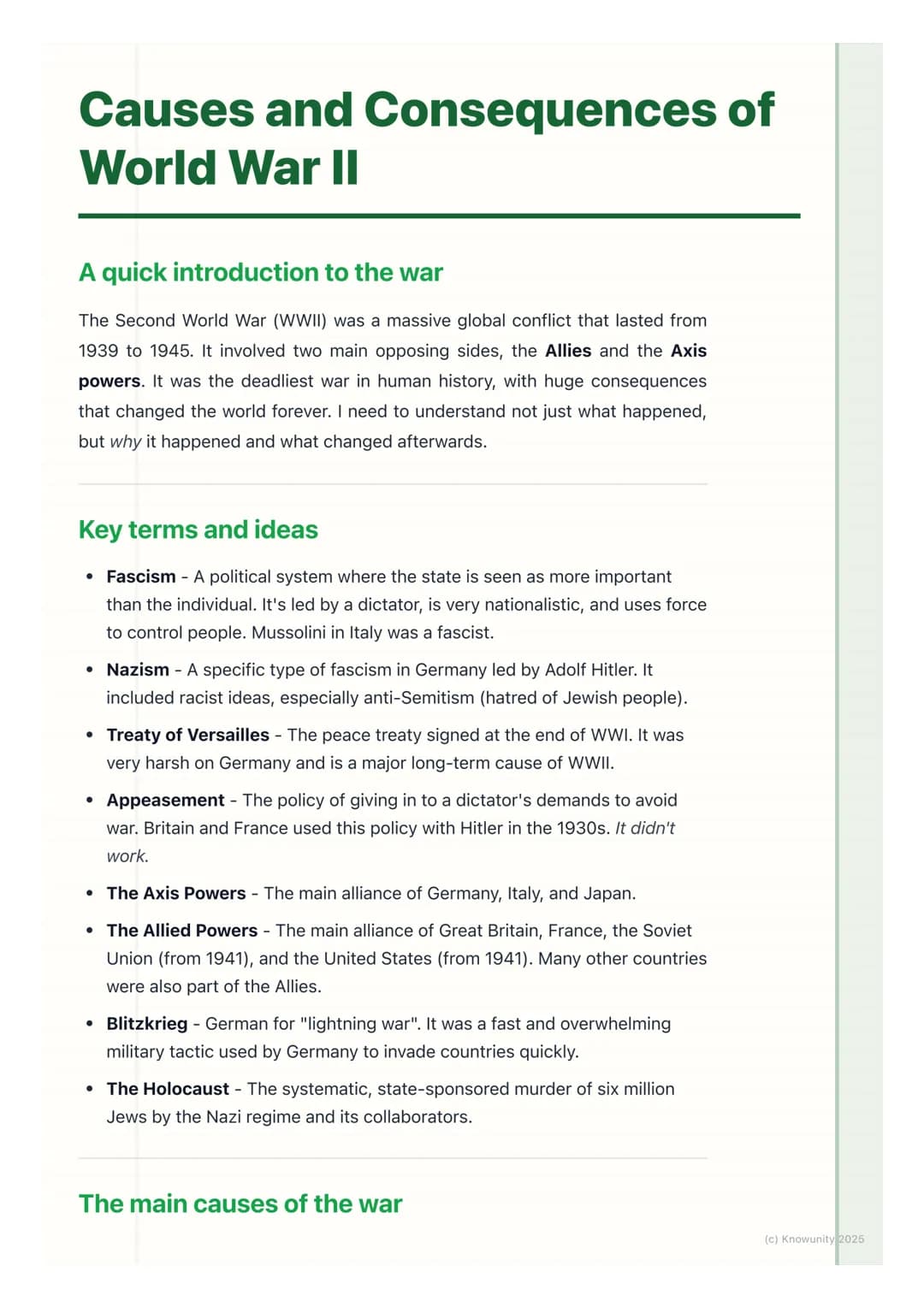
Introduction and Key Concepts
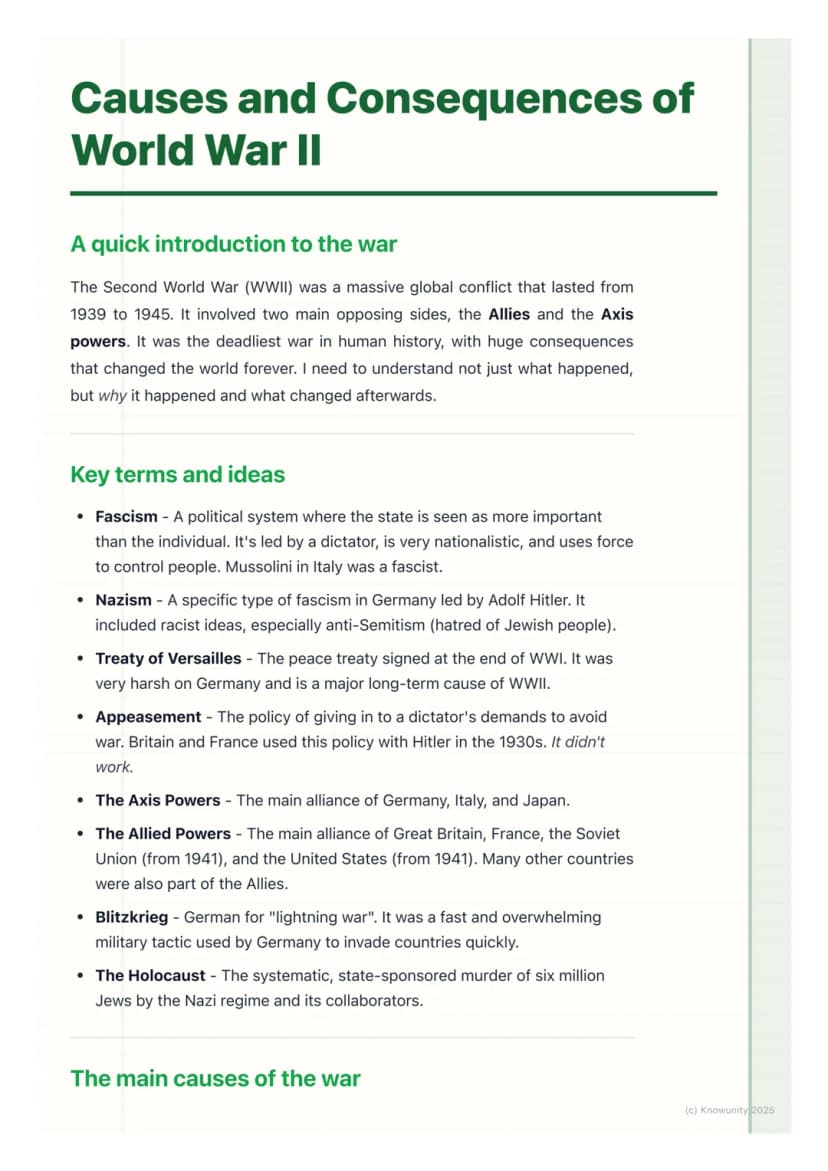
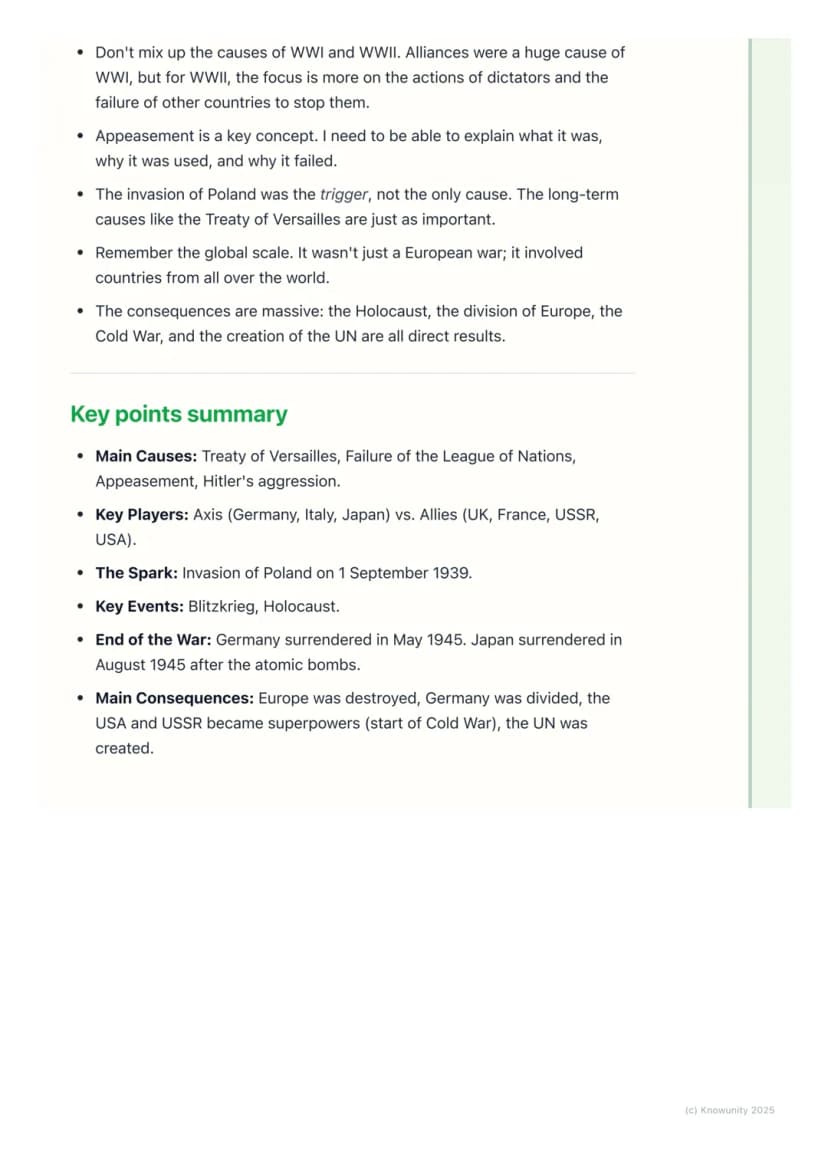
You've probably heard of WWII, but understanding why it happened makes all the difference in your exams. This massive global conflict split the world into two sides: the Allies (mainly Britain, France, USSR, and USA) versus the Axis powers (Germany, Italy, and Japan).
The most important concept to grasp is fascism – a political system where dictators control everything and the state matters more than individual people. Hitler's version, called Nazism, added horrific racist ideas that led to the Holocaust.
Two other key terms will come up constantly: appeasement (when Britain and France tried to avoid war by giving Hitler what he wanted) and blitzkrieg . The Treaty of Versailles from 1919 is also crucial – it was meant to keep peace after WWI but actually helped cause WWII.
Remember: Don't just memorise dates – focus on understanding the connections between causes and consequences.
2
of 6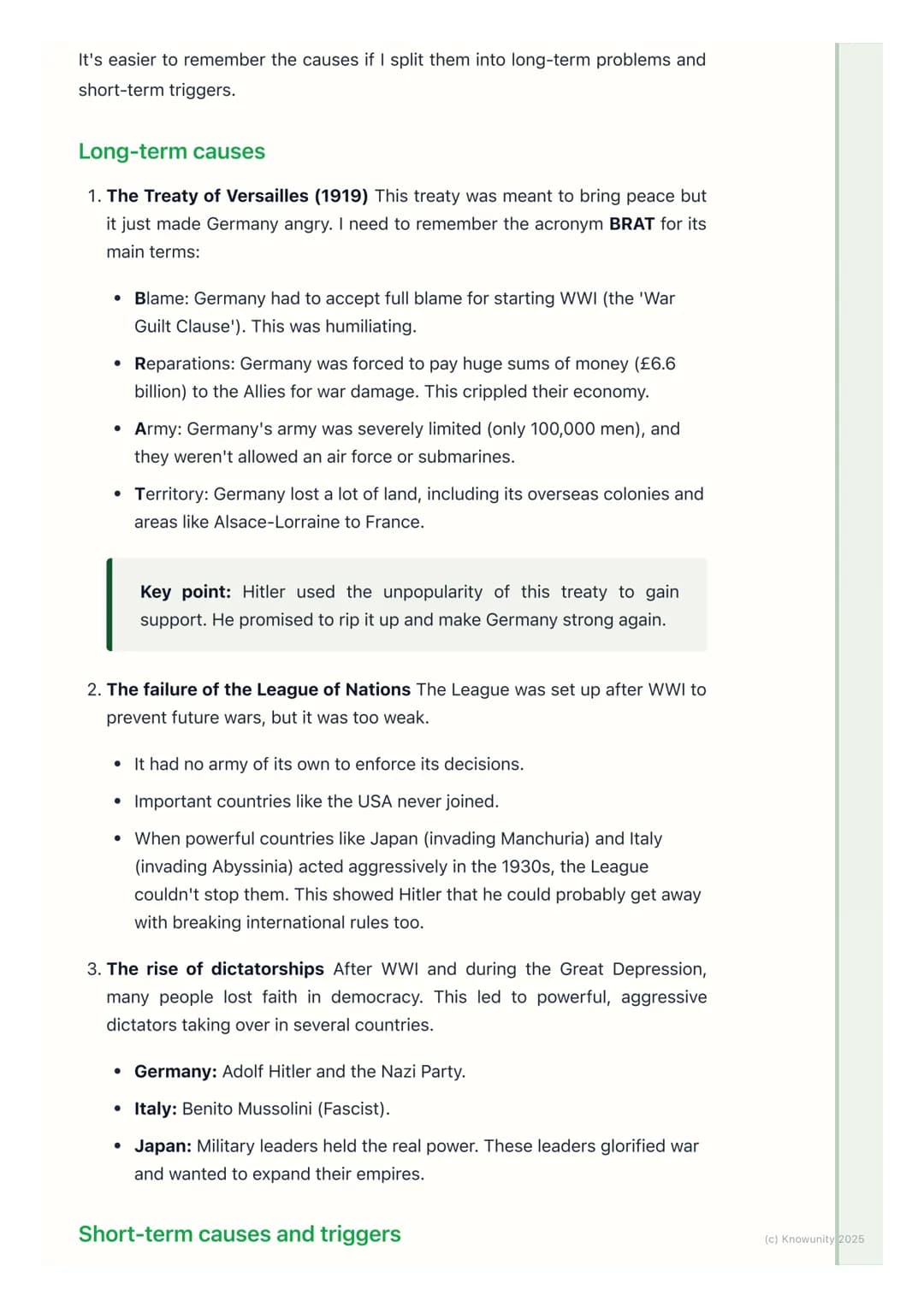
Long-term Causes
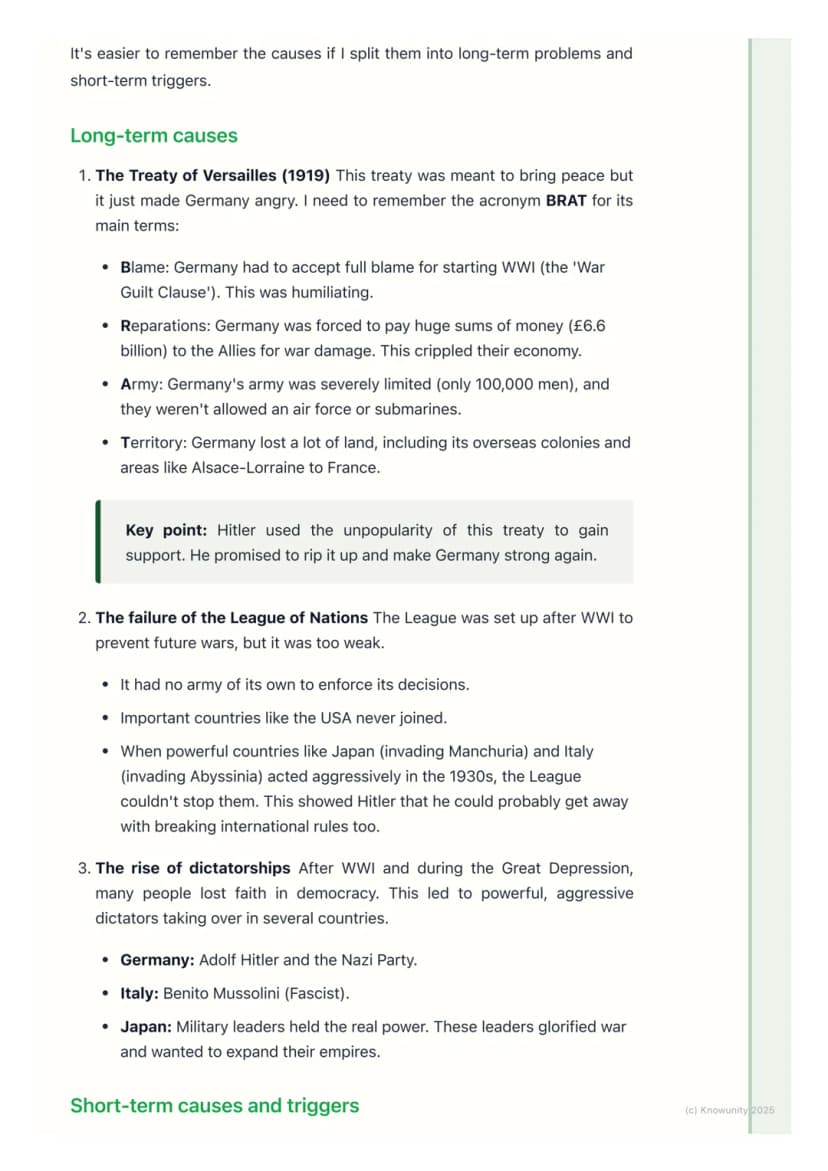
The Treaty of Versailles was basically a recipe for disaster. Use the acronym BRAT to remember its harsh terms: Blame (Germany had to accept full responsibility for WWI), Reparations (£6.6 billion in payments that crippled Germany's economy), Army (limited to just 100,000 men), and Territory (Germany lost loads of land).
Hitler used Germans' anger about this treaty to gain support. People were desperate after economic crisis and national humiliation, so his promises to tear up the treaty and make Germany great again sounded brilliant.
The League of Nations was supposed to prevent future wars but was completely useless. It had no army and couldn't stop aggressive countries like Japan or Italy from invading other nations. This showed Hitler he could probably get away with breaking international rules too.
Meanwhile, dictatorships were popping up everywhere as people lost faith in democracy during the Great Depression. These leaders – Hitler in Germany, Mussolini in Italy, and military leaders in Japan – all glorified war and wanted to expand their empires.
Exam tip: Long-term causes are just as important as the immediate trigger – make sure you can explain both!
3
of 6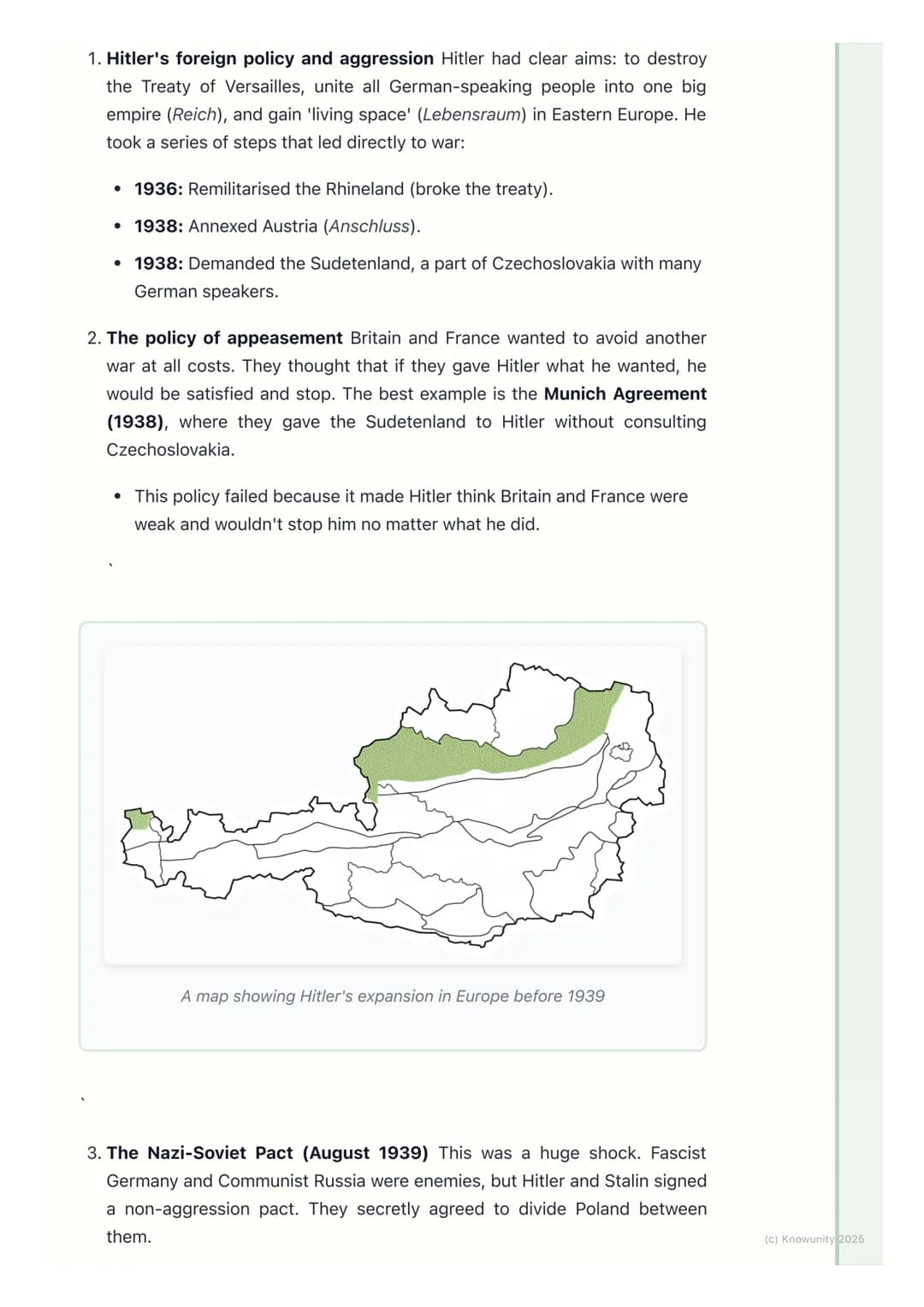
Short-term Causes and Triggers
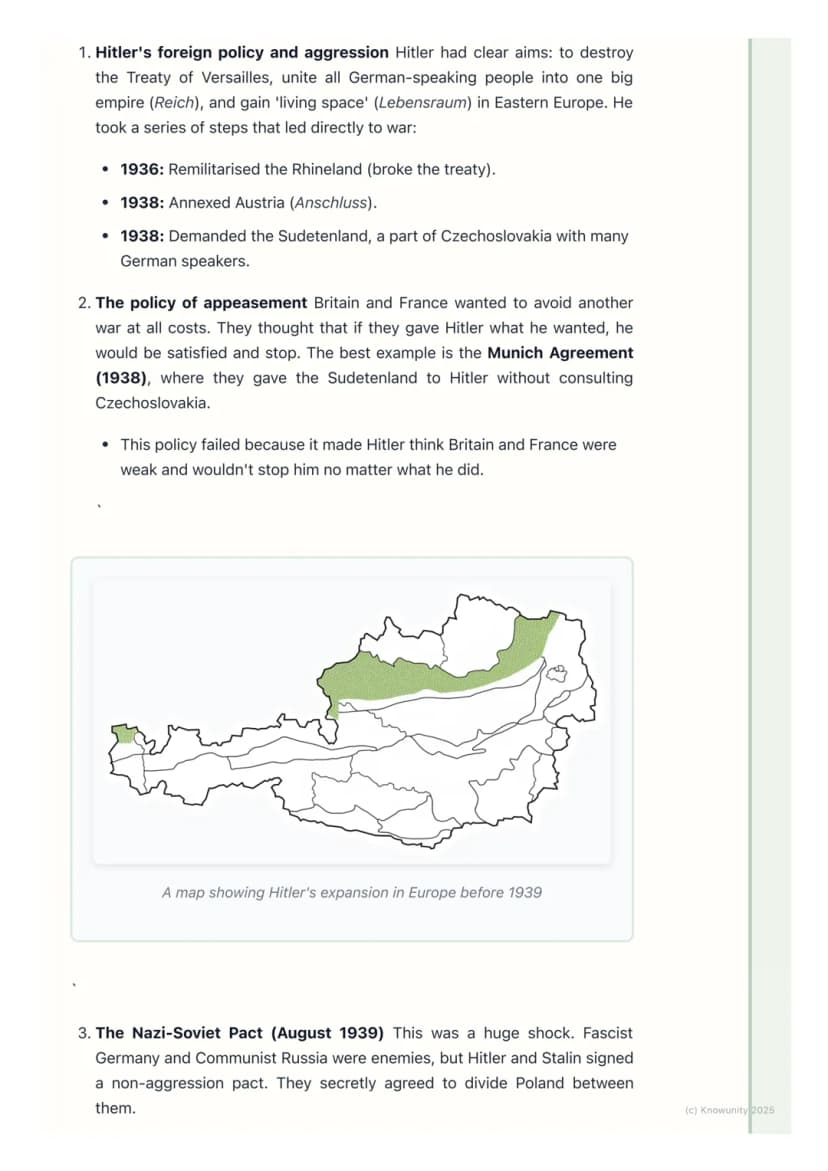
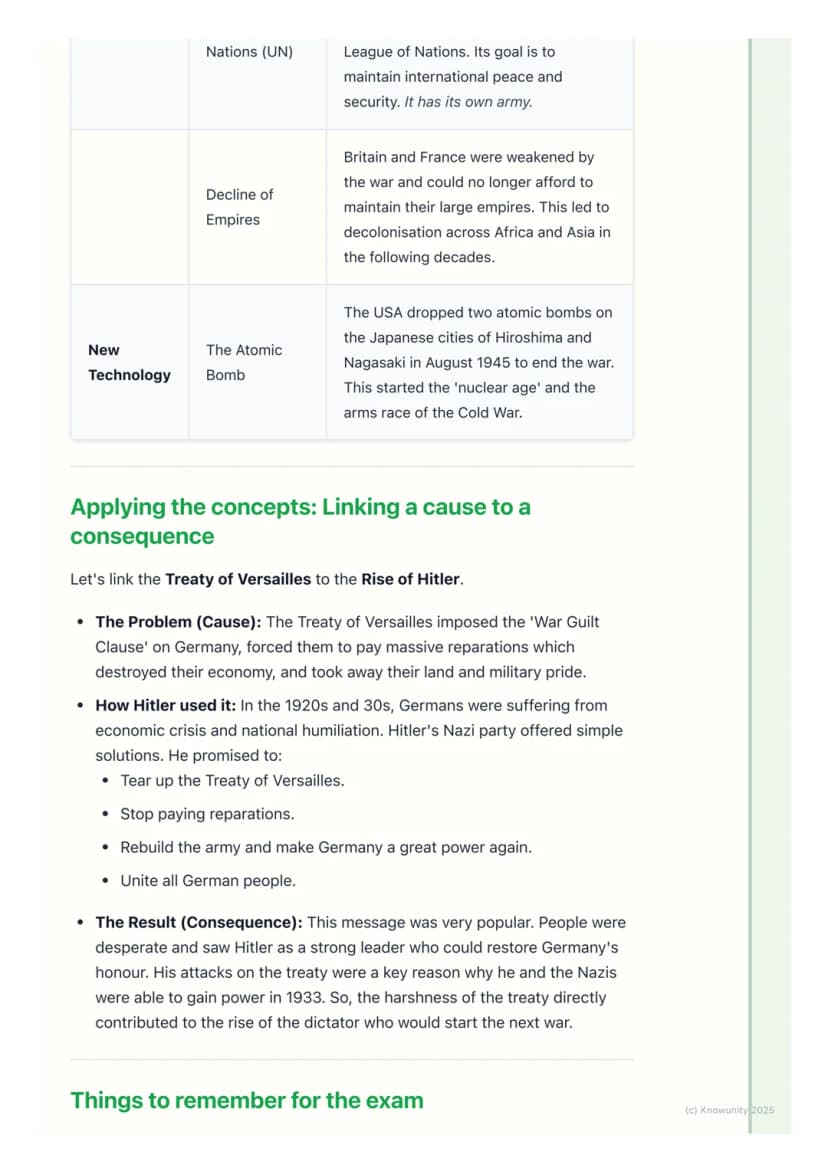
Hitler had clear goals: destroy the Treaty of Versailles, unite all German speakers, and grab 'living space' (Lebensraum) in Eastern Europe. He tested the waters by remilitarising the Rhineland in 1936, then annexed Austria in 1938, then demanded the Sudetenland from Czechoslovakia.
This is where appeasement comes in. Britain and France were so desperate to avoid another war that they kept giving Hitler what he wanted. The Munich Agreement in 1938 handed over the Sudetenland without even asking Czechoslovakia – basically throwing them under the bus.
Appeasement completely backfired because it made Hitler think Britain and France were weak and wouldn't stop him no matter what he did. He was getting bolder with each success.
The Nazi-Soviet Pact in August 1939 was a massive shock – fascist Germany and communist Russia agreeing not to fight each other and secretly planning to carve up Poland between them. This meant Hitler didn't have to worry about fighting on two fronts, giving him the green light for invasion.
Key point: Appeasement wasn't cowardice – leaders genuinely thought they were preventing war, but it actually encouraged Hitler's aggression.
4
of 6
The Final Trigger and Human Consequences
On 1 September 1939, Hitler invaded Poland. Britain and France had promised to protect Poland, so they gave Hitler an ultimatum to withdraw. When he ignored it, they declared war on 3 September 1939. World War II had officially begun.
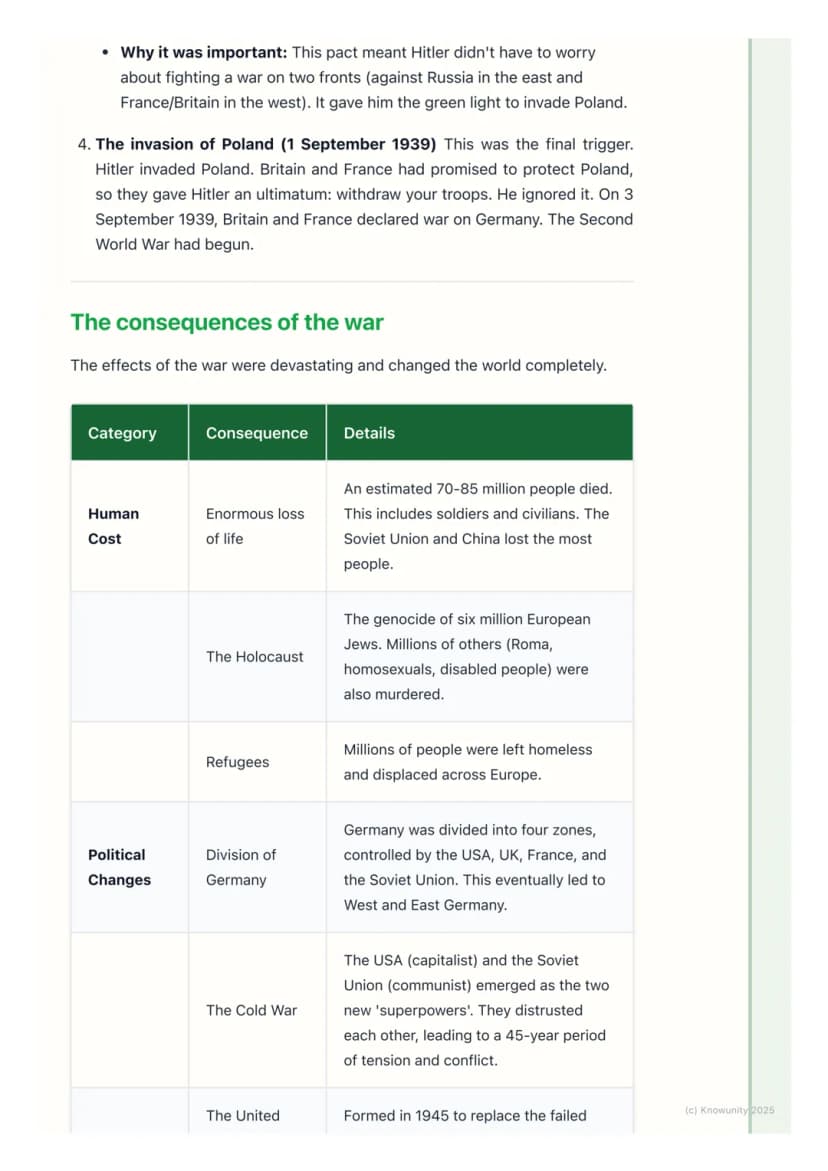
The human cost was absolutely staggering. An estimated 70-85 million people died – that's more than the entire population of Britain today. The Holocaust saw six million Jews systematically murdered, along with millions of others including Roma people, homosexuals, and disabled individuals.
Millions more became refugees, left homeless and displaced across Europe. The Soviet Union and China lost the most people, with some estimates putting Soviet deaths alone at 27 million. These weren't just numbers – they were real people with families, dreams, and lives cut short.
The war also saw the first use of atomic weapons when the USA dropped bombs on Hiroshima and Nagasaki in August 1945. This wasn't just about ending the war – it ushered in the nuclear age and changed warfare forever.
Remember: The scale of suffering was unprecedented – understanding this helps explain why the world was so determined to create international organisations like the UN afterwards.
5
of 6
Political and Global Consequences
The war's aftermath completely reshaped the world map and power structure. Germany was divided into four zones controlled by the USA, UK, France, and Soviet Union, eventually becoming West and East Germany. This division symbolised the broader split that was coming.
The Cold War emerged as the USA and Soviet Union became the world's new superpowers. Despite being wartime allies, their opposing ideologies (capitalism vs communism) created 45 years of tension, proxy wars, and the constant threat of nuclear conflict.
The United Nations was founded in 1945 to replace the failed League of Nations. Unlike its predecessor, the UN had more power and backing from major world powers, though it still struggles with enforcement today.
European empires crumbled as Britain and France, weakened by the war, could no longer afford to maintain their colonies. This triggered decolonisation across Africa and Asia in the following decades, creating many of the countries we know today.
Think about it: Many of today's global conflicts and political tensions can be traced back to these post-WWII changes – the war's consequences are still with us.
6
of 6
Exam Success Tips
Don't confuse WWI and WWII causes – alliances were crucial for the first war, but WWII was more about dictators' actions and other countries' failure to stop them early. Make sure you can explain the difference clearly.
Appeasement is absolutely vital to understand. Know what it was (giving dictators what they want to avoid war), why leaders used it (desperate to prevent another devastating conflict), and why it failed (encouraged Hitler's aggression).
The invasion of Poland was just the trigger, not the whole story. Your essays need to show you understand the long-term causes like the Treaty of Versailles were equally important in creating the conditions for war.
Remember the global scale – this wasn't just Europeans fighting each other. Countries from every continent were involved, and the consequences affected the entire world. The Holocaust, the Cold War division of Europe, and the creation of the UN all stemmed directly from this conflict.
Exam strategy: Always link causes to consequences in your answers – show how the harsh Treaty of Versailles helped Hitler rise to power, or how appeasement encouraged his aggression.
そんなこと聞いてくれるのを待ってたよ...
KnowunityのAIコンパニオンとは?
KnowunityのAIコンパニオンは学生向けに設計されたAIツールで、単なる答えを提供するだけではありません。数百万のKnowunityリソースを基に構築され、関連する情報、個別の学習プラン、クイズ、コンテンツをチャット内で直接提供し、あなたの個別の学習過程に適応します。
Knowunityアプリはどこでダウンロードできますか?
Google Play StoreとApple App Storeからアプリをダウンロードできます。
Knowunityは本当に無料ですか?
その通り!学習コンテンツへの無料アクセス、仲間の学生とのつながり、そして即座のサポートを手のひらで楽しもう。
Historyの人気コンテンツ
9人気コンテンツ
9探しているものが見つからない?他の教科も見てみよう。
生徒たちが愛用中 — あなたもきっと気に入るはず。
4.6/5App Store
4.7/5Google Play
このアプリはとても使いやすくて、デザインも良いです。今のところ探していたものは全て見つかったし、プレゼン資料からもたくさん学べました!絶対に課題でも使いたいと思います!もちろん、アイデアを得るのにもすごく役立ちます。
Stefan SiOSユーザー
このアプリは本当に素晴らしいです。学習ノートやサポート資料がとても豊富で[...]。例えば、私の苦手科目はフランス語なんですが、このアプリにはサポートオプションがたくさんあります。このアプリのおかげでフランス語が上達しました。誰にでもおすすめしたいです。
Samantha KlichAndroidユーザー
すごい、本当に驚いた。広告で何度も見かけたからアプリを試してみたら、めちゃくちゃ感動した。このアプリは学校で欲しかった「まさにこれ!」って感じのサポートで、特に練習問題や要点まとめみたいな機能がたくさんあって、個人的にすごく助かってる。
AnnaiOSユーザー
History15 閲覧数·更新日 May 26, 2026·6 ページThe Causes and Effects of World War II
World War II was the deadliest conflict in human history, lasting from 1939 to 1945 and changing the world forever. Understanding why it started and what happened afterwards is crucial for grasping how our modern world was shaped. This wasn't... もっと見る
1
of 6サインアップしてコンテンツを見よう。無料だよ!
- 全ドキュメントへのアクセス
- 成績アップ
- 数百万人の学生と一緒に学習
Introduction and Key Concepts
You've probably heard of WWII, but understanding why it happened makes all the difference in your exams. This massive global conflict split the world into two sides: the Allies (mainly Britain, France, USSR, and USA) versus the Axis powers (Germany, Italy, and Japan).
The most important concept to grasp is fascism – a political system where dictators control everything and the state matters more than individual people. Hitler's version, called Nazism, added horrific racist ideas that led to the Holocaust.
Two other key terms will come up constantly: appeasement (when Britain and France tried to avoid war by giving Hitler what he wanted) and blitzkrieg . The Treaty of Versailles from 1919 is also crucial – it was meant to keep peace after WWI but actually helped cause WWII.
Remember: Don't just memorise dates – focus on understanding the connections between causes and consequences.
2
of 6サインアップしてコンテンツを見よう。無料だよ!
- 全ドキュメントへのアクセス
- 成績アップ
- 数百万人の学生と一緒に学習
Long-term Causes
The Treaty of Versailles was basically a recipe for disaster. Use the acronym BRAT to remember its harsh terms: Blame (Germany had to accept full responsibility for WWI), Reparations (£6.6 billion in payments that crippled Germany's economy), Army (limited to just 100,000 men), and Territory (Germany lost loads of land).
Hitler used Germans' anger about this treaty to gain support. People were desperate after economic crisis and national humiliation, so his promises to tear up the treaty and make Germany great again sounded brilliant.
The League of Nations was supposed to prevent future wars but was completely useless. It had no army and couldn't stop aggressive countries like Japan or Italy from invading other nations. This showed Hitler he could probably get away with breaking international rules too.
Meanwhile, dictatorships were popping up everywhere as people lost faith in democracy during the Great Depression. These leaders – Hitler in Germany, Mussolini in Italy, and military leaders in Japan – all glorified war and wanted to expand their empires.
Exam tip: Long-term causes are just as important as the immediate trigger – make sure you can explain both!
3
of 6サインアップしてコンテンツを見よう。無料だよ!
- 全ドキュメントへのアクセス
- 成績アップ
- 数百万人の学生と一緒に学習
Short-term Causes and Triggers
Hitler had clear goals: destroy the Treaty of Versailles, unite all German speakers, and grab 'living space' (Lebensraum) in Eastern Europe. He tested the waters by remilitarising the Rhineland in 1936, then annexed Austria in 1938, then demanded the Sudetenland from Czechoslovakia.
This is where appeasement comes in. Britain and France were so desperate to avoid another war that they kept giving Hitler what he wanted. The Munich Agreement in 1938 handed over the Sudetenland without even asking Czechoslovakia – basically throwing them under the bus.
Appeasement completely backfired because it made Hitler think Britain and France were weak and wouldn't stop him no matter what he did. He was getting bolder with each success.
The Nazi-Soviet Pact in August 1939 was a massive shock – fascist Germany and communist Russia agreeing not to fight each other and secretly planning to carve up Poland between them. This meant Hitler didn't have to worry about fighting on two fronts, giving him the green light for invasion.
Key point: Appeasement wasn't cowardice – leaders genuinely thought they were preventing war, but it actually encouraged Hitler's aggression.
4
of 6サインアップしてコンテンツを見よう。無料だよ!
- 全ドキュメントへのアクセス
- 成績アップ
- 数百万人の学生と一緒に学習
The Final Trigger and Human Consequences
On 1 September 1939, Hitler invaded Poland. Britain and France had promised to protect Poland, so they gave Hitler an ultimatum to withdraw. When he ignored it, they declared war on 3 September 1939. World War II had officially begun.
The human cost was absolutely staggering. An estimated 70-85 million people died – that's more than the entire population of Britain today. The Holocaust saw six million Jews systematically murdered, along with millions of others including Roma people, homosexuals, and disabled individuals.
Millions more became refugees, left homeless and displaced across Europe. The Soviet Union and China lost the most people, with some estimates putting Soviet deaths alone at 27 million. These weren't just numbers – they were real people with families, dreams, and lives cut short.
The war also saw the first use of atomic weapons when the USA dropped bombs on Hiroshima and Nagasaki in August 1945. This wasn't just about ending the war – it ushered in the nuclear age and changed warfare forever.
Remember: The scale of suffering was unprecedented – understanding this helps explain why the world was so determined to create international organisations like the UN afterwards.
5
of 6サインアップしてコンテンツを見よう。無料だよ!
- 全ドキュメントへのアクセス
- 成績アップ
- 数百万人の学生と一緒に学習
Political and Global Consequences
The war's aftermath completely reshaped the world map and power structure. Germany was divided into four zones controlled by the USA, UK, France, and Soviet Union, eventually becoming West and East Germany. This division symbolised the broader split that was coming.
The Cold War emerged as the USA and Soviet Union became the world's new superpowers. Despite being wartime allies, their opposing ideologies (capitalism vs communism) created 45 years of tension, proxy wars, and the constant threat of nuclear conflict.
The United Nations was founded in 1945 to replace the failed League of Nations. Unlike its predecessor, the UN had more power and backing from major world powers, though it still struggles with enforcement today.
European empires crumbled as Britain and France, weakened by the war, could no longer afford to maintain their colonies. This triggered decolonisation across Africa and Asia in the following decades, creating many of the countries we know today.
Think about it: Many of today's global conflicts and political tensions can be traced back to these post-WWII changes – the war's consequences are still with us.
6
of 6サインアップしてコンテンツを見よう。無料だよ!
- 全ドキュメントへのアクセス
- 成績アップ
- 数百万人の学生と一緒に学習
Exam Success Tips
Don't confuse WWI and WWII causes – alliances were crucial for the first war, but WWII was more about dictators' actions and other countries' failure to stop them early. Make sure you can explain the difference clearly.
Appeasement is absolutely vital to understand. Know what it was (giving dictators what they want to avoid war), why leaders used it (desperate to prevent another devastating conflict), and why it failed (encouraged Hitler's aggression).
The invasion of Poland was just the trigger, not the whole story. Your essays need to show you understand the long-term causes like the Treaty of Versailles were equally important in creating the conditions for war.
Remember the global scale – this wasn't just Europeans fighting each other. Countries from every continent were involved, and the consequences affected the entire world. The Holocaust, the Cold War division of Europe, and the creation of the UN all stemmed directly from this conflict.
Exam strategy: Always link causes to consequences in your answers – show how the harsh Treaty of Versailles helped Hitler rise to power, or how appeasement encouraged his aggression.
そんなこと聞いてくれるのを待ってたよ...
KnowunityのAIコンパニオンとは?
KnowunityのAIコンパニオンは学生向けに設計されたAIツールで、単なる答えを提供するだけではありません。数百万のKnowunityリソースを基に構築され、関連する情報、個別の学習プラン、クイズ、コンテンツをチャット内で直接提供し、あなたの個別の学習過程に適応します。
Knowunityアプリはどこでダウンロードできますか?
Google Play StoreとApple App Storeからアプリをダウンロードできます。
Knowunityは本当に無料ですか?
その通り!学習コンテンツへの無料アクセス、仲間の学生とのつながり、そして即座のサポートを手のひらで楽しもう。
Historyの人気コンテンツ
9人気コンテンツ
9探しているものが見つからない?他の教科も見てみよう。
生徒たちが愛用中 — あなたもきっと気に入るはず。
4.6/5App Store
4.7/5Google Play
このアプリはとても使いやすくて、デザインも良いです。今のところ探していたものは全て見つかったし、プレゼン資料からもたくさん学べました!絶対に課題でも使いたいと思います!もちろん、アイデアを得るのにもすごく役立ちます。
Stefan SiOSユーザー
このアプリは本当に素晴らしいです。学習ノートやサポート資料がとても豊富で[...]。例えば、私の苦手科目はフランス語なんですが、このアプリにはサポートオプションがたくさんあります。このアプリのおかげでフランス語が上達しました。誰にでもおすすめしたいです。
Samantha KlichAndroidユーザー
すごい、本当に驚いた。広告で何度も見かけたからアプリを試してみたら、めちゃくちゃ感動した。このアプリは学校で欲しかった「まさにこれ!」って感じのサポートで、特に練習問題や要点まとめみたいな機能がたくさんあって、個人的にすごく助かってる。
AnnaiOSユーザー