
Ever wondered what the ground beneath your feet is made...
 Geography4 閲覧数·更新日 Jun 19, 2026·7 ページ
Understanding Rocks and Their Cycle

1 / 7
1
of 7
Introduction to Rocks and Key Terms
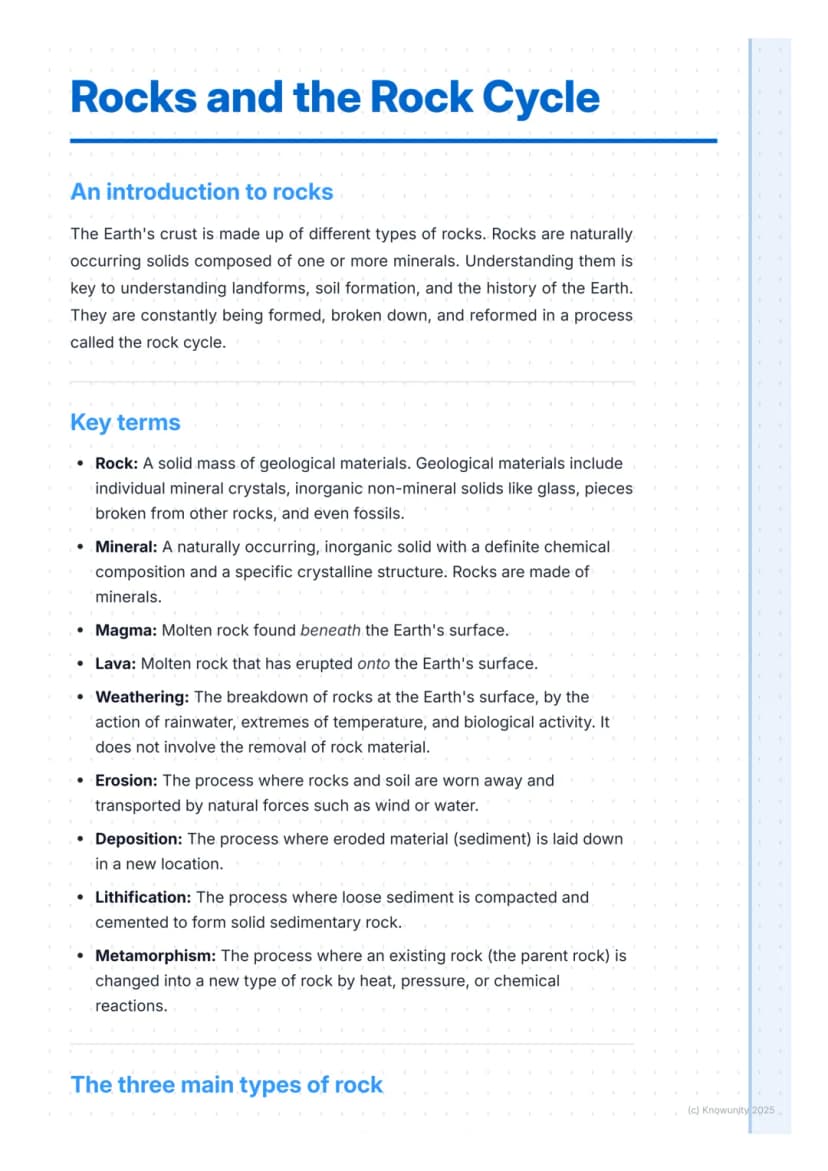
Rocks are everywhere around you – from the Cliffs of Moher to the pavements in Dublin. They're naturally occurring solids made up of minerals, which are like the building blocks of rocks. Think of minerals as ingredients and rocks as the finished recipe.
The most important thing to grasp is that rocks never stay the same forever. They're constantly being formed, broken down, and reformed through the rock cycle. This means the granite in Wicklow could eventually become sand on a beach, then turn into sandstone, and maybe even melt back into magma deep underground.
You'll need to know the difference between magma (molten rock underground) and lava (molten rock that's erupted onto the surface). Also remember that weathering breaks rocks down where they are, whilst erosion actually moves the broken pieces somewhere else.
Top Tip: Don't just memorise definitions – think about how these processes connect to create the Irish landscapes you know!
2
of 7
The Three Main Rock Types
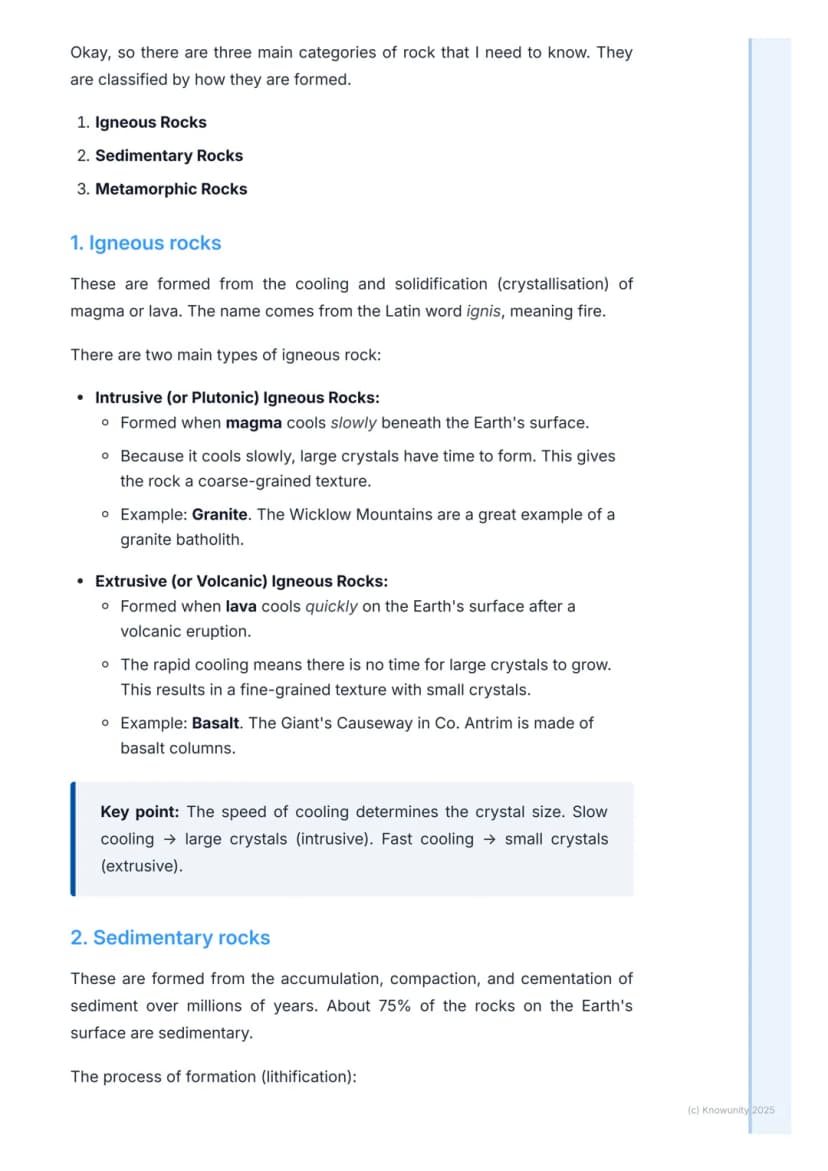
There are three main types of rocks, and they're classified by how they formed – not what they look like. Each type tells a different story about Earth's processes.
Igneous rocks form when magma or lava cools down. The key thing here is cooling speed. If magma cools slowly underground, you get large crystals (like granite in the Wicklow Mountains). If lava cools quickly on the surface, you get small crystals (like basalt at the Giant's Causeway). Remember: slow cooling = big crystals, fast cooling = tiny crystals.
Sedimentary rocks are like nature's recycling project. They form when bits of other rocks (sediment) get squashed and glued together over millions of years. About 75% of rocks on Earth's surface are sedimentary, which makes sense when you think about it – they form on the surface where we can see them.
The formation process is straightforward: weathering breaks down rocks, erosion moves the pieces, deposition drops them in layers, then compaction and cementation turn them into solid rock.
Remember: Only sedimentary rocks contain fossils – the heat and pressure that create other rock types would destroy any fossil remains.
3
of 7
Types of Sedimentary and Metamorphic Rocks
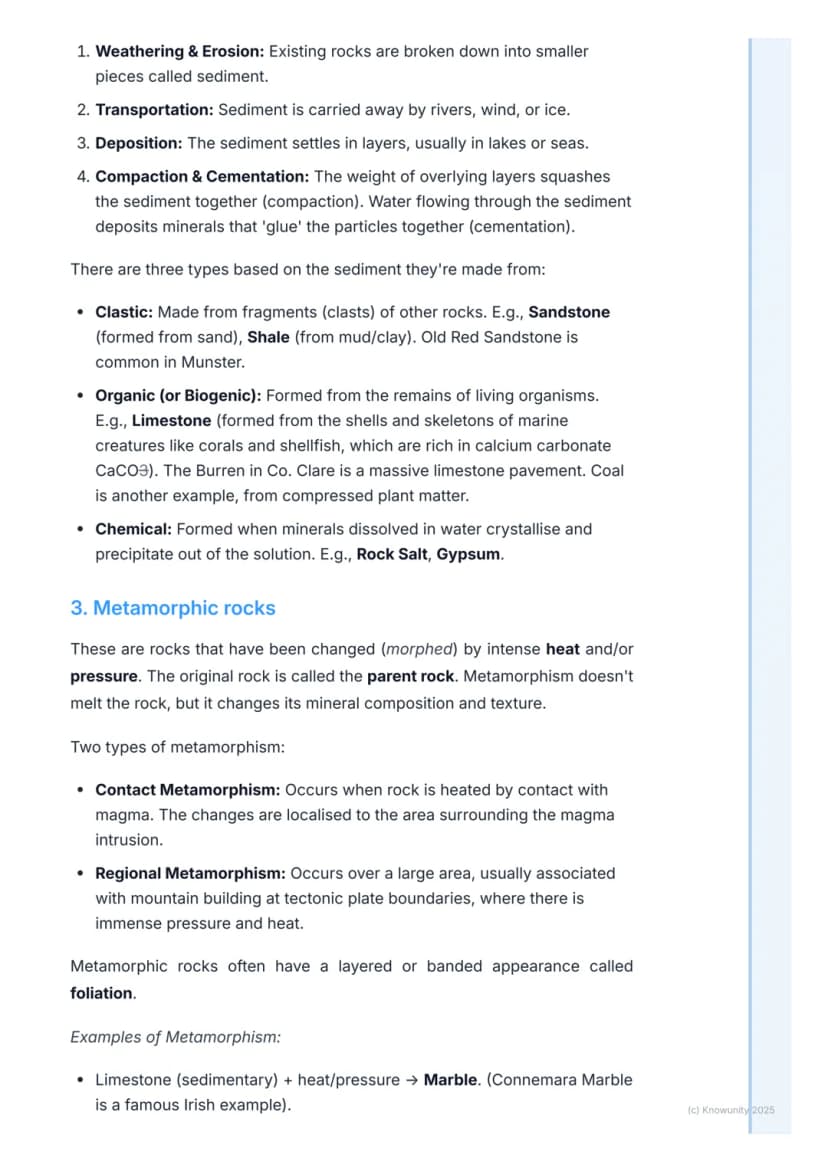
Sedimentary rocks come in three flavours based on what they're made from. Clastic rocks like sandstone are made from rock fragments. Organic rocks like limestone come from dead sea creatures (the Burren is a massive limestone pavement). Chemical rocks form when minerals crystallise out of water.
Metamorphic rocks are the shapeshifters of the rock world. They start as one type of rock (the parent rock) and get transformed by intense heat and pressure – but not enough to melt them completely. Think of it like baking a cake that changes texture and appearance but doesn't turn into liquid.
There are two ways this happens: contact metamorphism (rock gets heated by nearby magma) and regional metamorphism (huge areas get squashed during mountain building). The results often have a layered or banded appearance called foliation.
The transformations are pretty predictable: limestone becomes marble (like Connemara marble), sandstone becomes quartzite (like the Sugar Loaf mountain), and shale becomes slate.
Exam Tip: Learn the Irish examples – examiners love when you can connect geology to local landmarks!
4
of 7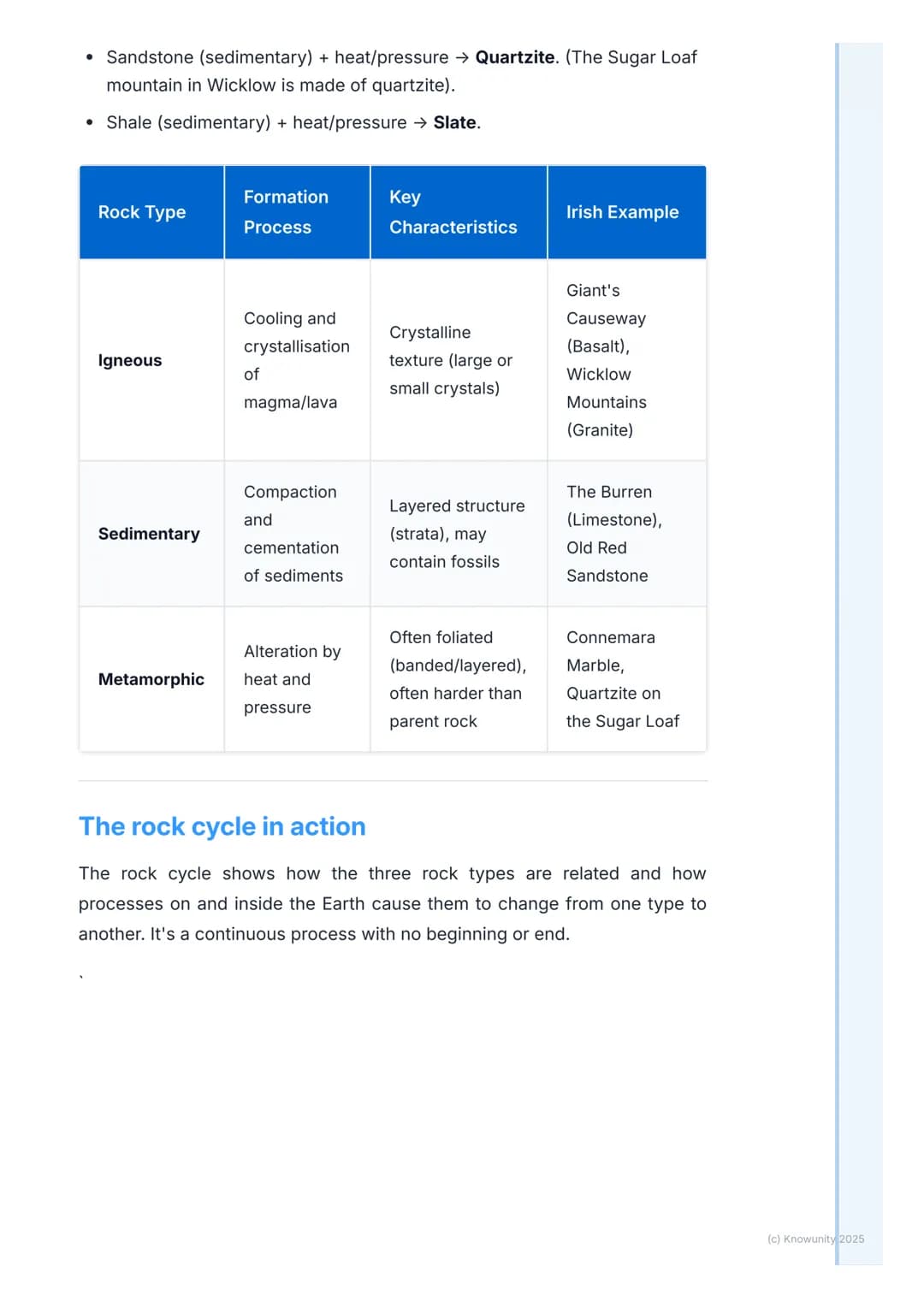
Understanding the Rock Cycle
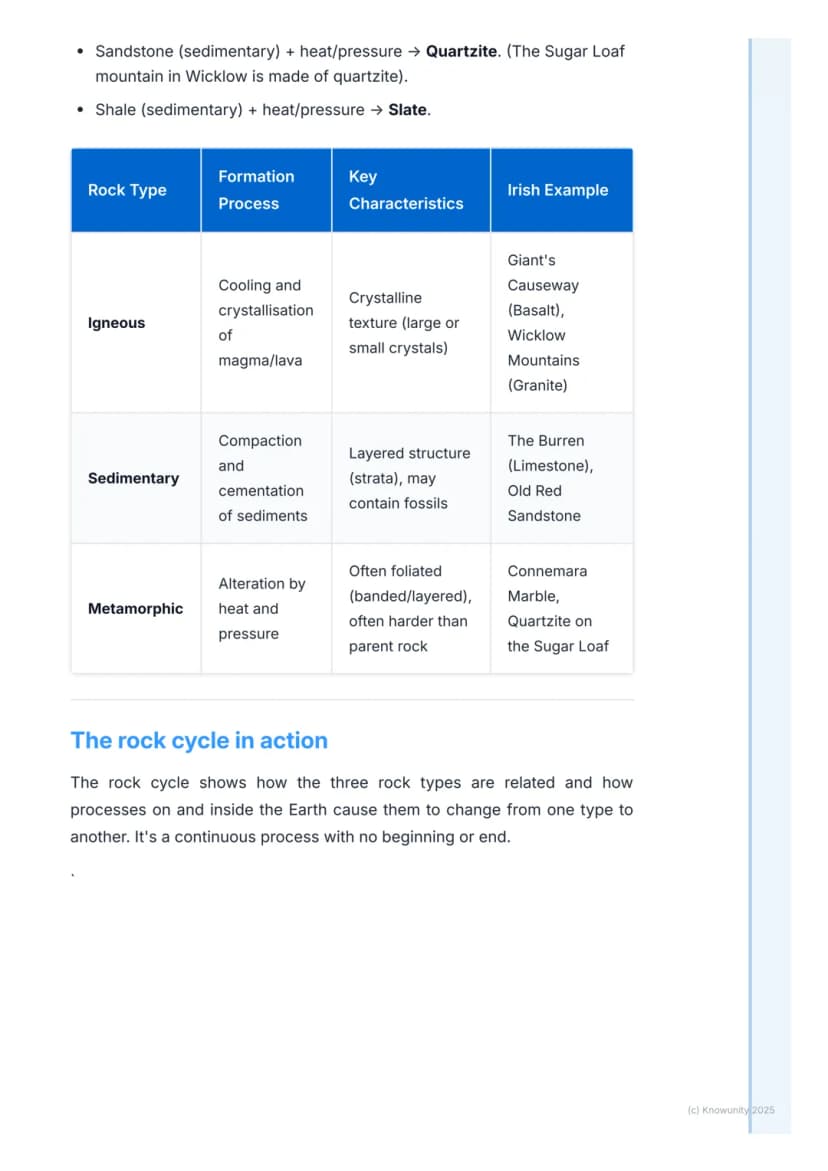
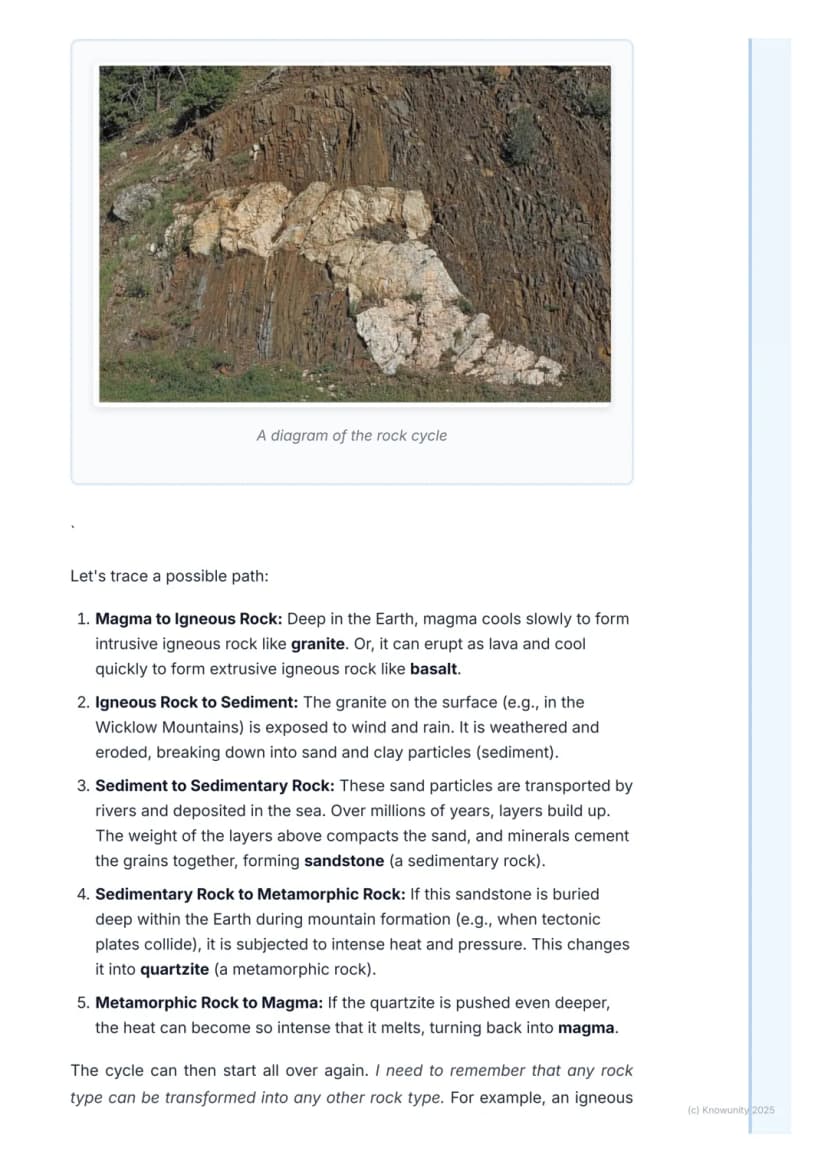
The rock cycle is like a giant recycling system with no beginning or end. Any rock type can transform into any other rock type – that's the beauty of it. A piece of granite could become sand, then sandstone, then quartzite, then melt back into magma.
Here's a typical journey: magma cools to form granite, which gets weathered into sand grains. These grains get deposited in layers and cemented into sandstone. If the sandstone gets buried deep during mountain formation, heat and pressure transform it into quartzite. Push it deeper still, and it melts back into magma.
The whole system is powered by two energy sources: heat from Earth's core (which drives melting and plate movement) and energy from the sun (which powers weather and erosion). Without these energy sources, the rock cycle would grind to a halt.
What's brilliant about this is that it explains why we see such diverse landscapes in Ireland – from volcanic basalt in Antrim to limestone pavements in Clare to granite mountains in Wicklow.
Key Point: The rock cycle connects all three rock types – understanding it helps you see the big picture of how Earth works.
5
of 7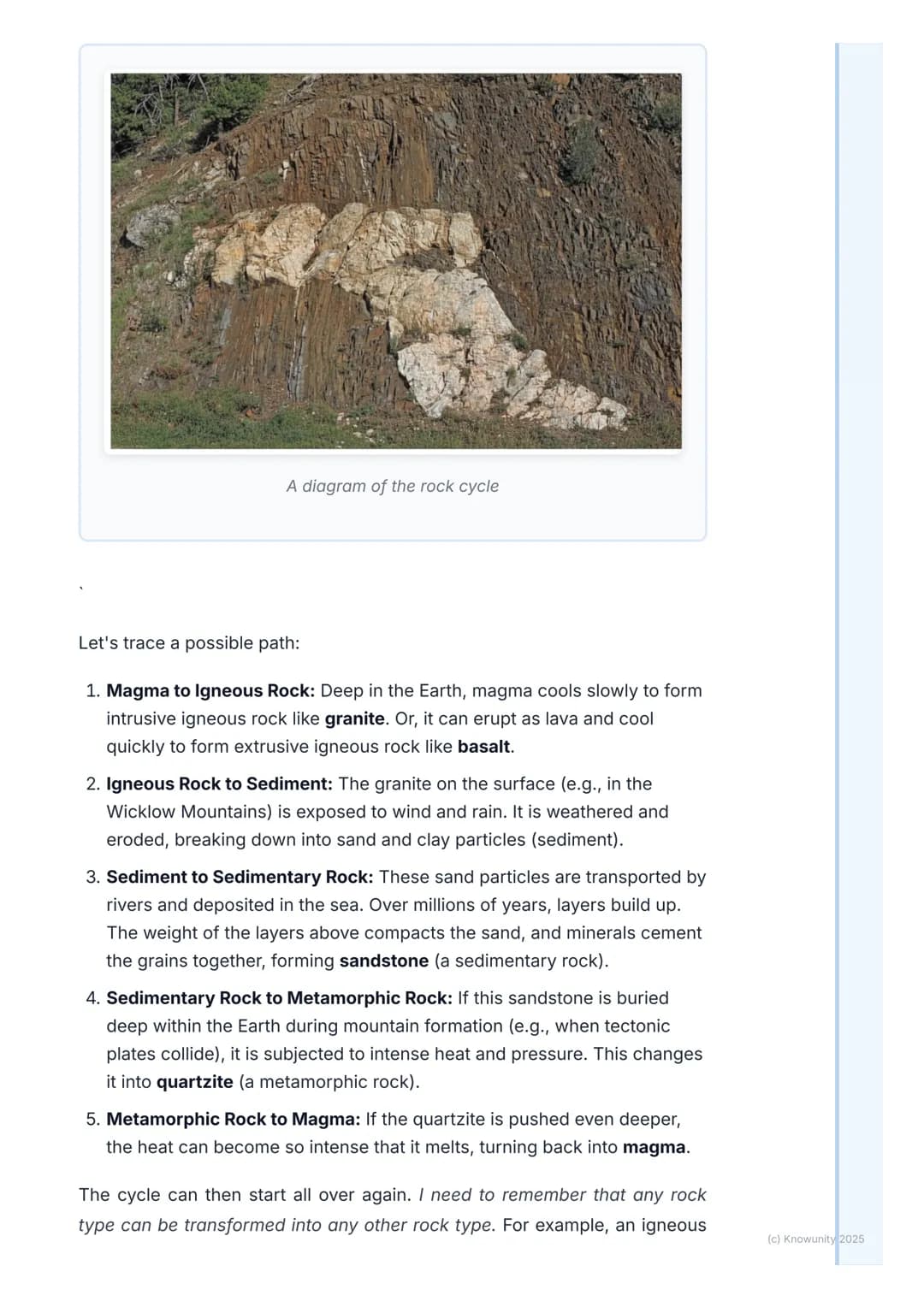
Tracing Rock Transformations
Let's follow a specific example through the cycle to make it real. Imagine starting with magma deep in Earth's crust. This magma slowly cools to form granite, like what you see in the Wicklow Mountains today.
Wind and rain start attacking this granite through weathering, breaking it down into sand and clay particles. Rivers carry this sediment away (erosion) and dump it in the sea (deposition). Over millions of years, layers build up on the seabed.
The weight of new layers squashes the sand grains together (compaction), whilst minerals in seawater cement them into solid sandstone. This is lithification in action – turning loose sediment into solid rock.
If this sandstone gets caught up in mountain building (when tectonic plates crash together), it experiences intense heat and pressure. This metamorphism transforms it into quartzite – a much harder, crystalline rock.
Reality Check: These processes take millions of years, but they're happening right now around you – rocks in your local area are slowly weathering and changing.
6
of 7
Exam Success and Key Reminders
Here's what trips up most students: confusing weathering with erosion. Weathering breaks rock down in place (like a statue crumbling), whilst erosion moves the broken pieces somewhere else (like a river carrying sand).
Crystal size in igneous rocks tells you everything about how they formed. Large crystals mean slow cooling underground (intrusive), small crystals mean fast cooling on the surface (extrusive). This is your key to identification.
Remember that magma is underground, lava is above ground – this determines whether you get intrusive or extrusive igneous rock. Also, only sedimentary rocks contain fossils because the heat and pressure that form other rock types destroy fossil remains.
For the exam, nail your Irish examples: Giant's Causeway (basalt), Wicklow Mountains (granite), the Burren (limestone), and Connemara marble. Examiners love local connections because they show you understand how geology applies to the real world.
Success Strategy: Don't just memorise – understand the processes and you'll be able to tackle any question they throw at you.
7
of 7
Quick Revision Summary
Three rock types: Igneous , Sedimentary (from compacted sediment), Metamorphic . Each tells a different story about Earth's processes.
The rock cycle connects everything – any rock can become any other rock through processes like melting, cooling, weathering, erosion, and metamorphism. It's powered by Earth's internal heat and energy from the sun.
Key processes: Weathering breaks down, erosion transports, deposition drops sediment in layers, compaction and cementation create sedimentary rocks, and metamorphism transforms existing rocks without melting them completely.
This system explains Ireland's diverse landscapes and continues shaping them today. The rocks beneath your feet have incredible stories to tell if you know how to read them.
Final Thought: Geology isn't just about memorising rock names – it's about understanding the dynamic planet we live on!
そんなこと聞いてくれるのを待ってたよ...
KnowunityのAIコンパニオンとは?
KnowunityのAIコンパニオンは学生向けに設計されたAIツールで、単なる答えを提供するだけではありません。数百万のKnowunityリソースを基に構築され、関連する情報、個別の学習プラン、クイズ、コンテンツをチャット内で直接提供し、あなたの個別の学習過程に適応します。
Knowunityアプリはどこでダウンロードできますか?
Google Play StoreとApple App Storeからアプリをダウンロードできます。
Knowunityは本当に無料ですか?
その通り!学習コンテンツへの無料アクセス、仲間の学生とのつながり、そして即座のサポートを手のひらで楽しもう。
Geographyの人気コンテンツ
9GeographyGeography notes on rocks
Includes types of rocks,uses of rocks, case studies
1st Year341
GeographyEarthquakes revision notes
Notes on earthquakes with diagrams
1st Year110
GeographyPopulation Change and Migration
This covers factors that cause populations to grow or shrink, including birth rates, death rates, and the reasons people migrate.
2nd Year90
GeographyRock notes geography
Geography
5th Year250
GeographyThe sea
Jc Geography
1st Year230
GeographyGeography notes On the sea
Includes costal erosion, sea cliffs, longshore drift etc.
1st Year160
GeographyInside the Earth
Students will learn about the basic layers of the Earth: the crust, mantle, and core, understanding that our planet is made up of different parts.
1st Year51
GeographyGeography notes on glaciation
Includes diagrams, erosion, deposition, transportation
1st Year210
GeographyGeography notes on weather
Includes instruments, diagrams, how to read weather
1st Year120
人気コンテンツ
9 Irish
IrishIrish oral questions and answers
Questions and answers for the leaving cert oral
5th Year4264
 English
Key Quotes : Sive
Key Quotes and explanations: Sive
6th Year2842
IrishIrish oral questions
Outline of oral questions
5th Year2055
IrishIníon- le hÁine Durkin
Aine Durkin’s poem, Iníon: Themes & summary
5th Year890
IrishIrish poetry 2027
Iníon + Dínit an Bhróin
5th Year1153
IrishLC HL notes- Iníon (poem)
Includes poem in English and Irish, theme, key words & phrases
5th Year2304
EnglishCultural Context : Shawshank Redemption : Sive : Small Things Like These
Comparative Study : Cultural Context : Shawshank Redemption, Sive and Small Things Like These
6th Year1430
IrishMo Ghrá-sa (Idir Lúibíní)
Notes on mo ghrá-sa
5th Year380
IrishAn Gaeilge Aiste
Irish Language essay
6th Year1320
探しているものが見つからない?他の教科も見てみよう。
生徒たちが愛用中 — あなたもきっと気に入るはず。
4.6/5App Store
4.7/5Google Play
このアプリはとても使いやすくて、デザインも良いです。今のところ探していたものは全て見つかったし、プレゼン資料からもたくさん学べました!絶対に課題でも使いたいと思います!もちろん、アイデアを得るのにもすごく役立ちます。
Stefan SiOSユーザー
このアプリは本当に素晴らしいです。学習ノートやサポート資料がとても豊富で[...]。例えば、私の苦手科目はフランス語なんですが、このアプリにはサポートオプションがたくさんあります。このアプリのおかげでフランス語が上達しました。誰にでもおすすめしたいです。
Samantha KlichAndroidユーザー
すごい、本当に驚いた。広告で何度も見かけたからアプリを試してみたら、めちゃくちゃ感動した。このアプリは学校で欲しかった「まさにこれ!」って感じのサポートで、特に練習問題や要点まとめみたいな機能がたくさんあって、個人的にすごく助かってる。
AnnaiOSユーザー
Geography4 閲覧数·更新日 Jun 19, 2026·7 ページUnderstanding Rocks and Their Cycle
Ever wondered what the ground beneath your feet is made of? The Earth's crust is constantly changing through an amazing process called the rock cycle, where rocks transform from one type to another over millions of years. Understanding rocks...
1
of 7
サインアップしてコンテンツを見よう。無料だよ!
- 全ドキュメントへのアクセス
- 成績アップ
- 数百万人の学生と一緒に学習
Introduction to Rocks and Key Terms
Rocks are everywhere around you – from the Cliffs of Moher to the pavements in Dublin. They're naturally occurring solids made up of minerals, which are like the building blocks of rocks. Think of minerals as ingredients and rocks as the finished recipe.
The most important thing to grasp is that rocks never stay the same forever. They're constantly being formed, broken down, and reformed through the rock cycle. This means the granite in Wicklow could eventually become sand on a beach, then turn into sandstone, and maybe even melt back into magma deep underground.
You'll need to know the difference between magma (molten rock underground) and lava (molten rock that's erupted onto the surface). Also remember that weathering breaks rocks down where they are, whilst erosion actually moves the broken pieces somewhere else.
Top Tip: Don't just memorise definitions – think about how these processes connect to create the Irish landscapes you know!
2
of 7サインアップしてコンテンツを見よう。無料だよ!
- 全ドキュメントへのアクセス
- 成績アップ
- 数百万人の学生と一緒に学習
The Three Main Rock Types
There are three main types of rocks, and they're classified by how they formed – not what they look like. Each type tells a different story about Earth's processes.
Igneous rocks form when magma or lava cools down. The key thing here is cooling speed. If magma cools slowly underground, you get large crystals (like granite in the Wicklow Mountains). If lava cools quickly on the surface, you get small crystals (like basalt at the Giant's Causeway). Remember: slow cooling = big crystals, fast cooling = tiny crystals.
Sedimentary rocks are like nature's recycling project. They form when bits of other rocks (sediment) get squashed and glued together over millions of years. About 75% of rocks on Earth's surface are sedimentary, which makes sense when you think about it – they form on the surface where we can see them.
The formation process is straightforward: weathering breaks down rocks, erosion moves the pieces, deposition drops them in layers, then compaction and cementation turn them into solid rock.
Remember: Only sedimentary rocks contain fossils – the heat and pressure that create other rock types would destroy any fossil remains.
3
of 7サインアップしてコンテンツを見よう。無料だよ!
- 全ドキュメントへのアクセス
- 成績アップ
- 数百万人の学生と一緒に学習
Types of Sedimentary and Metamorphic Rocks
Sedimentary rocks come in three flavours based on what they're made from. Clastic rocks like sandstone are made from rock fragments. Organic rocks like limestone come from dead sea creatures (the Burren is a massive limestone pavement). Chemical rocks form when minerals crystallise out of water.
Metamorphic rocks are the shapeshifters of the rock world. They start as one type of rock (the parent rock) and get transformed by intense heat and pressure – but not enough to melt them completely. Think of it like baking a cake that changes texture and appearance but doesn't turn into liquid.
There are two ways this happens: contact metamorphism (rock gets heated by nearby magma) and regional metamorphism (huge areas get squashed during mountain building). The results often have a layered or banded appearance called foliation.
The transformations are pretty predictable: limestone becomes marble (like Connemara marble), sandstone becomes quartzite (like the Sugar Loaf mountain), and shale becomes slate.
Exam Tip: Learn the Irish examples – examiners love when you can connect geology to local landmarks!
4
of 7サインアップしてコンテンツを見よう。無料だよ!
- 全ドキュメントへのアクセス
- 成績アップ
- 数百万人の学生と一緒に学習
Understanding the Rock Cycle
The rock cycle is like a giant recycling system with no beginning or end. Any rock type can transform into any other rock type – that's the beauty of it. A piece of granite could become sand, then sandstone, then quartzite, then melt back into magma.
Here's a typical journey: magma cools to form granite, which gets weathered into sand grains. These grains get deposited in layers and cemented into sandstone. If the sandstone gets buried deep during mountain formation, heat and pressure transform it into quartzite. Push it deeper still, and it melts back into magma.
The whole system is powered by two energy sources: heat from Earth's core (which drives melting and plate movement) and energy from the sun (which powers weather and erosion). Without these energy sources, the rock cycle would grind to a halt.
What's brilliant about this is that it explains why we see such diverse landscapes in Ireland – from volcanic basalt in Antrim to limestone pavements in Clare to granite mountains in Wicklow.
Key Point: The rock cycle connects all three rock types – understanding it helps you see the big picture of how Earth works.
5
of 7サインアップしてコンテンツを見よう。無料だよ!
- 全ドキュメントへのアクセス
- 成績アップ
- 数百万人の学生と一緒に学習
Tracing Rock Transformations
Let's follow a specific example through the cycle to make it real. Imagine starting with magma deep in Earth's crust. This magma slowly cools to form granite, like what you see in the Wicklow Mountains today.
Wind and rain start attacking this granite through weathering, breaking it down into sand and clay particles. Rivers carry this sediment away (erosion) and dump it in the sea (deposition). Over millions of years, layers build up on the seabed.
The weight of new layers squashes the sand grains together (compaction), whilst minerals in seawater cement them into solid sandstone. This is lithification in action – turning loose sediment into solid rock.
If this sandstone gets caught up in mountain building (when tectonic plates crash together), it experiences intense heat and pressure. This metamorphism transforms it into quartzite – a much harder, crystalline rock.
Reality Check: These processes take millions of years, but they're happening right now around you – rocks in your local area are slowly weathering and changing.
6
of 7サインアップしてコンテンツを見よう。無料だよ!
- 全ドキュメントへのアクセス
- 成績アップ
- 数百万人の学生と一緒に学習
Exam Success and Key Reminders
Here's what trips up most students: confusing weathering with erosion. Weathering breaks rock down in place (like a statue crumbling), whilst erosion moves the broken pieces somewhere else (like a river carrying sand).
Crystal size in igneous rocks tells you everything about how they formed. Large crystals mean slow cooling underground (intrusive), small crystals mean fast cooling on the surface (extrusive). This is your key to identification.
Remember that magma is underground, lava is above ground – this determines whether you get intrusive or extrusive igneous rock. Also, only sedimentary rocks contain fossils because the heat and pressure that form other rock types destroy fossil remains.
For the exam, nail your Irish examples: Giant's Causeway (basalt), Wicklow Mountains (granite), the Burren (limestone), and Connemara marble. Examiners love local connections because they show you understand how geology applies to the real world.
Success Strategy: Don't just memorise – understand the processes and you'll be able to tackle any question they throw at you.
7
of 7サインアップしてコンテンツを見よう。無料だよ!
- 全ドキュメントへのアクセス
- 成績アップ
- 数百万人の学生と一緒に学習
Quick Revision Summary
Three rock types: Igneous , Sedimentary (from compacted sediment), Metamorphic . Each tells a different story about Earth's processes.
The rock cycle connects everything – any rock can become any other rock through processes like melting, cooling, weathering, erosion, and metamorphism. It's powered by Earth's internal heat and energy from the sun.
Key processes: Weathering breaks down, erosion transports, deposition drops sediment in layers, compaction and cementation create sedimentary rocks, and metamorphism transforms existing rocks without melting them completely.
This system explains Ireland's diverse landscapes and continues shaping them today. The rocks beneath your feet have incredible stories to tell if you know how to read them.
Final Thought: Geology isn't just about memorising rock names – it's about understanding the dynamic planet we live on!
そんなこと聞いてくれるのを待ってたよ...
KnowunityのAIコンパニオンとは?
KnowunityのAIコンパニオンは学生向けに設計されたAIツールで、単なる答えを提供するだけではありません。数百万のKnowunityリソースを基に構築され、関連する情報、個別の学習プラン、クイズ、コンテンツをチャット内で直接提供し、あなたの個別の学習過程に適応します。
Knowunityアプリはどこでダウンロードできますか?
Google Play StoreとApple App Storeからアプリをダウンロードできます。
Knowunityは本当に無料ですか?
その通り!学習コンテンツへの無料アクセス、仲間の学生とのつながり、そして即座のサポートを手のひらで楽しもう。
Geographyの人気コンテンツ
9GeographyGeography notes on rocks
Includes types of rocks,uses of rocks, case studies
1st Year341
GeographyEarthquakes revision notes
Notes on earthquakes with diagrams
1st Year110
GeographyPopulation Change and Migration
This covers factors that cause populations to grow or shrink, including birth rates, death rates, and the reasons people migrate.
2nd Year90
GeographyRock notes geography
Geography
5th Year250
GeographyThe sea
Jc Geography
1st Year230
GeographyGeography notes On the sea
Includes costal erosion, sea cliffs, longshore drift etc.
1st Year160
GeographyInside the Earth
Students will learn about the basic layers of the Earth: the crust, mantle, and core, understanding that our planet is made up of different parts.
1st Year51
GeographyGeography notes on glaciation
Includes diagrams, erosion, deposition, transportation
1st Year210
GeographyGeography notes on weather
Includes instruments, diagrams, how to read weather
1st Year120
人気コンテンツ
9IrishIrish oral questions and answers
Questions and answers for the leaving cert oral
5th Year4264
EnglishKey Quotes : Sive
Key Quotes and explanations: Sive
6th Year2842
IrishIrish oral questions
Outline of oral questions
5th Year2055
IrishIníon- le hÁine Durkin
Aine Durkin’s poem, Iníon: Themes & summary
5th Year890
IrishIrish poetry 2027
Iníon + Dínit an Bhróin
5th Year1153
IrishLC HL notes- Iníon (poem)
Includes poem in English and Irish, theme, key words & phrases
5th Year2304
EnglishCultural Context : Shawshank Redemption : Sive : Small Things Like These
Comparative Study : Cultural Context : Shawshank Redemption, Sive and Small Things Like These
6th Year1430
IrishMo Ghrá-sa (Idir Lúibíní)
Notes on mo ghrá-sa
5th Year380
IrishAn Gaeilge Aiste
Irish Language essay
6th Year1320
探しているものが見つからない?他の教科も見てみよう。
生徒たちが愛用中 — あなたもきっと気に入るはず。
4.6/5App Store
4.7/5Google Play
このアプリはとても使いやすくて、デザインも良いです。今のところ探していたものは全て見つかったし、プレゼン資料からもたくさん学べました!絶対に課題でも使いたいと思います!もちろん、アイデアを得るのにもすごく役立ちます。
Stefan SiOSユーザー
このアプリは本当に素晴らしいです。学習ノートやサポート資料がとても豊富で[...]。例えば、私の苦手科目はフランス語なんですが、このアプリにはサポートオプションがたくさんあります。このアプリのおかげでフランス語が上達しました。誰にでもおすすめしたいです。
Samantha KlichAndroidユーザー
すごい、本当に驚いた。広告で何度も見かけたからアプリを試してみたら、めちゃくちゃ感動した。このアプリは学校で欲しかった「まさにこれ!」って感じのサポートで、特に練習問題や要点まとめみたいな機能がたくさんあって、個人的にすごく助かってる。
AnnaiOSユーザー