
Weather talk is everywhere in Ireland, so mastering French weather... もっと見る
 French2 閲覧数·更新日 Jun 12, 2026·6 ページ
Parler du Temps: Expressions Météorologiques
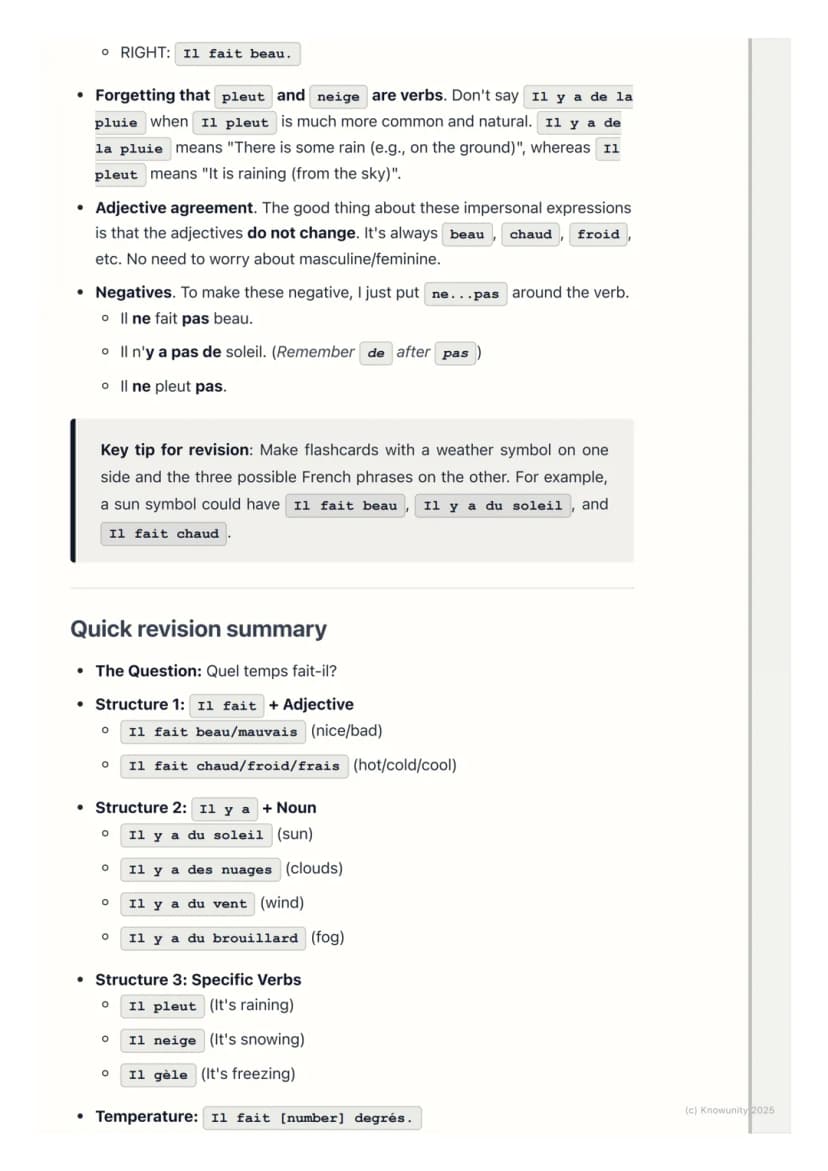

1 / 6
1
of 6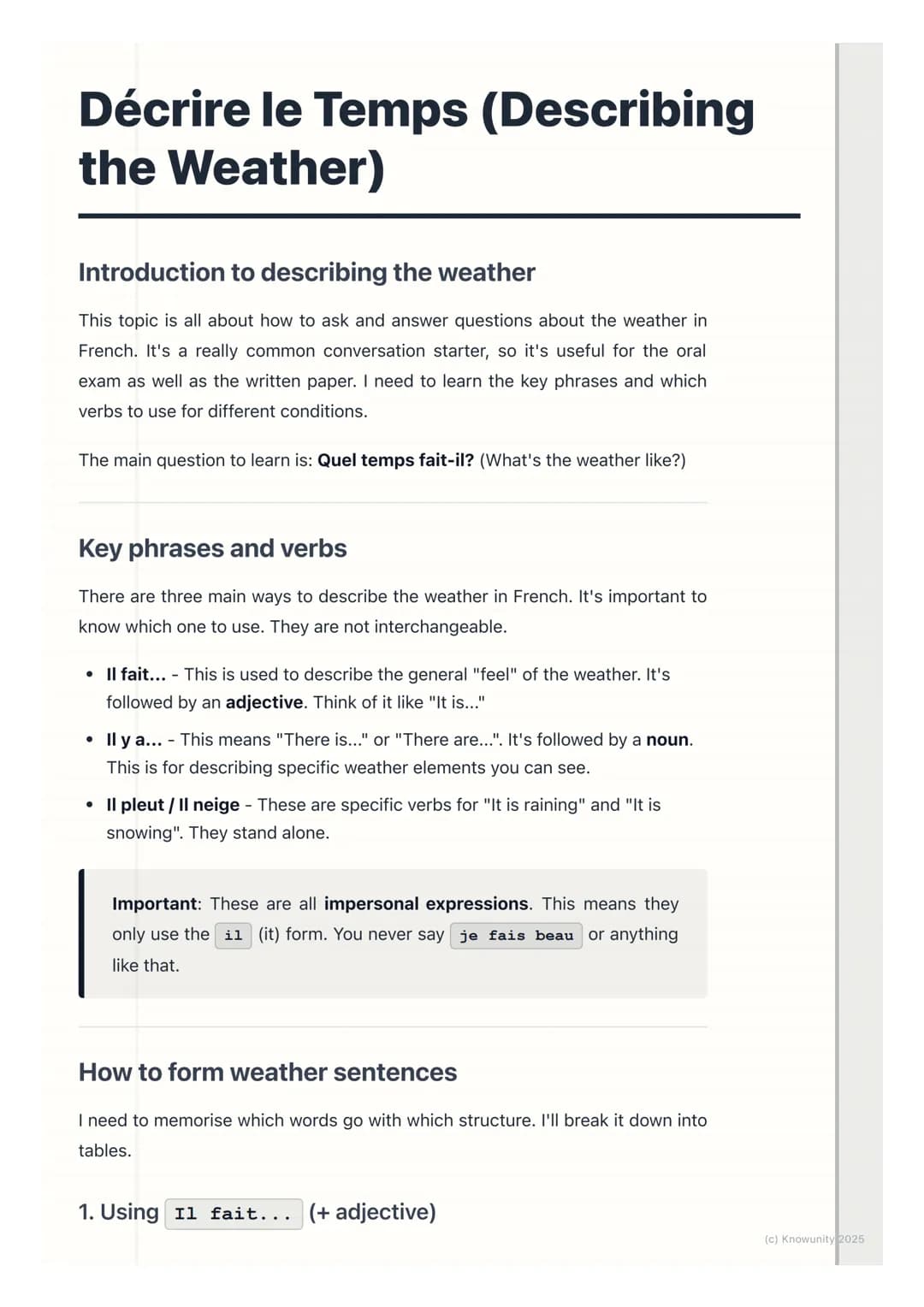
Getting Started with Weather Questions
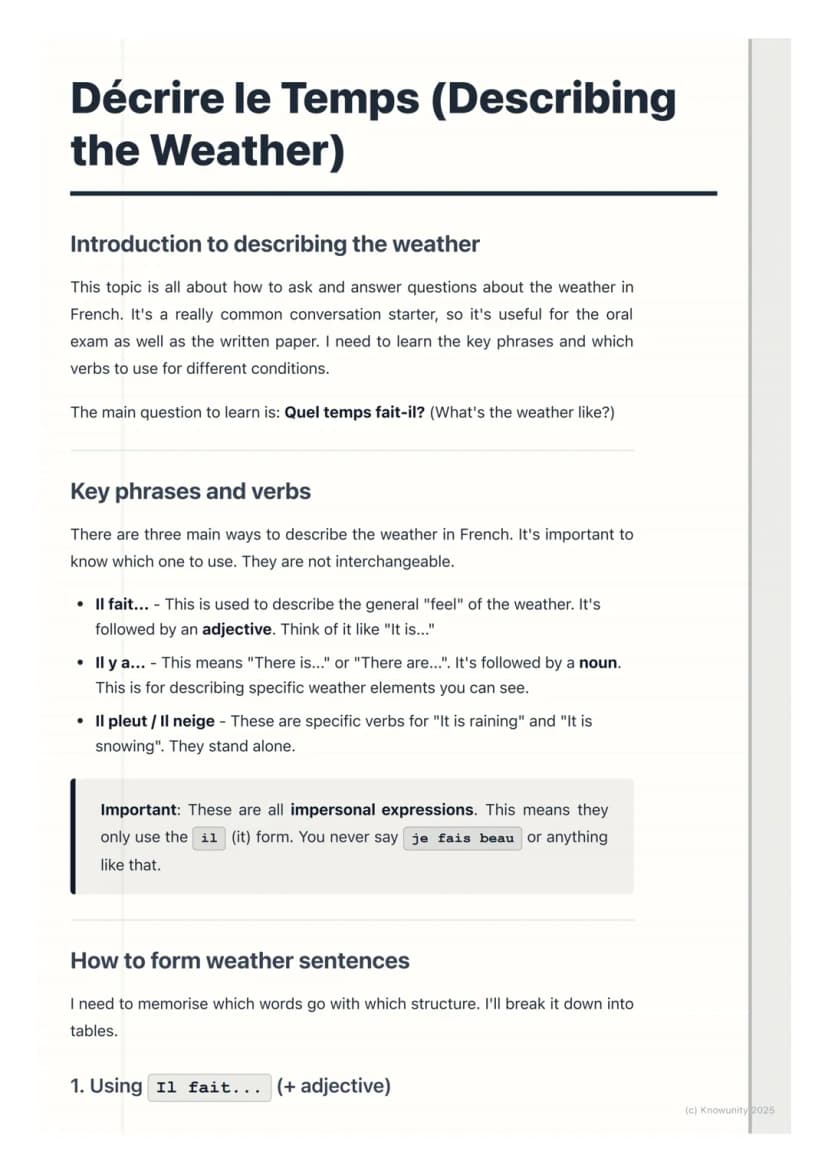
The magic question you need to know is "Quel temps fait-il?" (What's the weather like?). This is your go-to phrase for starting weather conversations, and it's dead handy for oral exams too.
French has three main ways to describe weather, and they're not interchangeable - each has its own job. Think of them like different tools in a toolbox: Il fait... for general feelings, Il y a... for things you can see, and specific verbs like Il pleut for actions happening right now.
Here's the crucial bit: these are all impersonal expressions. That means they only work with "il" (it) - you'd never say "je fais beau" or anything mad like that! It's always about "it" doing the weather.
Quick Tip: Think of weather as something that just "happens" - it's never about you personally doing the weather!
2
of 6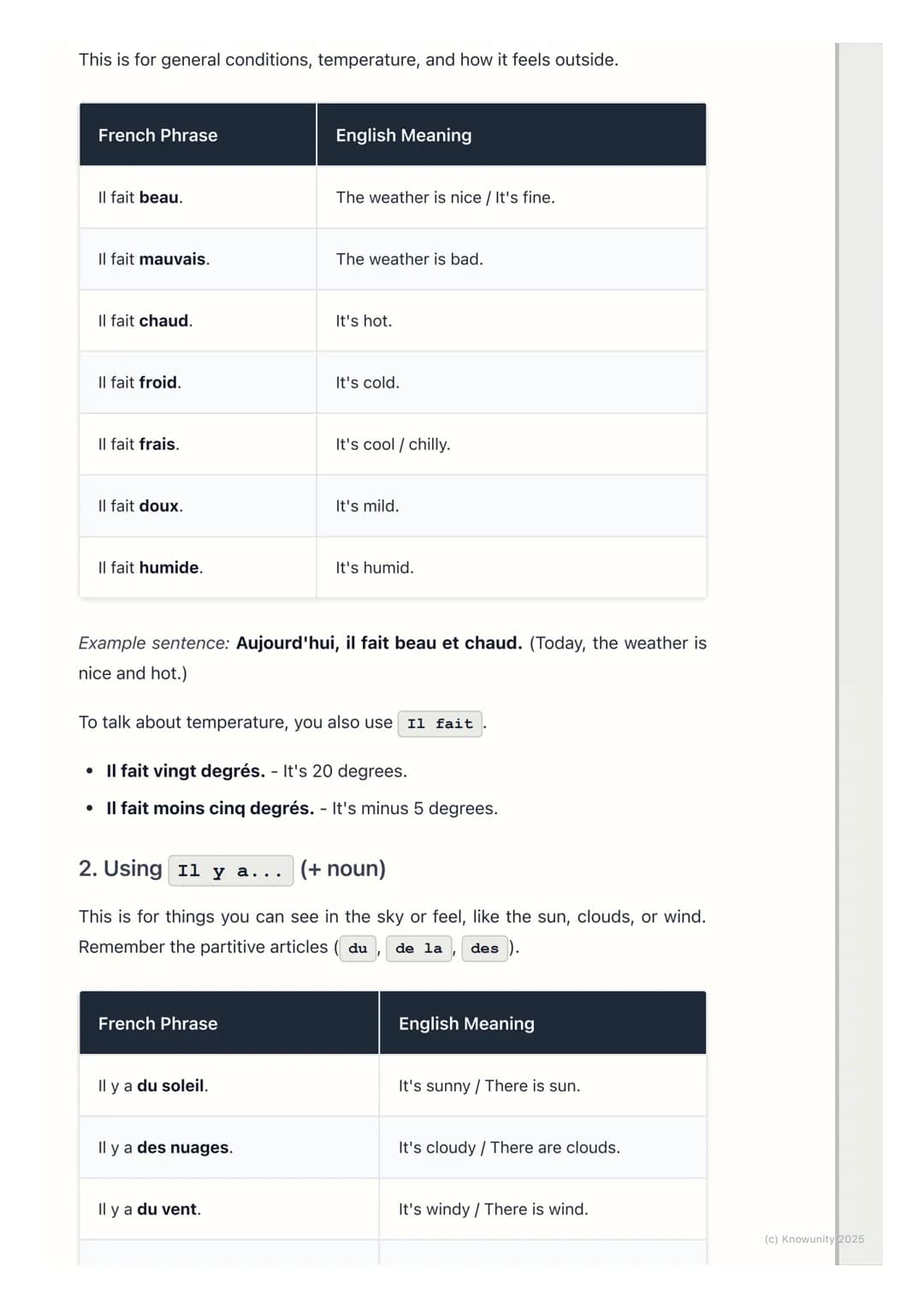
Structure 1: Il fait + Adjective
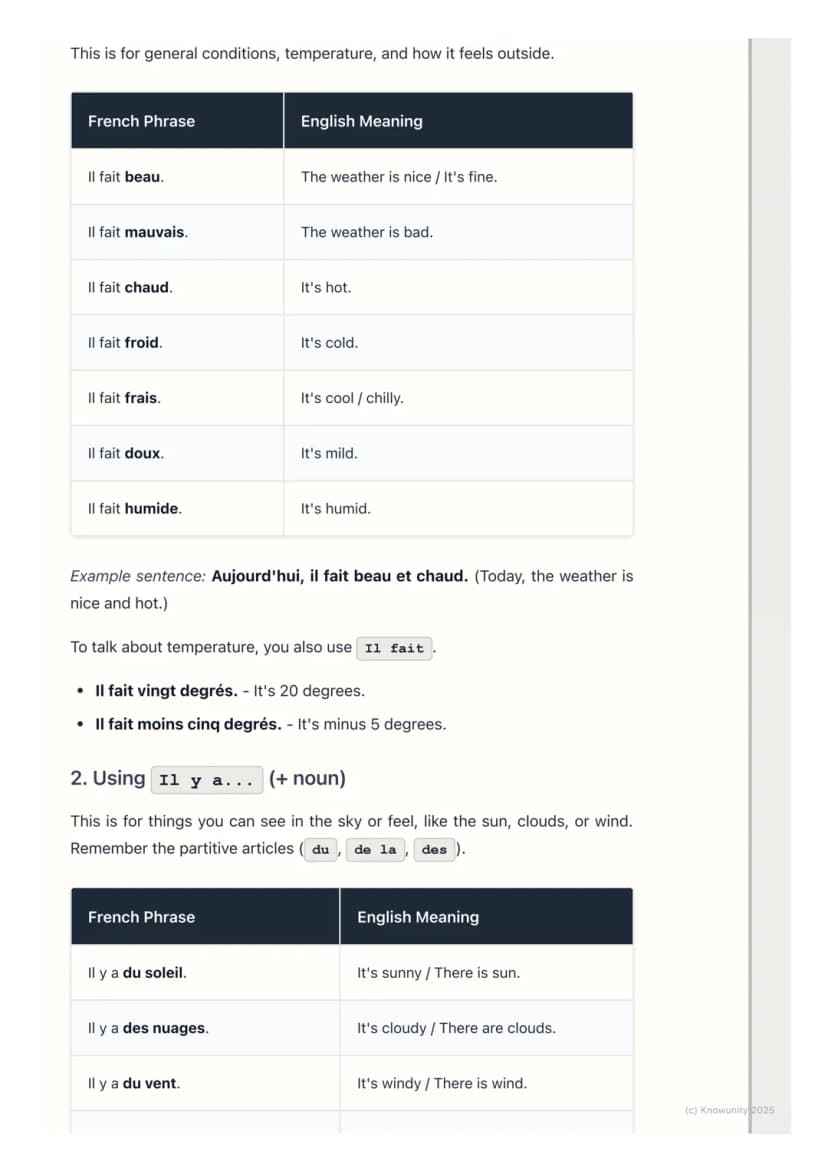
When you want to describe how the weather feels generally, use Il fait followed by an adjective. This covers temperature and the overall vibe of the day.
Il fait beau (nice weather), Il fait mauvais (bad weather), Il fait chaud (hot), Il fait froid (cold), Il fait frais (cool), and Il fait doux (mild) are your essential phrases. For example: "Aujourd'hui, il fait beau et chaud" (Today, it's nice and hot).
Temperature is dead simple with this structure too. Il fait vingt degrés (It's 20 degrees) or Il fait moins cinq degrés (It's minus 5 degrees). Just stick the number after "Il fait" and you're sorted.
Remember: These adjectives never change form - no worrying about masculine/feminine endings here!
3
of 6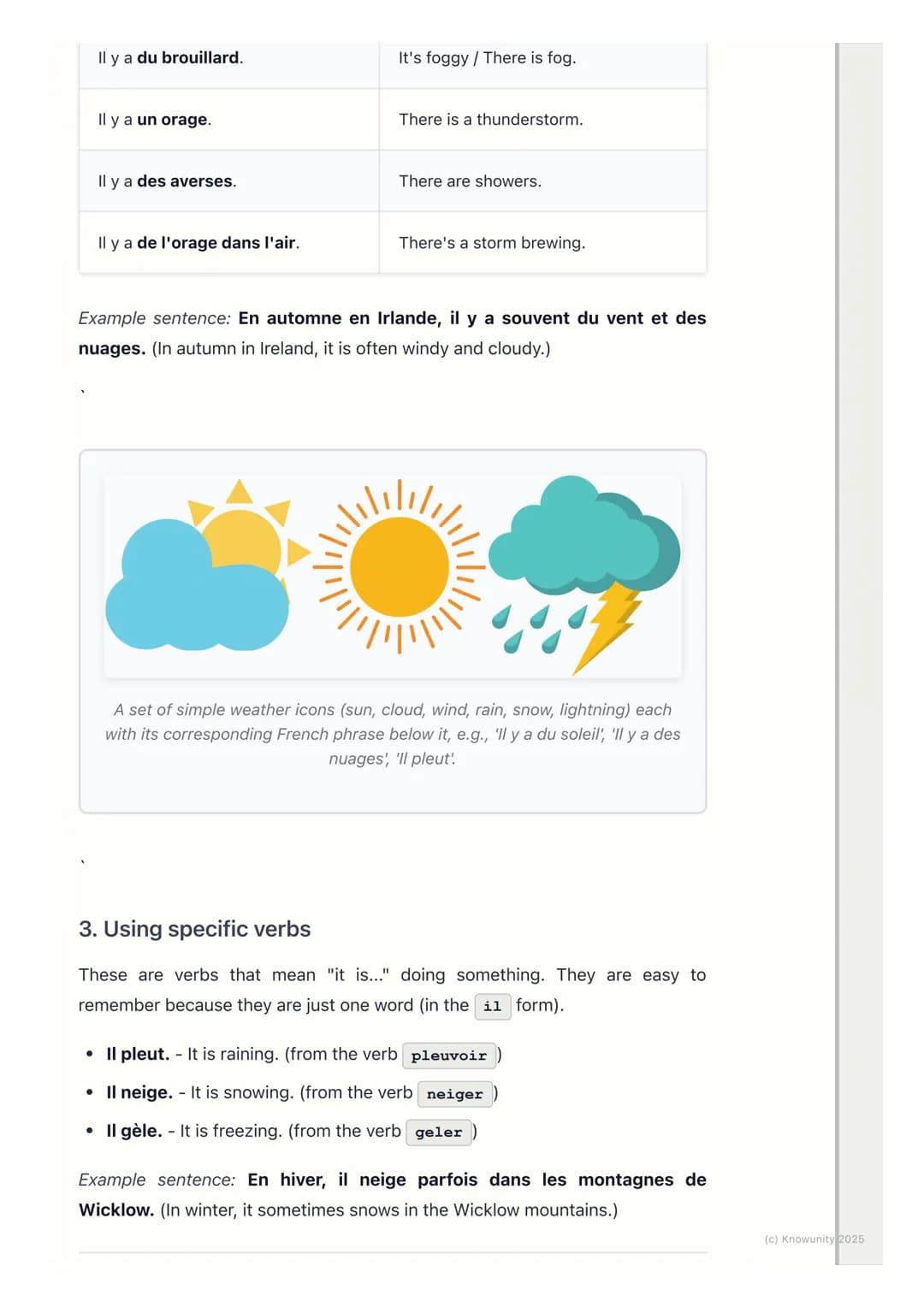
Structure 2: Il y a + Noun
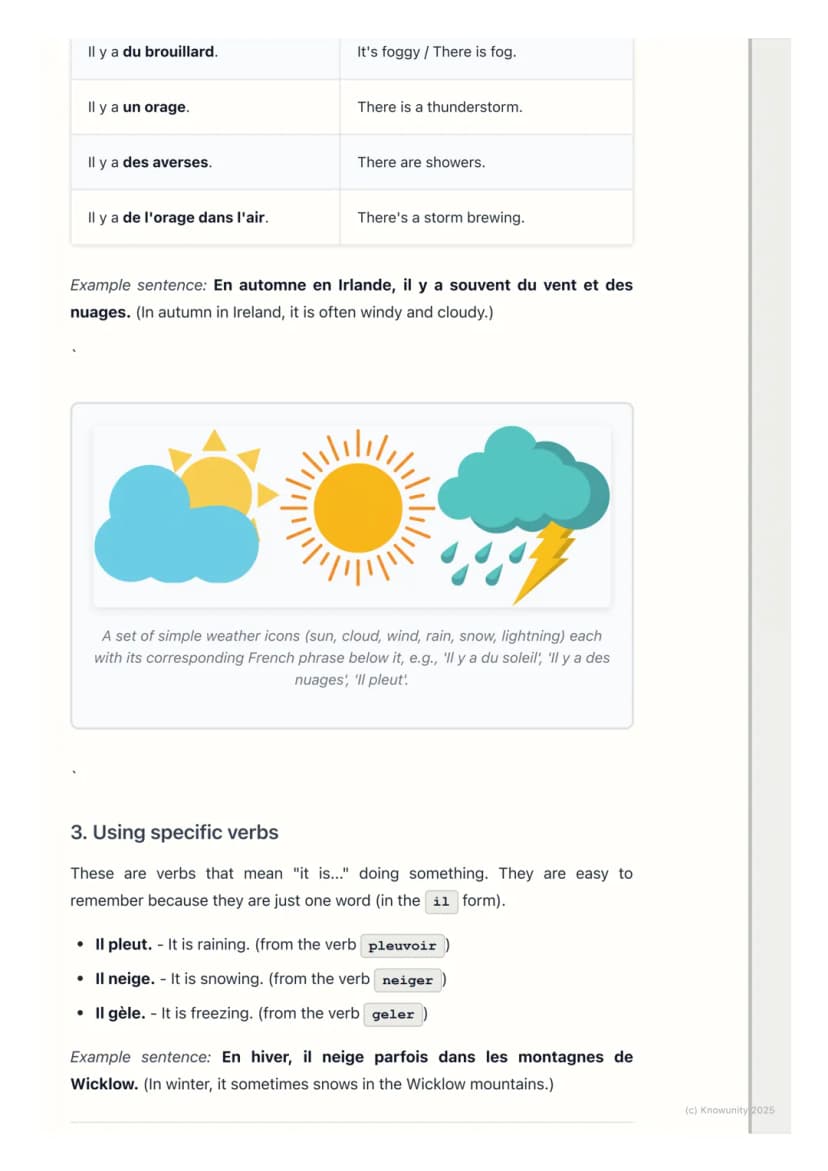
Use Il y a when describing specific weather elements you can actually see or feel - like sun, clouds, or wind. Remember your partitive articles: du, de la, des!
Il y a du soleil (it's sunny), Il y a des nuages (it's cloudy), Il y a du vent (it's windy), and Il y a du brouillard (it's foggy) are brilliant for painting a picture of what's happening outside. You can also say Il y a un orage (there's a thunderstorm) or Il y a des averses (there are showers).
Try this example: "En automne en Irlande, il y a souvent du vent et des nuages" (In autumn in Ireland, it's often windy and cloudy). Dead accurate for Irish weather!
Top Tip: If you can point at it in the sky or feel it on your face, use "Il y a"!
4
of 6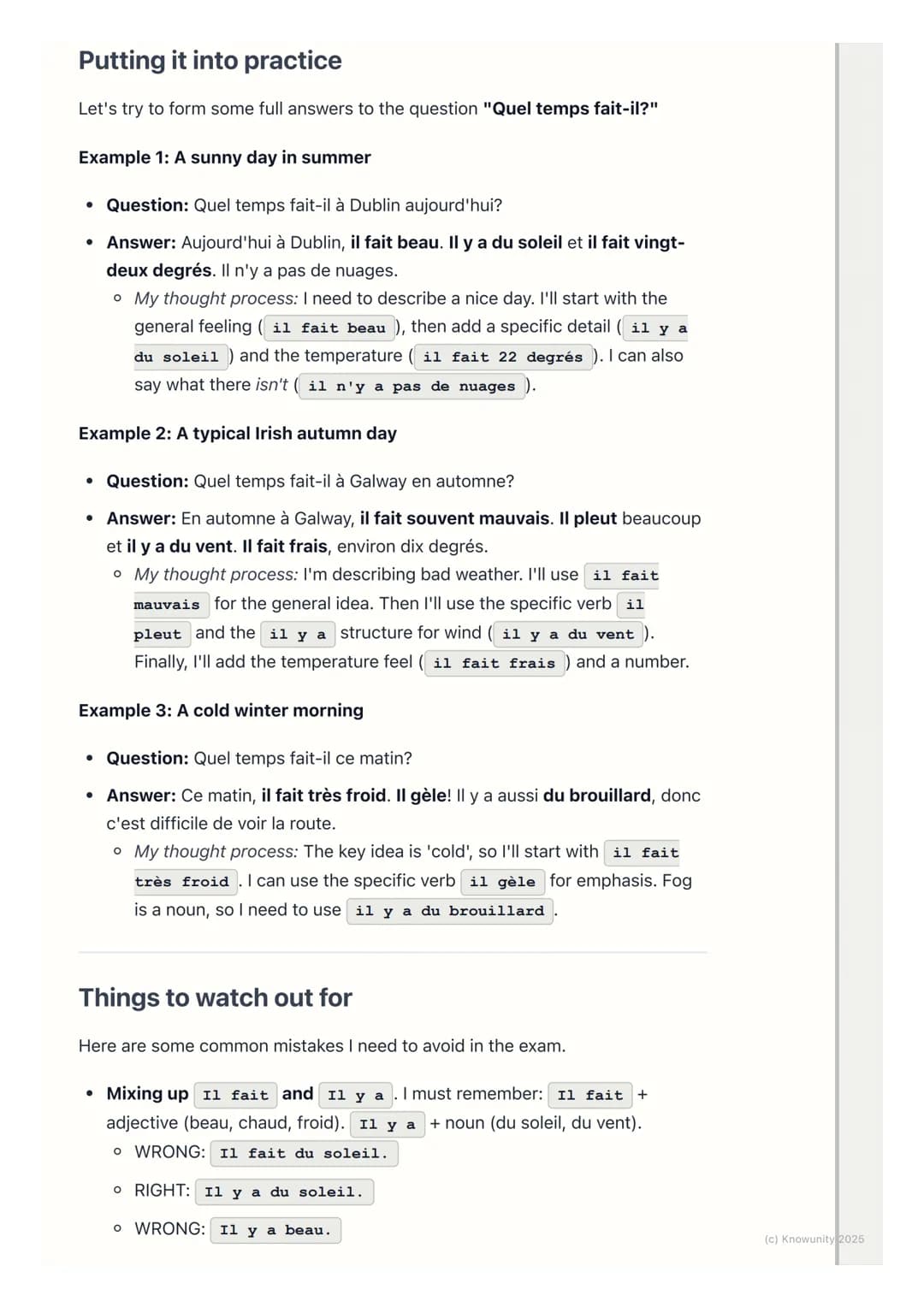
Structure 3: Specific Weather Verbs
Some weather conditions get their own special verbs - these are one-word wonders that pack a punch! The big three are Il pleut (it's raining), Il neige (it's snowing), and Il gèle (it's freezing).
These verbs come from pleuvoir, neiger, and geler, but you only need to remember the "il" form. They're perfect for describing active weather that's happening right now.
Here's a proper Irish example: "En hiver, il neige parfois dans les montagnes de Wicklow" (In winter, it sometimes snows in the Wicklow mountains). These verbs make your French sound natural and confident.
Don't mix these up with "Il y a de la pluie" - while that's technically correct, saying Il pleut is much more common and sounds way better!
Watch Out: Don't say "Il y a de la pluie" when "Il pleut" does the job perfectly!
5
of 6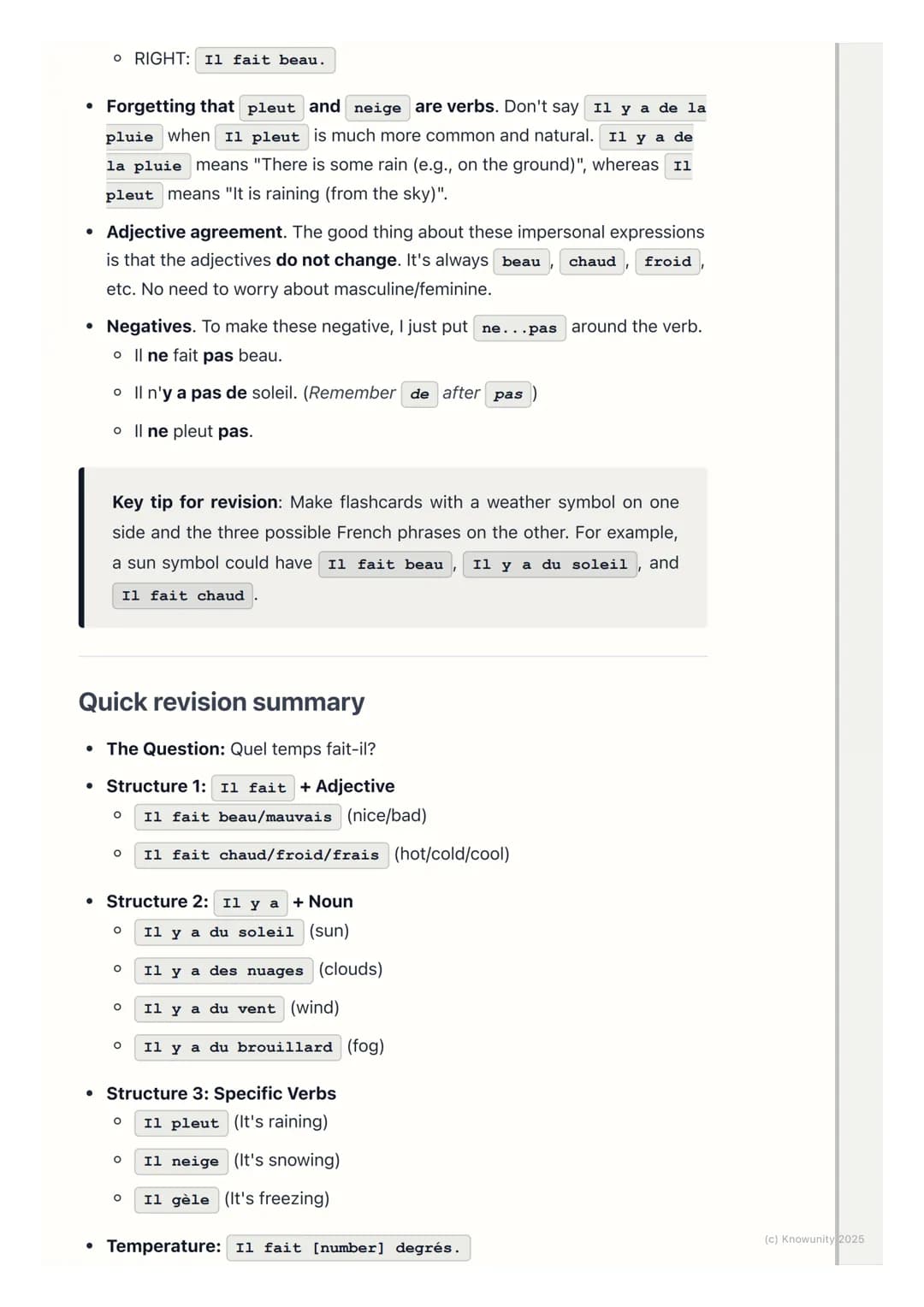
Putting It All Together
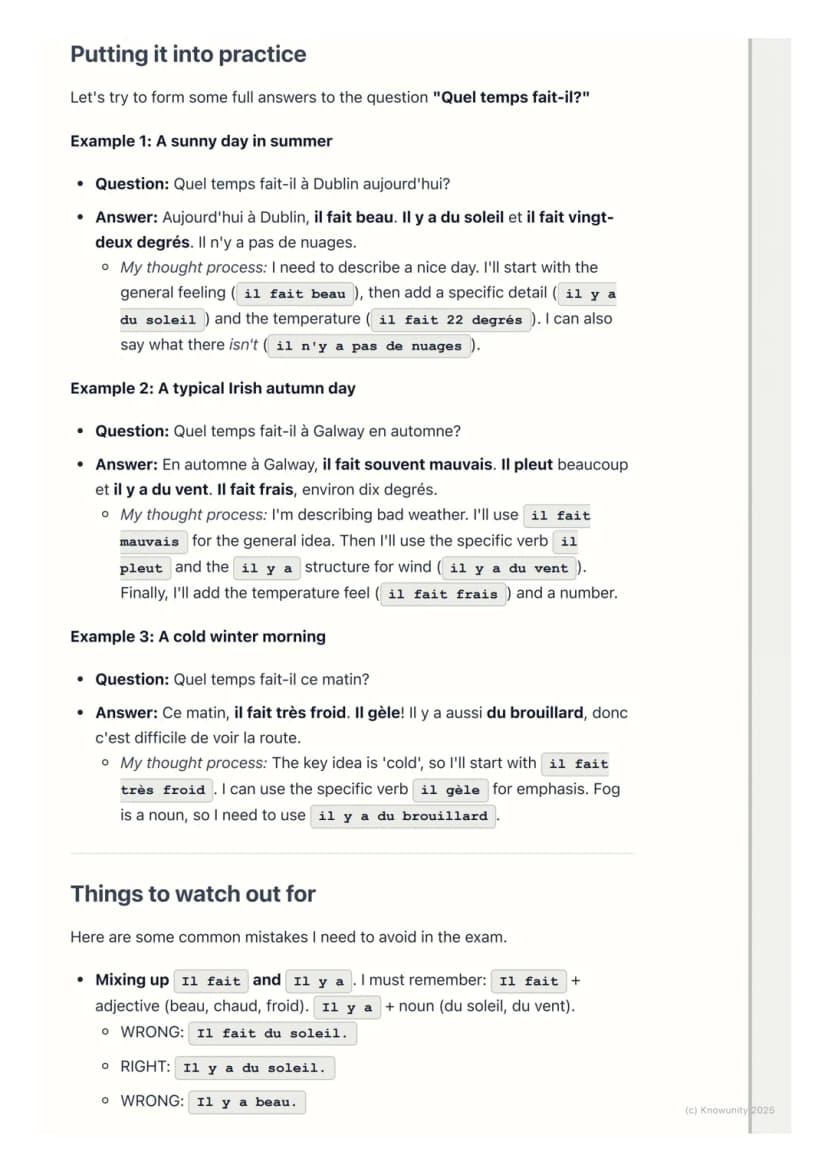
Now let's build some proper answers to "Quel temps fait-il?" that'll impress in your exams! Start with the general feel, add specific details, then mention temperature.
For a lovely summer day: "Aujourd'hui à Dublin, il fait beau. Il y a du soleil et il fait vingt-deux degrés. Il n'y a pas de nuages." You're mixing all three structures like a pro!
For typical Irish autumn weather: "En automne à Galway, il fait souvent mauvais. Il pleut beaucoup et il y a du vent. Il fait frais, environ dix degrés." Perfect for describing our lovely Irish climate!
The key is layering your descriptions - don't just stick to one structure. Mix them up to create rich, detailed answers that show off your French skills brilliantly.
Exam Gold: Always start with the general feel (Il fait...), then add what you can see (Il y a...), and finish with specific actions or temperature!
6
of 6
そんなこと聞いてくれるのを待ってたよ...
KnowunityのAIコンパニオンとは?
KnowunityのAIコンパニオンは学生向けに設計されたAIツールで、単なる答えを提供するだけではありません。数百万のKnowunityリソースを基に構築され、関連する情報、個別の学習プラン、クイズ、コンテンツをチャット内で直接提供し、あなたの個別の学習過程に適応します。
Knowunityアプリはどこでダウンロードできますか?
Google Play StoreとApple App Storeからアプリをダウンロードできます。
Knowunityは本当に無料ですか?
その通り!学習コンテンツへの無料アクセス、仲間の学生とのつながり、そして即座のサポートを手のひらで楽しもう。
Frenchの人気コンテンツ
2人気コンテンツ
9 Irish
IrishIrish oral questions and answers
Questions and answers for the leaving cert oral
5th Year4264
 English
Key Quotes : Sive
Key Quotes and explanations: Sive
6th Year2842
IrishIrish oral questions
Outline of oral questions
5th Year2055
IrishIníon- le hÁine Durkin
Aine Durkin’s poem, Iníon: Themes & summary
5th Year850
IrishIrish poetry 2027
Iníon + Dínit an Bhróin
5th Year1133
IrishLC HL notes- Iníon (poem)
Includes poem in English and Irish, theme, key words & phrases
5th Year2284
EnglishCultural Context : Shawshank Redemption : Sive : Small Things Like These
Comparative Study : Cultural Context : Shawshank Redemption, Sive and Small Things Like These
6th Year1430
IrishMo Ghrá-sa (Idir Lúibíní)
Notes on mo ghrá-sa
5th Year380
IrishAn Gaeilge Aiste
Irish Language essay
6th Year1320
探しているものが見つからない?他の教科も見てみよう。
生徒たちが愛用中 — あなたもきっと気に入るはず。
4.6/5App Store
4.7/5Google Play
このアプリはとても使いやすくて、デザインも良いです。今のところ探していたものは全て見つかったし、プレゼン資料からもたくさん学べました!絶対に課題でも使いたいと思います!もちろん、アイデアを得るのにもすごく役立ちます。
Stefan SiOSユーザー
このアプリは本当に素晴らしいです。学習ノートやサポート資料がとても豊富で[...]。例えば、私の苦手科目はフランス語なんですが、このアプリにはサポートオプションがたくさんあります。このアプリのおかげでフランス語が上達しました。誰にでもおすすめしたいです。
Samantha KlichAndroidユーザー
すごい、本当に驚いた。広告で何度も見かけたからアプリを試してみたら、めちゃくちゃ感動した。このアプリは学校で欲しかった「まさにこれ!」って感じのサポートで、特に練習問題や要点まとめみたいな機能がたくさんあって、個人的にすごく助かってる。
AnnaiOSユーザー
French2 閲覧数·更新日 Jun 12, 2026·6 ページParler du Temps: Expressions Météorologiques
Weather talk is everywhere in Ireland, so mastering French weather expressions is brilliant for both your exams and real conversations! You'll learn the three main ways to describe weather in French, plus loads of useful phrases that'll make you sound... もっと見る
1
of 6サインアップしてコンテンツを見よう。無料だよ!
- 全ドキュメントへのアクセス
- 成績アップ
- 数百万人の学生と一緒に学習
Getting Started with Weather Questions
The magic question you need to know is "Quel temps fait-il?" (What's the weather like?). This is your go-to phrase for starting weather conversations, and it's dead handy for oral exams too.
French has three main ways to describe weather, and they're not interchangeable - each has its own job. Think of them like different tools in a toolbox: Il fait... for general feelings, Il y a... for things you can see, and specific verbs like Il pleut for actions happening right now.
Here's the crucial bit: these are all impersonal expressions. That means they only work with "il" (it) - you'd never say "je fais beau" or anything mad like that! It's always about "it" doing the weather.
Quick Tip: Think of weather as something that just "happens" - it's never about you personally doing the weather!
2
of 6サインアップしてコンテンツを見よう。無料だよ!
- 全ドキュメントへのアクセス
- 成績アップ
- 数百万人の学生と一緒に学習
Structure 1: Il fait + Adjective
When you want to describe how the weather feels generally, use Il fait followed by an adjective. This covers temperature and the overall vibe of the day.
Il fait beau (nice weather), Il fait mauvais (bad weather), Il fait chaud (hot), Il fait froid (cold), Il fait frais (cool), and Il fait doux (mild) are your essential phrases. For example: "Aujourd'hui, il fait beau et chaud" (Today, it's nice and hot).
Temperature is dead simple with this structure too. Il fait vingt degrés (It's 20 degrees) or Il fait moins cinq degrés (It's minus 5 degrees). Just stick the number after "Il fait" and you're sorted.
Remember: These adjectives never change form - no worrying about masculine/feminine endings here!
3
of 6サインアップしてコンテンツを見よう。無料だよ!
- 全ドキュメントへのアクセス
- 成績アップ
- 数百万人の学生と一緒に学習
Structure 2: Il y a + Noun
Use Il y a when describing specific weather elements you can actually see or feel - like sun, clouds, or wind. Remember your partitive articles: du, de la, des!
Il y a du soleil (it's sunny), Il y a des nuages (it's cloudy), Il y a du vent (it's windy), and Il y a du brouillard (it's foggy) are brilliant for painting a picture of what's happening outside. You can also say Il y a un orage (there's a thunderstorm) or Il y a des averses (there are showers).
Try this example: "En automne en Irlande, il y a souvent du vent et des nuages" (In autumn in Ireland, it's often windy and cloudy). Dead accurate for Irish weather!
Top Tip: If you can point at it in the sky or feel it on your face, use "Il y a"!
4
of 6サインアップしてコンテンツを見よう。無料だよ!
- 全ドキュメントへのアクセス
- 成績アップ
- 数百万人の学生と一緒に学習
Structure 3: Specific Weather Verbs
Some weather conditions get their own special verbs - these are one-word wonders that pack a punch! The big three are Il pleut (it's raining), Il neige (it's snowing), and Il gèle (it's freezing).
These verbs come from pleuvoir, neiger, and geler, but you only need to remember the "il" form. They're perfect for describing active weather that's happening right now.
Here's a proper Irish example: "En hiver, il neige parfois dans les montagnes de Wicklow" (In winter, it sometimes snows in the Wicklow mountains). These verbs make your French sound natural and confident.
Don't mix these up with "Il y a de la pluie" - while that's technically correct, saying Il pleut is much more common and sounds way better!
Watch Out: Don't say "Il y a de la pluie" when "Il pleut" does the job perfectly!
5
of 6サインアップしてコンテンツを見よう。無料だよ!
- 全ドキュメントへのアクセス
- 成績アップ
- 数百万人の学生と一緒に学習
Putting It All Together
Now let's build some proper answers to "Quel temps fait-il?" that'll impress in your exams! Start with the general feel, add specific details, then mention temperature.
For a lovely summer day: "Aujourd'hui à Dublin, il fait beau. Il y a du soleil et il fait vingt-deux degrés. Il n'y a pas de nuages." You're mixing all three structures like a pro!
For typical Irish autumn weather: "En automne à Galway, il fait souvent mauvais. Il pleut beaucoup et il y a du vent. Il fait frais, environ dix degrés." Perfect for describing our lovely Irish climate!
The key is layering your descriptions - don't just stick to one structure. Mix them up to create rich, detailed answers that show off your French skills brilliantly.
Exam Gold: Always start with the general feel (Il fait...), then add what you can see (Il y a...), and finish with specific actions or temperature!
6
of 6サインアップしてコンテンツを見よう。無料だよ!
- 全ドキュメントへのアクセス
- 成績アップ
- 数百万人の学生と一緒に学習
そんなこと聞いてくれるのを待ってたよ...
KnowunityのAIコンパニオンとは?
KnowunityのAIコンパニオンは学生向けに設計されたAIツールで、単なる答えを提供するだけではありません。数百万のKnowunityリソースを基に構築され、関連する情報、個別の学習プラン、クイズ、コンテンツをチャット内で直接提供し、あなたの個別の学習過程に適応します。
Knowunityアプリはどこでダウンロードできますか?
Google Play StoreとApple App Storeからアプリをダウンロードできます。
Knowunityは本当に無料ですか?
その通り!学習コンテンツへの無料アクセス、仲間の学生とのつながり、そして即座のサポートを手のひらで楽しもう。
Frenchの人気コンテンツ
2人気コンテンツ
9IrishIrish oral questions and answers
Questions and answers for the leaving cert oral
5th Year4264
EnglishKey Quotes : Sive
Key Quotes and explanations: Sive
6th Year2842
IrishIrish oral questions
Outline of oral questions
5th Year2055
IrishIníon- le hÁine Durkin
Aine Durkin’s poem, Iníon: Themes & summary
5th Year850
IrishIrish poetry 2027
Iníon + Dínit an Bhróin
5th Year1133
IrishLC HL notes- Iníon (poem)
Includes poem in English and Irish, theme, key words & phrases
5th Year2284
EnglishCultural Context : Shawshank Redemption : Sive : Small Things Like These
Comparative Study : Cultural Context : Shawshank Redemption, Sive and Small Things Like These
6th Year1430
IrishMo Ghrá-sa (Idir Lúibíní)
Notes on mo ghrá-sa
5th Year380
IrishAn Gaeilge Aiste
Irish Language essay
6th Year1320
探しているものが見つからない?他の教科も見てみよう。
生徒たちが愛用中 — あなたもきっと気に入るはず。
4.6/5App Store
4.7/5Google Play
このアプリはとても使いやすくて、デザインも良いです。今のところ探していたものは全て見つかったし、プレゼン資料からもたくさん学べました!絶対に課題でも使いたいと思います!もちろん、アイデアを得るのにもすごく役立ちます。
Stefan SiOSユーザー
このアプリは本当に素晴らしいです。学習ノートやサポート資料がとても豊富で[...]。例えば、私の苦手科目はフランス語なんですが、このアプリにはサポートオプションがたくさんあります。このアプリのおかげでフランス語が上達しました。誰にでもおすすめしたいです。
Samantha KlichAndroidユーザー
すごい、本当に驚いた。広告で何度も見かけたからアプリを試してみたら、めちゃくちゃ感動した。このアプリは学校で欲しかった「まさにこれ!」って感じのサポートで、特に練習問題や要点まとめみたいな機能がたくさんあって、個人的にすごく助かってる。
AnnaiOSユーザー