
Ever wonder why you don't float off into space when...
 Engineering16 閲覧数·更新日 Jun 5, 2026·5 ページ
Understanding Gravity and Friction: Key Concepts
1 / 5
1
of 5
Introduction to Forces
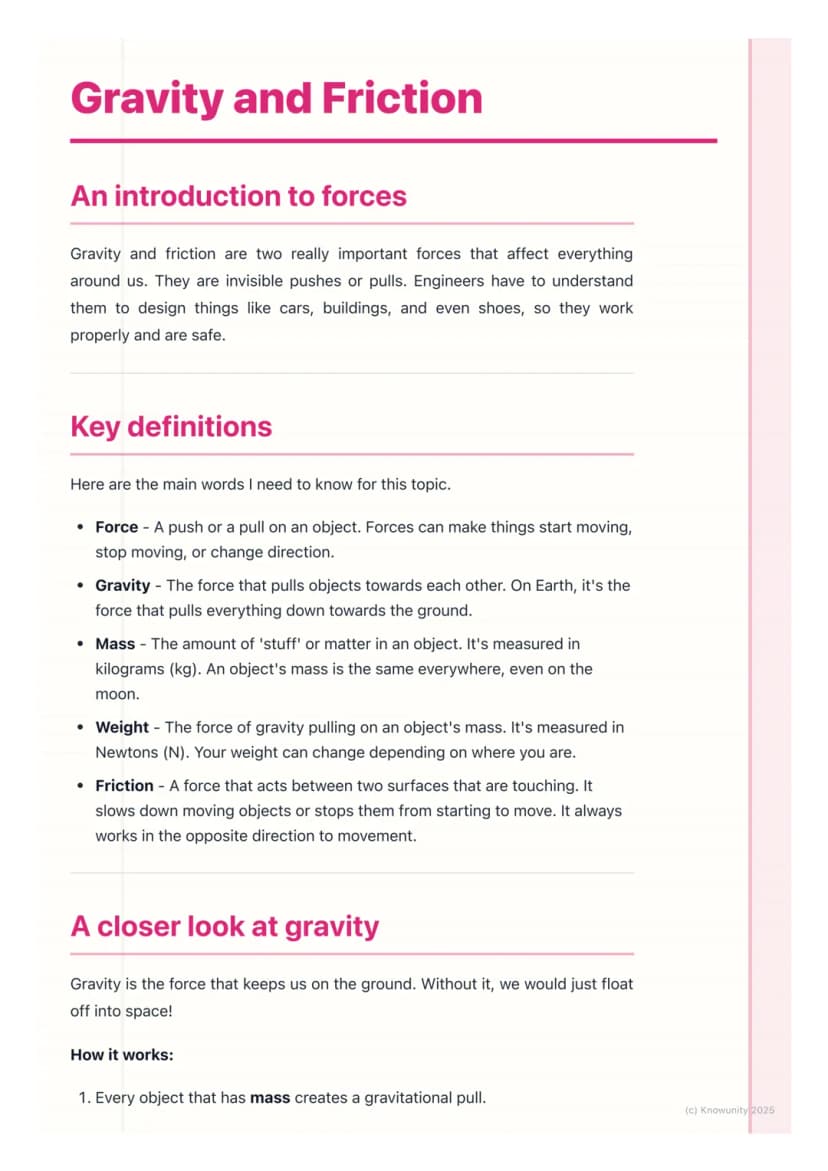
You can't see them, but forces are constantly pushing and pulling everything around you! These invisible forces make things start moving, stop moving, or change direction completely.
Gravity is the force that keeps your feet on the ground and makes things fall down towards Earth. Friction happens when surfaces rub together - it's what stops you from sliding around like you're on ice all the time.
Engineers need to understand these forces brilliantly to design safe cars, sturdy buildings, and even the trainers on your feet. Once you get how these work, you'll start spotting them everywhere!
Quick Tip: Think of forces as invisible hands that are always pushing or pulling objects - even when nothing seems to be happening!
2
of 5
How Gravity Actually Works
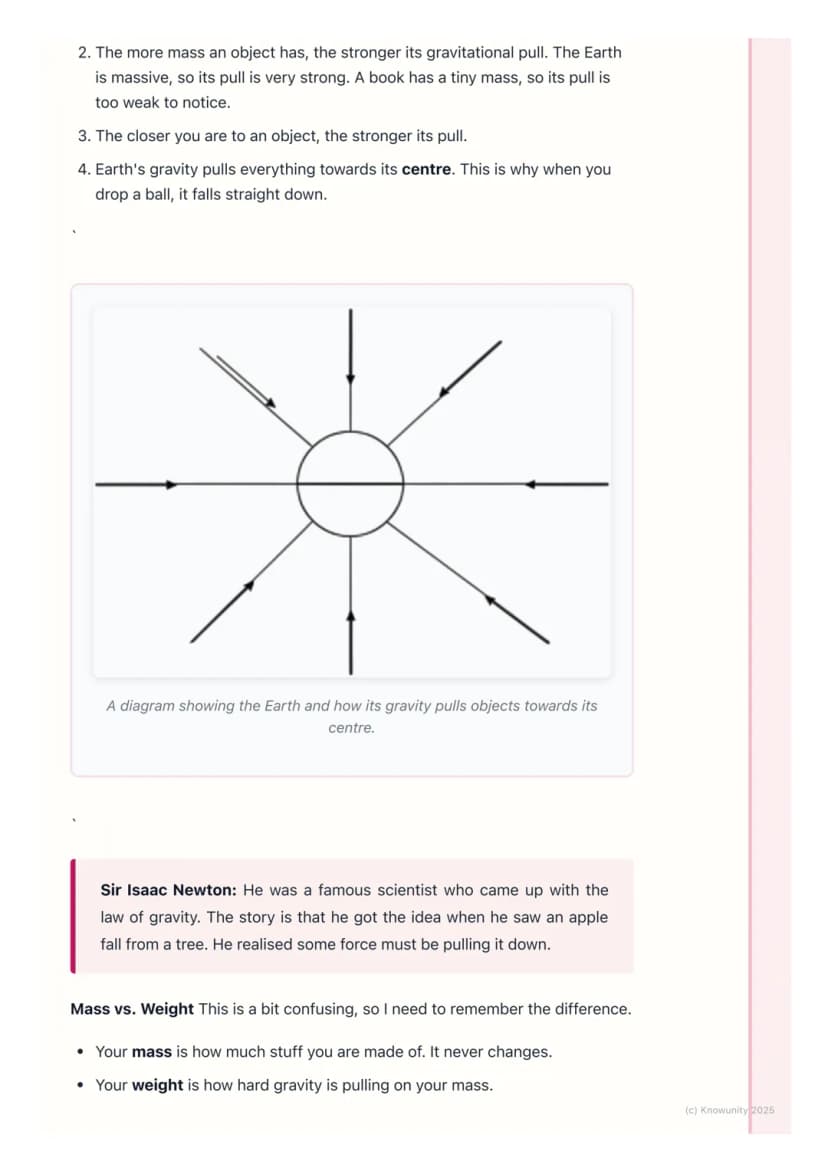
Here's the mad thing about gravity - every single object that has mass (the amount of stuff it's made of) pulls on every other object! Earth is absolutely massive, so its gravitational pull is incredibly strong.
The closer you are to something, the stronger the pull gets. That's why when you drop your phone, it falls straight down towards Earth's centre rather than floating sideways.
Mass versus weight trips up loads of students, but it's actually dead simple. Your mass (measured in kg) never changes - you're made of the same amount of stuff whether you're in Dublin or on the Moon. Your weight (measured in Newtons) is just how hard gravity pulls on that mass.
On the Moon, you'd weigh about six times less than on Earth, but you'd still be exactly the same person with the same mass!
Remember: Sir Isaac Newton figured out gravity when he saw an apple fall - sometimes the best discoveries come from noticing everyday things!
3
of 5
Understanding Friction
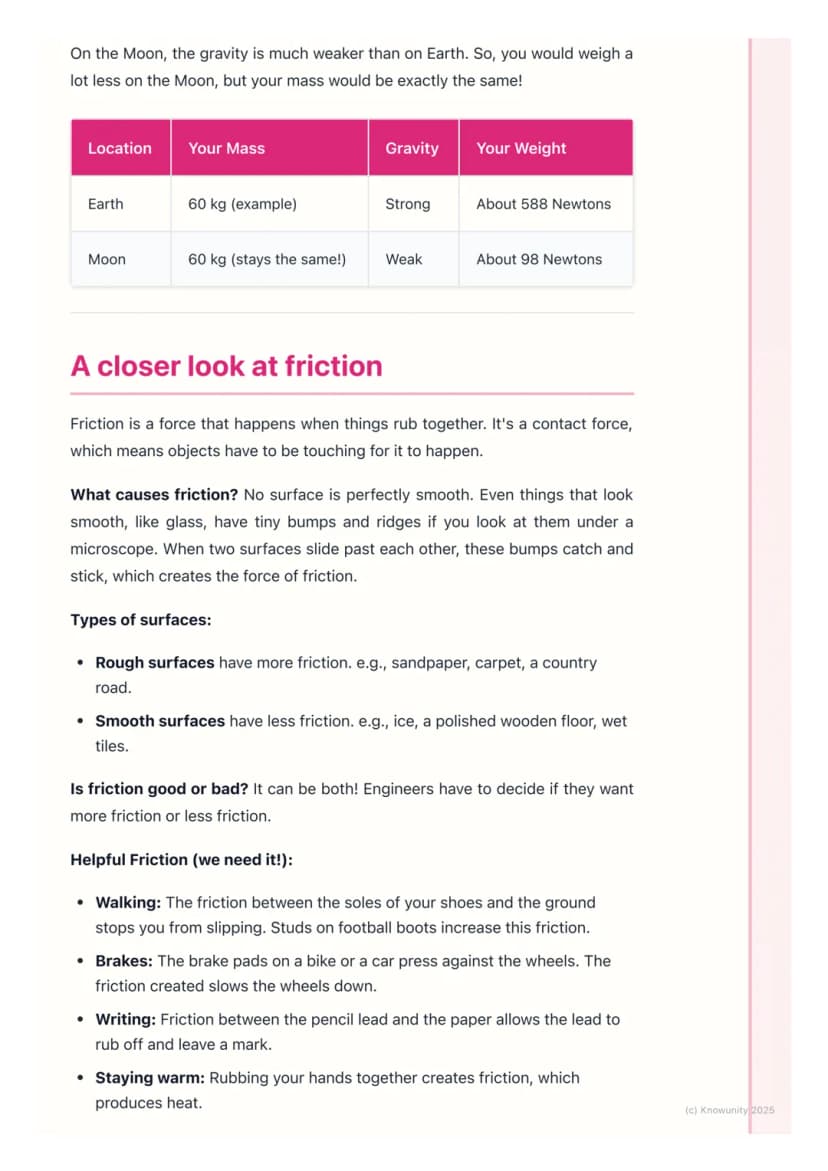
Friction is the force you feel when surfaces rub together, and it always works against movement. Even surfaces that look perfectly smooth have tiny bumps and ridges that catch and stick when they slide past each other.
Rough surfaces like sandpaper or a football pitch create loads of friction. Smooth surfaces like ice or wet tiles have much less friction - that's why they're so slippery!
Sometimes friction is brilliant and sometimes it's a right pain. You absolutely need it for walking (without it, you'd slip constantly), using brakes on your bike, or even writing with a pencil. But friction also wears out your shoes and makes it harder to push heavy things around.
Engineers get really clever about this - they add oil to engine parts to reduce unwanted friction, but they make car tyres rough to increase helpful friction with the road.
Key Point: Friction always pushes in the opposite direction to movement - if something slides right, friction pushes it left!
4
of 5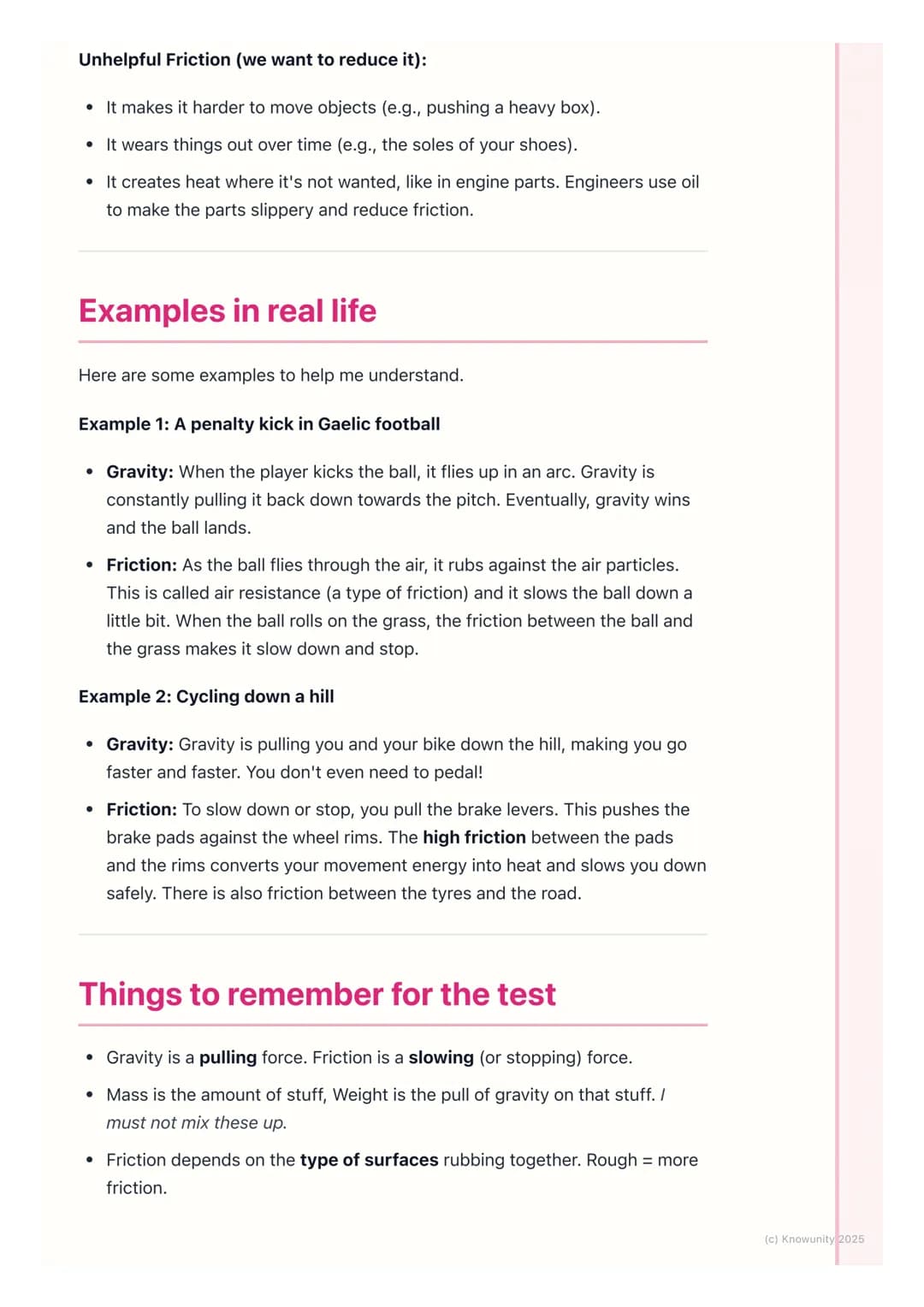
Real-Life Examples
Picture a penalty kick in Gaelic football. When the ball leaves the player's boot, gravity immediately starts pulling it back down towards the pitch. Meanwhile, air resistance (a type of friction) slows the ball down as it flies through the air.
When you're cycling down a hill, gravity pulls you faster and faster - you don't even need to pedal! To slow down safely, you squeeze the brake levers, which creates loads of friction between the brake pads and your wheel rims.
These forces work together constantly. Gravity might be pulling a book off your desk, but friction between the book and the desk surface keeps it in place. It's like an invisible tug-of-war happening all around you!
Every sport, every form of transport, and every simple task like walking involves these two forces working either together or against each other.
Think About It: Next time you're walking on different surfaces, notice how your shoes grip differently - that's friction changing with the surface type!
5
of 5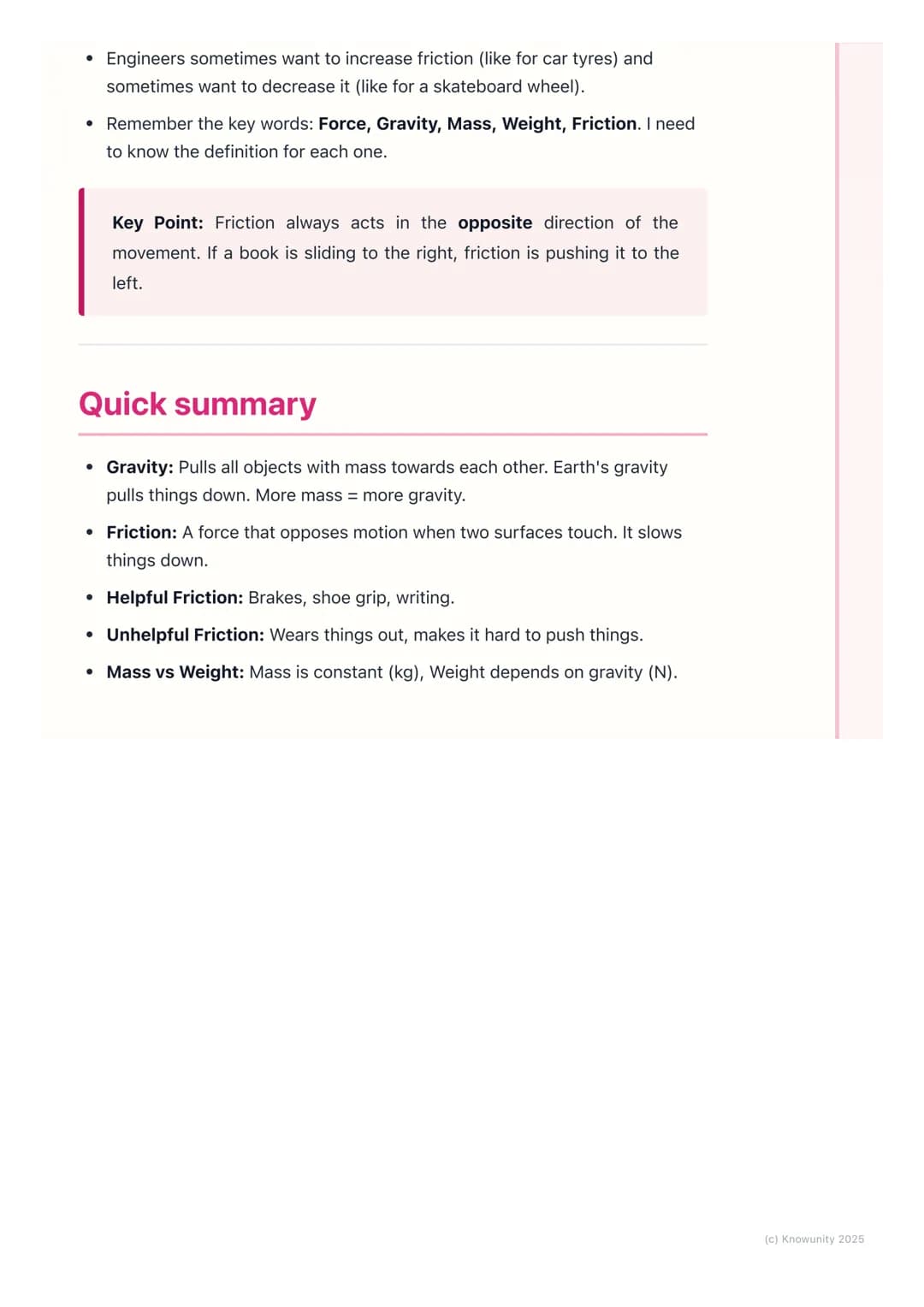
Key Points for Tests
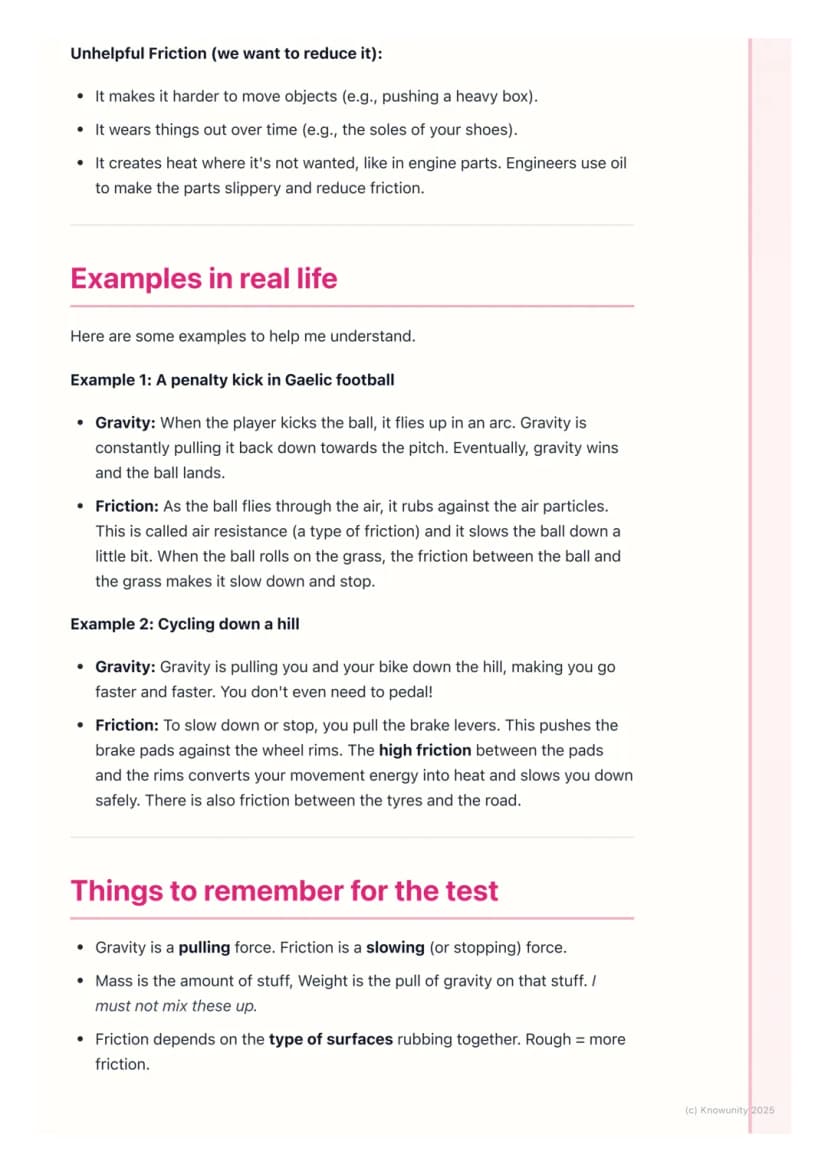
Remember that gravity always pulls objects together (on Earth, that means downwards), while friction always opposes movement between touching surfaces. Don't mix up mass and weight - mass stays constant, but weight changes depending on gravity's strength.
The type of surface makes a huge difference to friction. Engineers sometimes want more friction (like football boot studs) and sometimes want less (like skateboard wheels). Both forces are essential for understanding how things move in the real world.
For your exams, make sure you can define these terms clearly: Force (push or pull), Gravity (pulls objects towards each other), Mass (amount of matter in kg), Weight (gravity's pull measured in Newtons), and Friction (opposes motion between surfaces).
These concepts aren't just for tests though - they explain why your world works the way it does, from why you can walk without slipping to why things eventually stop moving when you let them go.
Exam Success: Practice explaining these forces using everyday examples - it makes them much easier to remember and understand!
そんなこと聞いてくれるのを待ってたよ...
KnowunityのAIコンパニオンとは?
KnowunityのAIコンパニオンは学生向けに設計されたAIツールで、単なる答えを提供するだけではありません。数百万のKnowunityリソースを基に構築され、関連する情報、個別の学習プラン、クイズ、コンテンツをチャット内で直接提供し、あなたの個別の学習過程に適応します。
Knowunityアプリはどこでダウンロードできますか?
Google Play StoreとApple App Storeからアプリをダウンロードできます。
Knowunityは本当に無料ですか?
その通り!学習コンテンツへの無料アクセス、仲間の学生とのつながり、そして即座のサポートを手のひらで楽しもう。
Engineeringの人気コンテンツ
1人気コンテンツ
9探しているものが見つからない?他の教科も見てみよう。
生徒たちが愛用中 — あなたもきっと気に入るはず。
4.6/5App Store
4.7/5Google Play
このアプリはとても使いやすくて、デザインも良いです。今のところ探していたものは全て見つかったし、プレゼン資料からもたくさん学べました!絶対に課題でも使いたいと思います!もちろん、アイデアを得るのにもすごく役立ちます。
Stefan SiOSユーザー
このアプリは本当に素晴らしいです。学習ノートやサポート資料がとても豊富で[...]。例えば、私の苦手科目はフランス語なんですが、このアプリにはサポートオプションがたくさんあります。このアプリのおかげでフランス語が上達しました。誰にでもおすすめしたいです。
Samantha KlichAndroidユーザー
すごい、本当に驚いた。広告で何度も見かけたからアプリを試してみたら、めちゃくちゃ感動した。このアプリは学校で欲しかった「まさにこれ!」って感じのサポートで、特に練習問題や要点まとめみたいな機能がたくさんあって、個人的にすごく助かってる。
AnnaiOSユーザー
Engineering16 閲覧数·更新日 Jun 5, 2026·5 ページUnderstanding Gravity and Friction: Key Concepts
Ever wonder why you don't float off into space when you jump, or why your shoes grip the ground when you walk? Two invisible forces called gravity and friction are working around you all the time, affecting everything from kicking...
1
of 5
サインアップしてコンテンツを見よう。無料だよ!
- 全ドキュメントへのアクセス
- 成績アップ
- 数百万人の学生と一緒に学習
Introduction to Forces
You can't see them, but forces are constantly pushing and pulling everything around you! These invisible forces make things start moving, stop moving, or change direction completely.
Gravity is the force that keeps your feet on the ground and makes things fall down towards Earth. Friction happens when surfaces rub together - it's what stops you from sliding around like you're on ice all the time.
Engineers need to understand these forces brilliantly to design safe cars, sturdy buildings, and even the trainers on your feet. Once you get how these work, you'll start spotting them everywhere!
Quick Tip: Think of forces as invisible hands that are always pushing or pulling objects - even when nothing seems to be happening!
2
of 5サインアップしてコンテンツを見よう。無料だよ!
- 全ドキュメントへのアクセス
- 成績アップ
- 数百万人の学生と一緒に学習
How Gravity Actually Works
Here's the mad thing about gravity - every single object that has mass (the amount of stuff it's made of) pulls on every other object! Earth is absolutely massive, so its gravitational pull is incredibly strong.
The closer you are to something, the stronger the pull gets. That's why when you drop your phone, it falls straight down towards Earth's centre rather than floating sideways.
Mass versus weight trips up loads of students, but it's actually dead simple. Your mass (measured in kg) never changes - you're made of the same amount of stuff whether you're in Dublin or on the Moon. Your weight (measured in Newtons) is just how hard gravity pulls on that mass.
On the Moon, you'd weigh about six times less than on Earth, but you'd still be exactly the same person with the same mass!
Remember: Sir Isaac Newton figured out gravity when he saw an apple fall - sometimes the best discoveries come from noticing everyday things!
3
of 5サインアップしてコンテンツを見よう。無料だよ!
- 全ドキュメントへのアクセス
- 成績アップ
- 数百万人の学生と一緒に学習
Understanding Friction
Friction is the force you feel when surfaces rub together, and it always works against movement. Even surfaces that look perfectly smooth have tiny bumps and ridges that catch and stick when they slide past each other.
Rough surfaces like sandpaper or a football pitch create loads of friction. Smooth surfaces like ice or wet tiles have much less friction - that's why they're so slippery!
Sometimes friction is brilliant and sometimes it's a right pain. You absolutely need it for walking (without it, you'd slip constantly), using brakes on your bike, or even writing with a pencil. But friction also wears out your shoes and makes it harder to push heavy things around.
Engineers get really clever about this - they add oil to engine parts to reduce unwanted friction, but they make car tyres rough to increase helpful friction with the road.
Key Point: Friction always pushes in the opposite direction to movement - if something slides right, friction pushes it left!
4
of 5サインアップしてコンテンツを見よう。無料だよ!
- 全ドキュメントへのアクセス
- 成績アップ
- 数百万人の学生と一緒に学習
Real-Life Examples
Picture a penalty kick in Gaelic football. When the ball leaves the player's boot, gravity immediately starts pulling it back down towards the pitch. Meanwhile, air resistance (a type of friction) slows the ball down as it flies through the air.
When you're cycling down a hill, gravity pulls you faster and faster - you don't even need to pedal! To slow down safely, you squeeze the brake levers, which creates loads of friction between the brake pads and your wheel rims.
These forces work together constantly. Gravity might be pulling a book off your desk, but friction between the book and the desk surface keeps it in place. It's like an invisible tug-of-war happening all around you!
Every sport, every form of transport, and every simple task like walking involves these two forces working either together or against each other.
Think About It: Next time you're walking on different surfaces, notice how your shoes grip differently - that's friction changing with the surface type!
5
of 5サインアップしてコンテンツを見よう。無料だよ!
- 全ドキュメントへのアクセス
- 成績アップ
- 数百万人の学生と一緒に学習
Key Points for Tests
Remember that gravity always pulls objects together (on Earth, that means downwards), while friction always opposes movement between touching surfaces. Don't mix up mass and weight - mass stays constant, but weight changes depending on gravity's strength.
The type of surface makes a huge difference to friction. Engineers sometimes want more friction (like football boot studs) and sometimes want less (like skateboard wheels). Both forces are essential for understanding how things move in the real world.
For your exams, make sure you can define these terms clearly: Force (push or pull), Gravity (pulls objects towards each other), Mass (amount of matter in kg), Weight (gravity's pull measured in Newtons), and Friction (opposes motion between surfaces).
These concepts aren't just for tests though - they explain why your world works the way it does, from why you can walk without slipping to why things eventually stop moving when you let them go.
Exam Success: Practice explaining these forces using everyday examples - it makes them much easier to remember and understand!
そんなこと聞いてくれるのを待ってたよ...
KnowunityのAIコンパニオンとは?
KnowunityのAIコンパニオンは学生向けに設計されたAIツールで、単なる答えを提供するだけではありません。数百万のKnowunityリソースを基に構築され、関連する情報、個別の学習プラン、クイズ、コンテンツをチャット内で直接提供し、あなたの個別の学習過程に適応します。
Knowunityアプリはどこでダウンロードできますか?
Google Play StoreとApple App Storeからアプリをダウンロードできます。
Knowunityは本当に無料ですか?
その通り!学習コンテンツへの無料アクセス、仲間の学生とのつながり、そして即座のサポートを手のひらで楽しもう。
Engineeringの人気コンテンツ
1人気コンテンツ
9探しているものが見つからない?他の教科も見てみよう。
生徒たちが愛用中 — あなたもきっと気に入るはず。
4.6/5App Store
4.7/5Google Play
このアプリはとても使いやすくて、デザインも良いです。今のところ探していたものは全て見つかったし、プレゼン資料からもたくさん学べました!絶対に課題でも使いたいと思います!もちろん、アイデアを得るのにもすごく役立ちます。
Stefan SiOSユーザー
このアプリは本当に素晴らしいです。学習ノートやサポート資料がとても豊富で[...]。例えば、私の苦手科目はフランス語なんですが、このアプリにはサポートオプションがたくさんあります。このアプリのおかげでフランス語が上達しました。誰にでもおすすめしたいです。
Samantha KlichAndroidユーザー
すごい、本当に驚いた。広告で何度も見かけたからアプリを試してみたら、めちゃくちゃ感動した。このアプリは学校で欲しかった「まさにこれ!」って感じのサポートで、特に練習問題や要点まとめみたいな機能がたくさんあって、個人的にすごく助かってる。
AnnaiOSユーザー