
Ever wonder what it actually means to be an active...
 CSPE1 閲覧数·更新日 Jun 8, 2026·6 ページ
Understanding Active Citizenship: Rights and Civic Duties
1 / 6
1
of 6
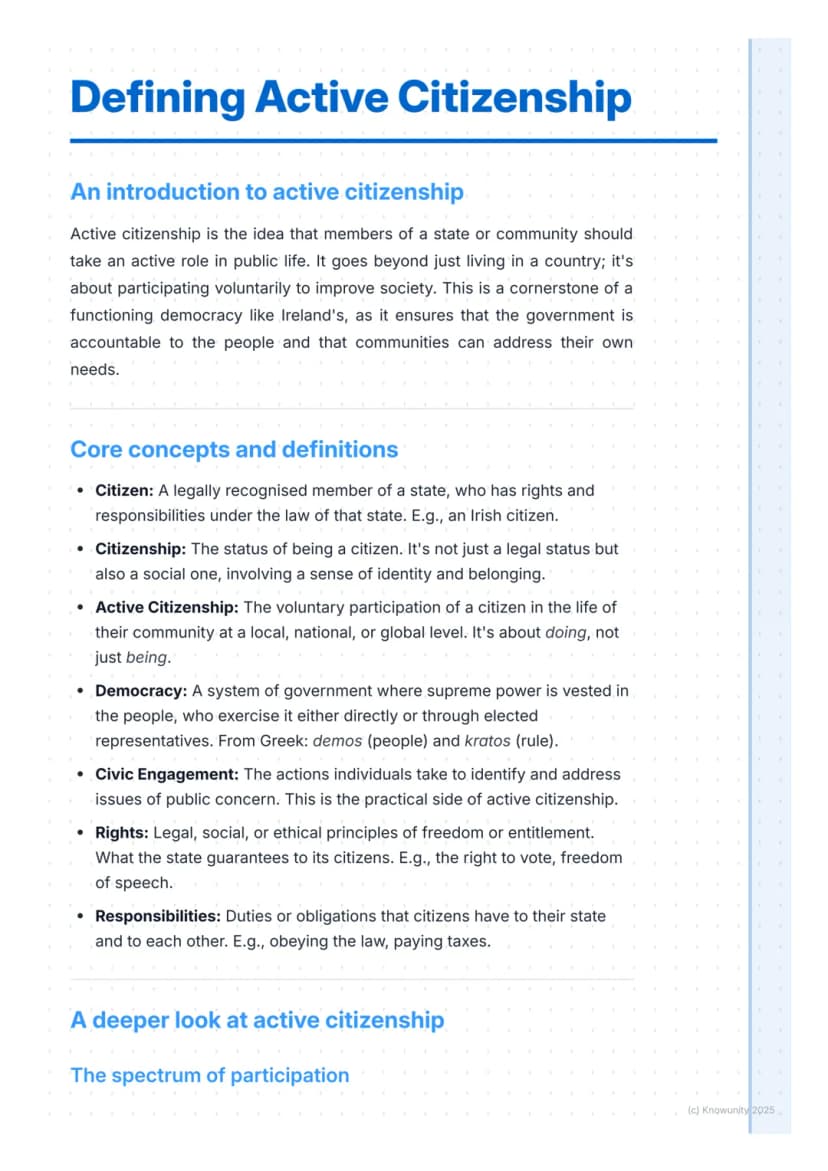
Defining Active Citizenship
Think of active citizenship as the difference between being a passenger and being the driver of democracy. It's about voluntarily participating in public life to improve society, rather than just sitting back and complaining about problems.
Democracy literally means "rule by the people" (from Greek demos and kratos), but it only works when people actually get involved. In Ireland, this means our government stays accountable to us, and communities can tackle their own issues instead of waiting for someone else to fix them.
The key distinction here is between being a citizen (legally recognised member of the state with rights and responsibilities) and practising citizenship (actually using those rights and fulfilling those responsibilities). Active citizenship is the "doing" part - it's civic engagement in action.
💡 Remember: You don't need to be protesting outside the Dáil to be an active citizen - even staying informed about current events is the foundation of active citizenship.
2
of 6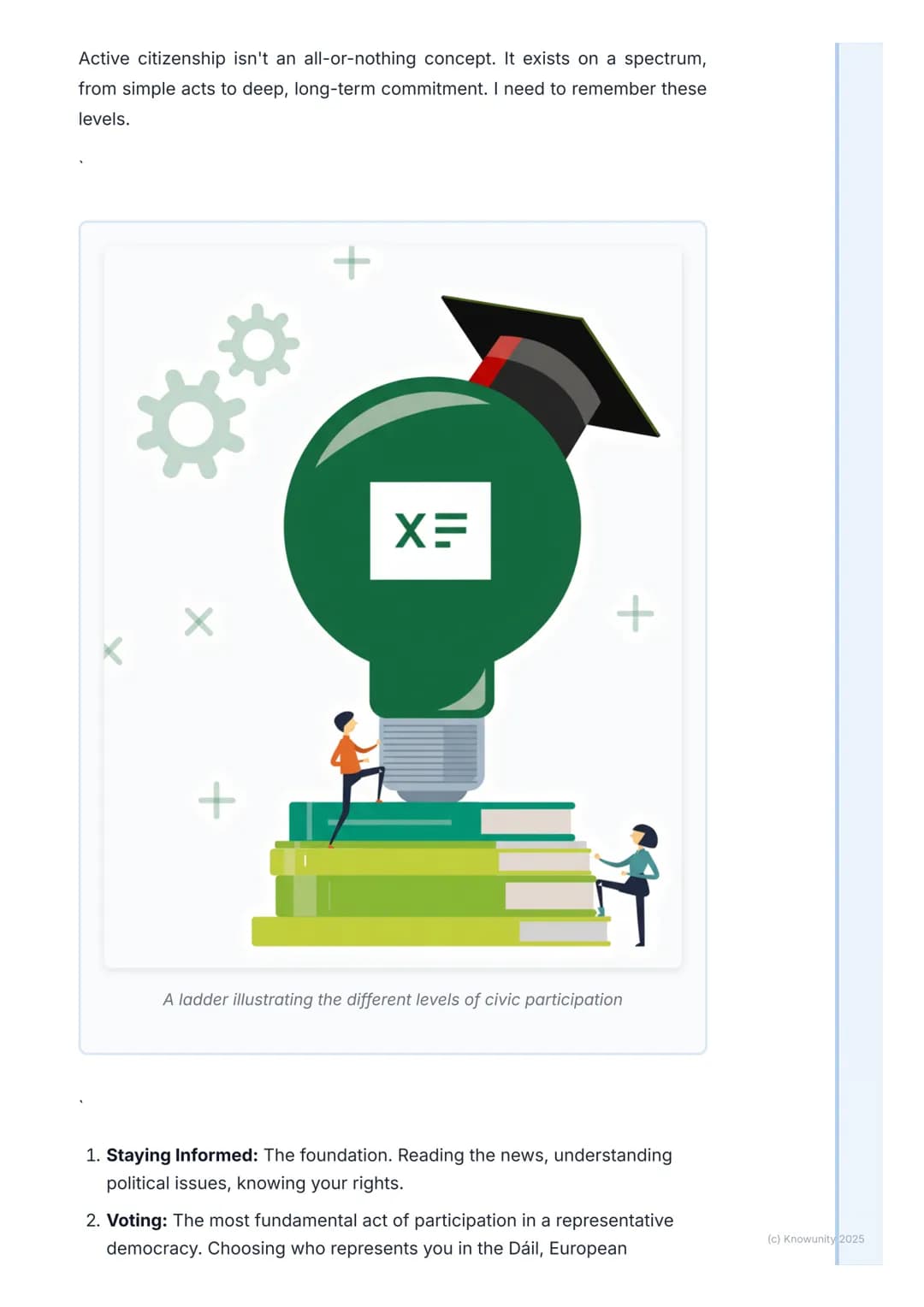
The Spectrum of Participation
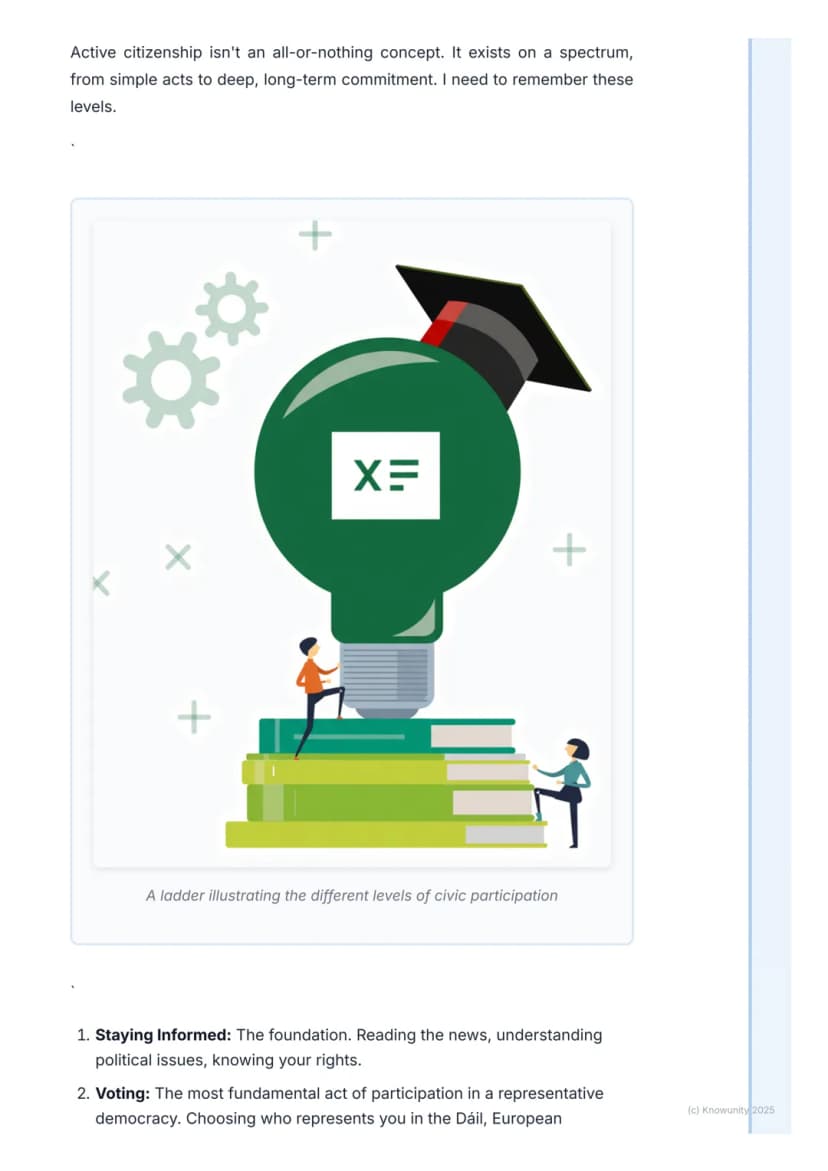
Active citizenship isn't all-or-nothing - it's like a ladder where you can participate at different levels depending on your time, interest and circumstances.
At the bottom, you've got staying informed - reading the news, understanding political issues, knowing your rights. Then comes voting in elections for the Dáil, European Parliament, and local councils. This is your most fundamental way to participate in democracy.
Moving up, there's community involvement - volunteering with St Vincent de Paul, joining sports clubs, or helping with Tidy Towns committees. The next level is advocacy and campaigning - signing petitions on Uplift.ie, contacting your TD about issues, joining peaceful protests, or using social media to raise awareness.
At the top of the ladder is leadership and organisation - setting up community groups, organising campaigns, running for student council, or even public office. Each level is valuable, and you can move between them as your life circumstances change.
💡 Exam Tip: Be ready to give specific Irish examples for each level - examiners love concrete examples over vague descriptions.
3
of 6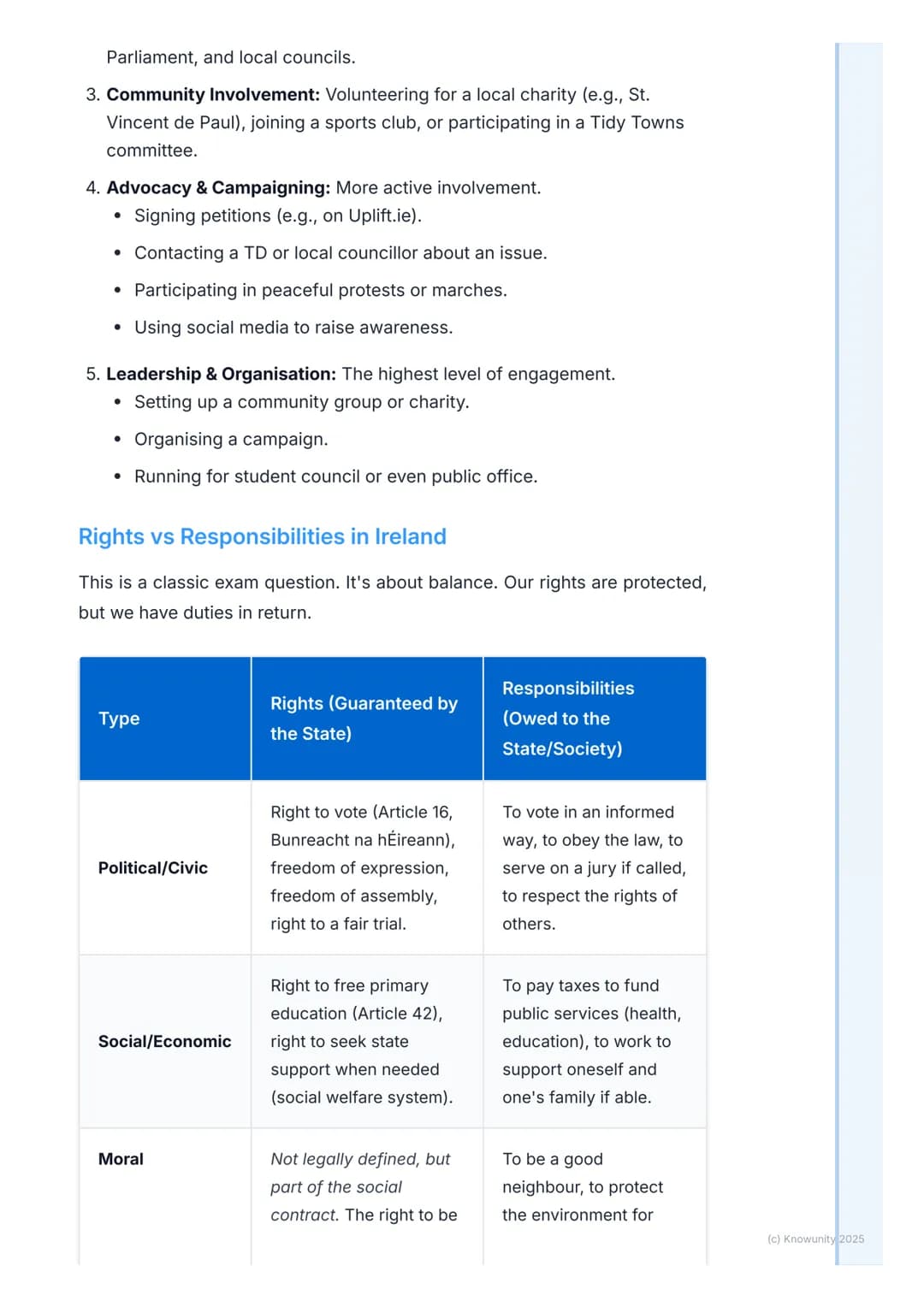
Rights vs Responsibilities in Ireland
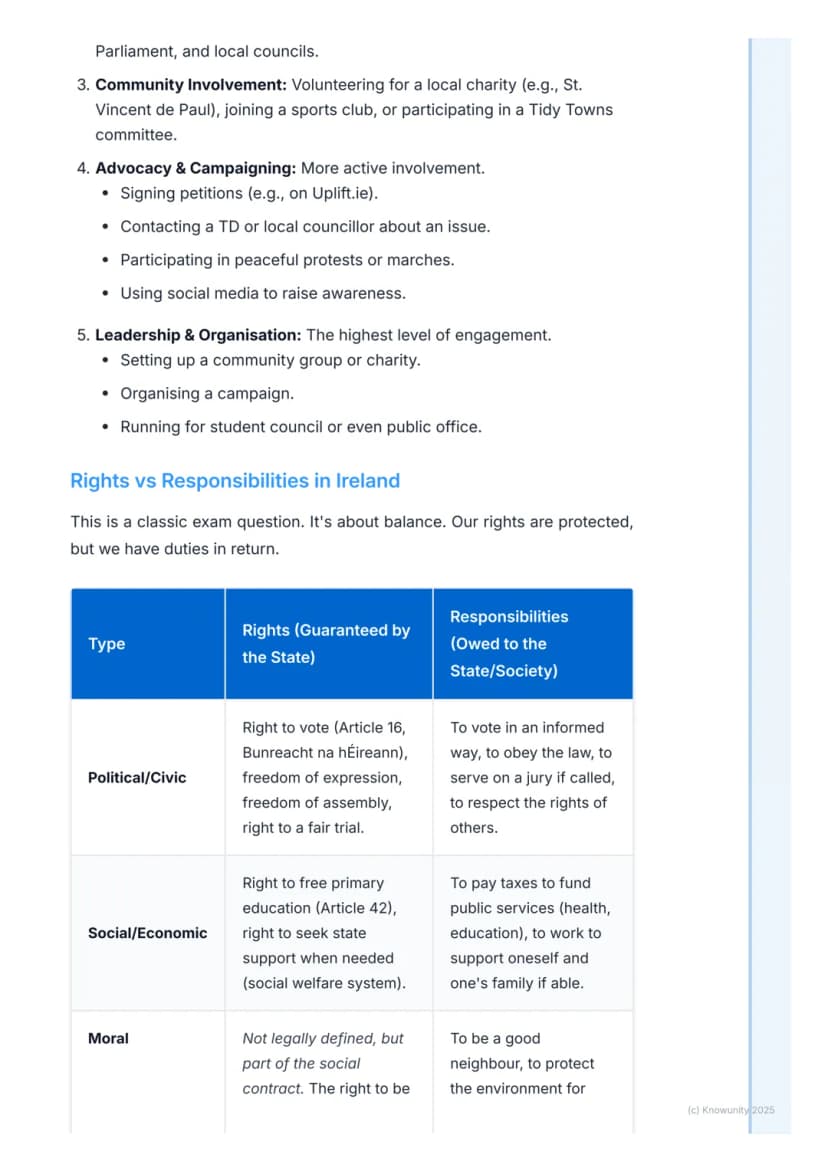
This balance between what the state guarantees you and what you owe back is classic exam material. Your rights in Ireland include basics like the right to vote, freedom of speech, and being treated with dignity. Many of these come from Bunreacht na hÉireann (the Irish Constitution).
Your responsibilities as a citizen include obeying the law, paying taxes, respecting others' rights, and protecting the environment for future generations. It's not just about following rules - it's about challenging injustice when you see it.
The key thing to remember is that rights and responsibilities aren't separate - they work together. Your right to free speech comes with the responsibility to respect others. Your right to vote comes with the responsibility to stay informed about the issues.
This isn't just philosophical stuff - it's practical. When citizens understand both sides of this equation, democracy works better because people are both protected and engaged.
💡 Quick Recall: Think "rights are protected BY the state, responsibilities are owed TO the state and each other."
4
of 6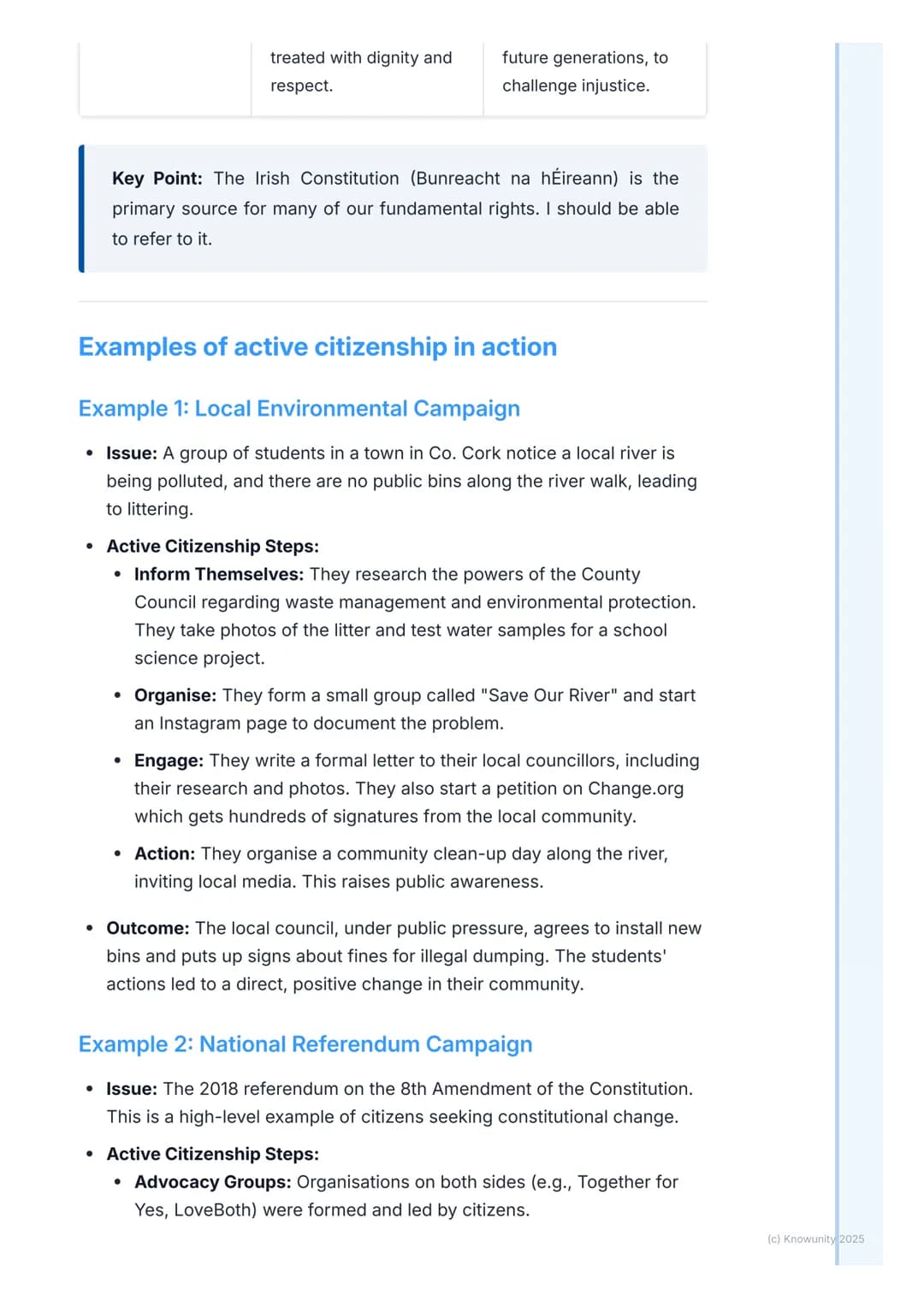
Examples of Active Citizenship in Action
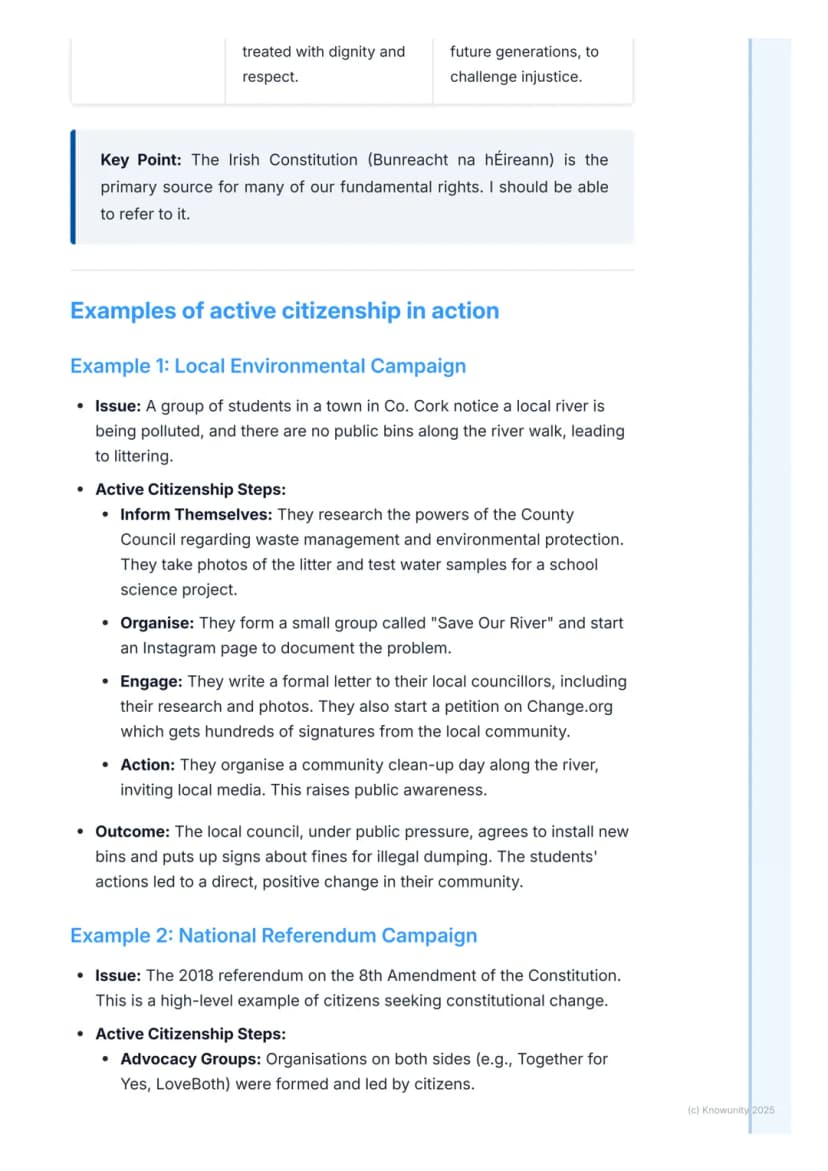
Let's look at how active citizenship actually works in practice. Say some students in Cork notice their local river is polluted and there are no bins along the river walk, causing more litter.
They start by informing themselves - researching the County Council's powers, taking photos, even testing water samples for a science project. Then they organise by forming "Save Our River" and creating social media to document the problem.
For engagement, they write formal letters to local councillors with their research and start an online petition that gets hundreds of signatures. Their action involves organising a community clean-up that attracts local media attention.
The outcome? The council installs new bins and puts up anti-dumping signs. That's civic engagement creating real change through democracy in action.
On a national level, think about the 2018 referendum on the 8th Amendment. Citizens formed advocacy groups, held public meetings, canvassed door-to-door, and drove massive voter registration campaigns - especially among young people.
💡 Exam Gold: Always use specific Irish examples like these rather than generic descriptions - it shows you understand how active citizenship works in practice.
5
of 6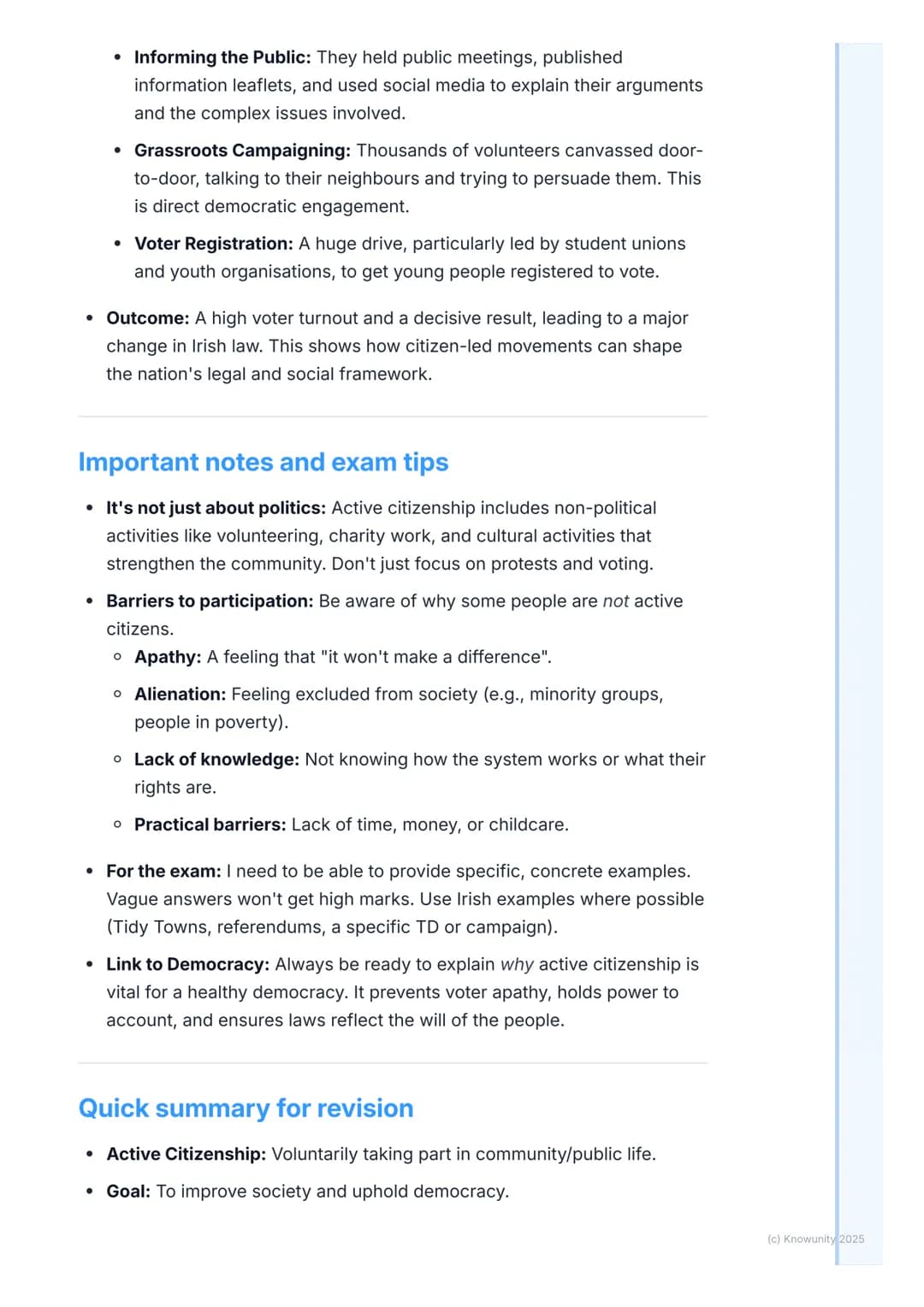
Barriers and Real-World Challenges
Not everyone becomes an active citizen, and understanding why is crucial for your exams. Apathy is huge - many people feel "it won't make a difference anyway." Then there's alienation - minority groups or people in poverty often feel excluded from democracy.
Lack of knowledge stops loads of people - they simply don't know how the system works or what their rights are. Practical barriers matter too - lack of time, money, or childcare can prevent civic engagement even when people want to participate.
For your exams, remember that active citizenship isn't just about politics. Volunteering, charity work, and cultural activities that strengthen communities all count. A Tidy Towns volunteer is as much an active citizen as someone campaigning for a TD.
The connection to democracy is essential here. Active citizenship prevents voter apathy, holds power accountable, and ensures laws reflect what people actually want. Without it, democracy becomes just a hollow structure with no real power.
💡 Revision Note: Be able to explain both what active citizenship looks like AND why some people can't or don't participate - examiners often ask about barriers.
6
of 6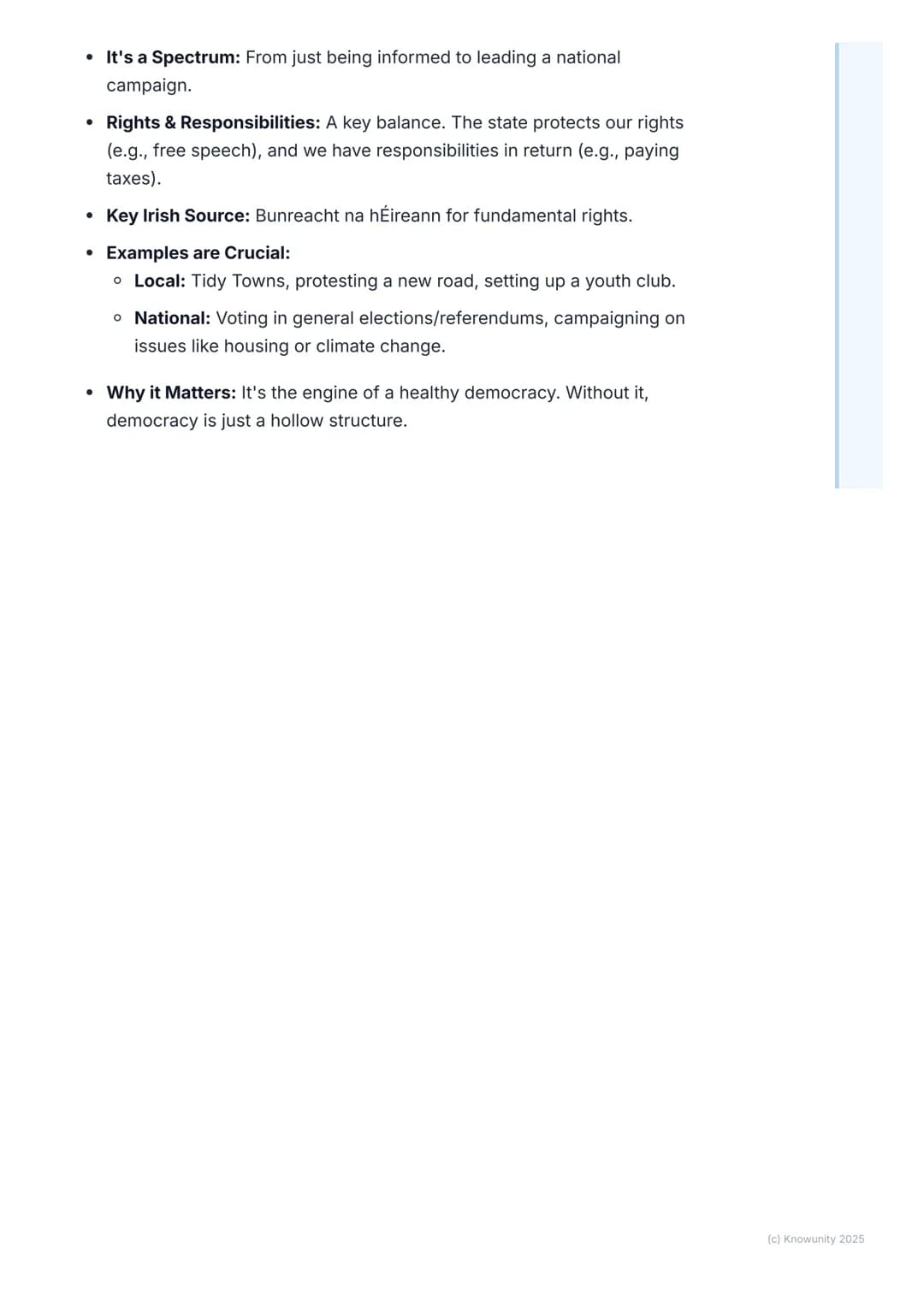
Quick Summary for Revision
Active citizenship means voluntarily participating in community and public life to improve society and strengthen democracy. It's a spectrum from staying informed to leading national campaigns - every level matters.
The balance between rights and responsibilities is crucial. Bunreacht na hÉireann protects your fundamental rights (like free speech), while you have responsibilities back to the state and community (like paying taxes and respecting others).
Your exam examples should be specific and Irish where possible. Local examples include Tidy Towns, protesting developments, or setting up youth clubs. National examples include voting in elections and referendums, or campaigning on housing and climate issues.
Active citizenship is the engine that makes democracy work. Without engaged citizens holding power accountable and working to solve problems, democracy is just empty procedures. It's about taking responsibility for the society you want to live in.
💡 Final Tip: Practice explaining why active citizenship matters for democracy - this connection appears in almost every exam question on this topic.
そんなこと聞いてくれるのを待ってたよ...
KnowunityのAIコンパニオンとは?
KnowunityのAIコンパニオンは学生向けに設計されたAIツールで、単なる答えを提供するだけではありません。数百万のKnowunityリソースを基に構築され、関連する情報、個別の学習プラン、クイズ、コンテンツをチャット内で直接提供し、あなたの個別の学習過程に適応します。
Knowunityアプリはどこでダウンロードできますか?
Google Play StoreとApple App Storeからアプリをダウンロードできます。
Knowunityは本当に無料ですか?
その通り!学習コンテンツへの無料アクセス、仲間の学生とのつながり、そして即座のサポートを手のひらで楽しもう。
人気コンテンツ
9 Irish
IrishIrish oral questions and answers
Questions and answers for the leaving cert oral
5th Year4264
 English
Key Quotes : Sive
Key Quotes and explanations: Sive
6th Year2842
IrishIrish oral questions
Outline of oral questions
5th Year2055
IrishIníon- le hÁine Durkin
Aine Durkin’s poem, Iníon: Themes & summary
5th Year850
IrishIrish poetry 2027
Iníon + Dínit an Bhróin
5th Year1133
IrishLC HL notes- Iníon (poem)
Includes poem in English and Irish, theme, key words & phrases
5th Year2284
EnglishCultural Context : Shawshank Redemption : Sive : Small Things Like These
Comparative Study : Cultural Context : Shawshank Redemption, Sive and Small Things Like These
6th Year1430
IrishMo Ghrá-sa (Idir Lúibíní)
Notes on mo ghrá-sa
5th Year380
IrishAn Gaeilge Aiste
Irish Language essay
6th Year1320
探しているものが見つからない?他の教科も見てみよう。
生徒たちが愛用中 — あなたもきっと気に入るはず。
4.6/5App Store
4.7/5Google Play
このアプリはとても使いやすくて、デザインも良いです。今のところ探していたものは全て見つかったし、プレゼン資料からもたくさん学べました!絶対に課題でも使いたいと思います!もちろん、アイデアを得るのにもすごく役立ちます。
Stefan SiOSユーザー
このアプリは本当に素晴らしいです。学習ノートやサポート資料がとても豊富で[...]。例えば、私の苦手科目はフランス語なんですが、このアプリにはサポートオプションがたくさんあります。このアプリのおかげでフランス語が上達しました。誰にでもおすすめしたいです。
Samantha KlichAndroidユーザー
すごい、本当に驚いた。広告で何度も見かけたからアプリを試してみたら、めちゃくちゃ感動した。このアプリは学校で欲しかった「まさにこれ!」って感じのサポートで、特に練習問題や要点まとめみたいな機能がたくさんあって、個人的にすごく助かってる。
AnnaiOSユーザー
CSPE1 閲覧数·更新日 Jun 8, 2026·6 ページUnderstanding Active Citizenship: Rights and Civic Duties
Ever wonder what it actually means to be an active citizen in Ireland? It's way more than just having an Irish passport or voting every few years. Active citizenship is about getting involved and making a real difference in your...
1
of 6
サインアップしてコンテンツを見よう。無料だよ!
- 全ドキュメントへのアクセス
- 成績アップ
- 数百万人の学生と一緒に学習
Defining Active Citizenship
Think of active citizenship as the difference between being a passenger and being the driver of democracy. It's about voluntarily participating in public life to improve society, rather than just sitting back and complaining about problems.
Democracy literally means "rule by the people" (from Greek demos and kratos), but it only works when people actually get involved. In Ireland, this means our government stays accountable to us, and communities can tackle their own issues instead of waiting for someone else to fix them.
The key distinction here is between being a citizen (legally recognised member of the state with rights and responsibilities) and practising citizenship (actually using those rights and fulfilling those responsibilities). Active citizenship is the "doing" part - it's civic engagement in action.
💡 Remember: You don't need to be protesting outside the Dáil to be an active citizen - even staying informed about current events is the foundation of active citizenship.
2
of 6サインアップしてコンテンツを見よう。無料だよ!
- 全ドキュメントへのアクセス
- 成績アップ
- 数百万人の学生と一緒に学習
The Spectrum of Participation
Active citizenship isn't all-or-nothing - it's like a ladder where you can participate at different levels depending on your time, interest and circumstances.
At the bottom, you've got staying informed - reading the news, understanding political issues, knowing your rights. Then comes voting in elections for the Dáil, European Parliament, and local councils. This is your most fundamental way to participate in democracy.
Moving up, there's community involvement - volunteering with St Vincent de Paul, joining sports clubs, or helping with Tidy Towns committees. The next level is advocacy and campaigning - signing petitions on Uplift.ie, contacting your TD about issues, joining peaceful protests, or using social media to raise awareness.
At the top of the ladder is leadership and organisation - setting up community groups, organising campaigns, running for student council, or even public office. Each level is valuable, and you can move between them as your life circumstances change.
💡 Exam Tip: Be ready to give specific Irish examples for each level - examiners love concrete examples over vague descriptions.
3
of 6サインアップしてコンテンツを見よう。無料だよ!
- 全ドキュメントへのアクセス
- 成績アップ
- 数百万人の学生と一緒に学習
Rights vs Responsibilities in Ireland
This balance between what the state guarantees you and what you owe back is classic exam material. Your rights in Ireland include basics like the right to vote, freedom of speech, and being treated with dignity. Many of these come from Bunreacht na hÉireann (the Irish Constitution).
Your responsibilities as a citizen include obeying the law, paying taxes, respecting others' rights, and protecting the environment for future generations. It's not just about following rules - it's about challenging injustice when you see it.
The key thing to remember is that rights and responsibilities aren't separate - they work together. Your right to free speech comes with the responsibility to respect others. Your right to vote comes with the responsibility to stay informed about the issues.
This isn't just philosophical stuff - it's practical. When citizens understand both sides of this equation, democracy works better because people are both protected and engaged.
💡 Quick Recall: Think "rights are protected BY the state, responsibilities are owed TO the state and each other."
4
of 6サインアップしてコンテンツを見よう。無料だよ!
- 全ドキュメントへのアクセス
- 成績アップ
- 数百万人の学生と一緒に学習
Examples of Active Citizenship in Action
Let's look at how active citizenship actually works in practice. Say some students in Cork notice their local river is polluted and there are no bins along the river walk, causing more litter.
They start by informing themselves - researching the County Council's powers, taking photos, even testing water samples for a science project. Then they organise by forming "Save Our River" and creating social media to document the problem.
For engagement, they write formal letters to local councillors with their research and start an online petition that gets hundreds of signatures. Their action involves organising a community clean-up that attracts local media attention.
The outcome? The council installs new bins and puts up anti-dumping signs. That's civic engagement creating real change through democracy in action.
On a national level, think about the 2018 referendum on the 8th Amendment. Citizens formed advocacy groups, held public meetings, canvassed door-to-door, and drove massive voter registration campaigns - especially among young people.
💡 Exam Gold: Always use specific Irish examples like these rather than generic descriptions - it shows you understand how active citizenship works in practice.
5
of 6サインアップしてコンテンツを見よう。無料だよ!
- 全ドキュメントへのアクセス
- 成績アップ
- 数百万人の学生と一緒に学習
Barriers and Real-World Challenges
Not everyone becomes an active citizen, and understanding why is crucial for your exams. Apathy is huge - many people feel "it won't make a difference anyway." Then there's alienation - minority groups or people in poverty often feel excluded from democracy.
Lack of knowledge stops loads of people - they simply don't know how the system works or what their rights are. Practical barriers matter too - lack of time, money, or childcare can prevent civic engagement even when people want to participate.
For your exams, remember that active citizenship isn't just about politics. Volunteering, charity work, and cultural activities that strengthen communities all count. A Tidy Towns volunteer is as much an active citizen as someone campaigning for a TD.
The connection to democracy is essential here. Active citizenship prevents voter apathy, holds power accountable, and ensures laws reflect what people actually want. Without it, democracy becomes just a hollow structure with no real power.
💡 Revision Note: Be able to explain both what active citizenship looks like AND why some people can't or don't participate - examiners often ask about barriers.
6
of 6サインアップしてコンテンツを見よう。無料だよ!
- 全ドキュメントへのアクセス
- 成績アップ
- 数百万人の学生と一緒に学習
Quick Summary for Revision
Active citizenship means voluntarily participating in community and public life to improve society and strengthen democracy. It's a spectrum from staying informed to leading national campaigns - every level matters.
The balance between rights and responsibilities is crucial. Bunreacht na hÉireann protects your fundamental rights (like free speech), while you have responsibilities back to the state and community (like paying taxes and respecting others).
Your exam examples should be specific and Irish where possible. Local examples include Tidy Towns, protesting developments, or setting up youth clubs. National examples include voting in elections and referendums, or campaigning on housing and climate issues.
Active citizenship is the engine that makes democracy work. Without engaged citizens holding power accountable and working to solve problems, democracy is just empty procedures. It's about taking responsibility for the society you want to live in.
💡 Final Tip: Practice explaining why active citizenship matters for democracy - this connection appears in almost every exam question on this topic.
そんなこと聞いてくれるのを待ってたよ...
KnowunityのAIコンパニオンとは?
KnowunityのAIコンパニオンは学生向けに設計されたAIツールで、単なる答えを提供するだけではありません。数百万のKnowunityリソースを基に構築され、関連する情報、個別の学習プラン、クイズ、コンテンツをチャット内で直接提供し、あなたの個別の学習過程に適応します。
Knowunityアプリはどこでダウンロードできますか?
Google Play StoreとApple App Storeからアプリをダウンロードできます。
Knowunityは本当に無料ですか?
その通り!学習コンテンツへの無料アクセス、仲間の学生とのつながり、そして即座のサポートを手のひらで楽しもう。
人気コンテンツ
9IrishIrish oral questions and answers
Questions and answers for the leaving cert oral
5th Year4264
EnglishKey Quotes : Sive
Key Quotes and explanations: Sive
6th Year2842
IrishIrish oral questions
Outline of oral questions
5th Year2055
IrishIníon- le hÁine Durkin
Aine Durkin’s poem, Iníon: Themes & summary
5th Year850
IrishIrish poetry 2027
Iníon + Dínit an Bhróin
5th Year1133
IrishLC HL notes- Iníon (poem)
Includes poem in English and Irish, theme, key words & phrases
5th Year2284
EnglishCultural Context : Shawshank Redemption : Sive : Small Things Like These
Comparative Study : Cultural Context : Shawshank Redemption, Sive and Small Things Like These
6th Year1430
IrishMo Ghrá-sa (Idir Lúibíní)
Notes on mo ghrá-sa
5th Year380
IrishAn Gaeilge Aiste
Irish Language essay
6th Year1320
探しているものが見つからない?他の教科も見てみよう。
生徒たちが愛用中 — あなたもきっと気に入るはず。
4.6/5App Store
4.7/5Google Play
このアプリはとても使いやすくて、デザインも良いです。今のところ探していたものは全て見つかったし、プレゼン資料からもたくさん学べました!絶対に課題でも使いたいと思います!もちろん、アイデアを得るのにもすごく役立ちます。
Stefan SiOSユーザー
このアプリは本当に素晴らしいです。学習ノートやサポート資料がとても豊富で[...]。例えば、私の苦手科目はフランス語なんですが、このアプリにはサポートオプションがたくさんあります。このアプリのおかげでフランス語が上達しました。誰にでもおすすめしたいです。
Samantha KlichAndroidユーザー
すごい、本当に驚いた。広告で何度も見かけたからアプリを試してみたら、めちゃくちゃ感動した。このアプリは学校で欲しかった「まさにこれ!」って感じのサポートで、特に練習問題や要点まとめみたいな機能がたくさんあって、個人的にすごく助かってる。
AnnaiOSユーザー