
Every business creates two crucial financial documents that tell the...
 Business2 閲覧数·更新日 Jun 11, 2026·7 ページ
Overview of Key Financial Statements: Income Statement and Balance Sheet

1 / 7
1
of 7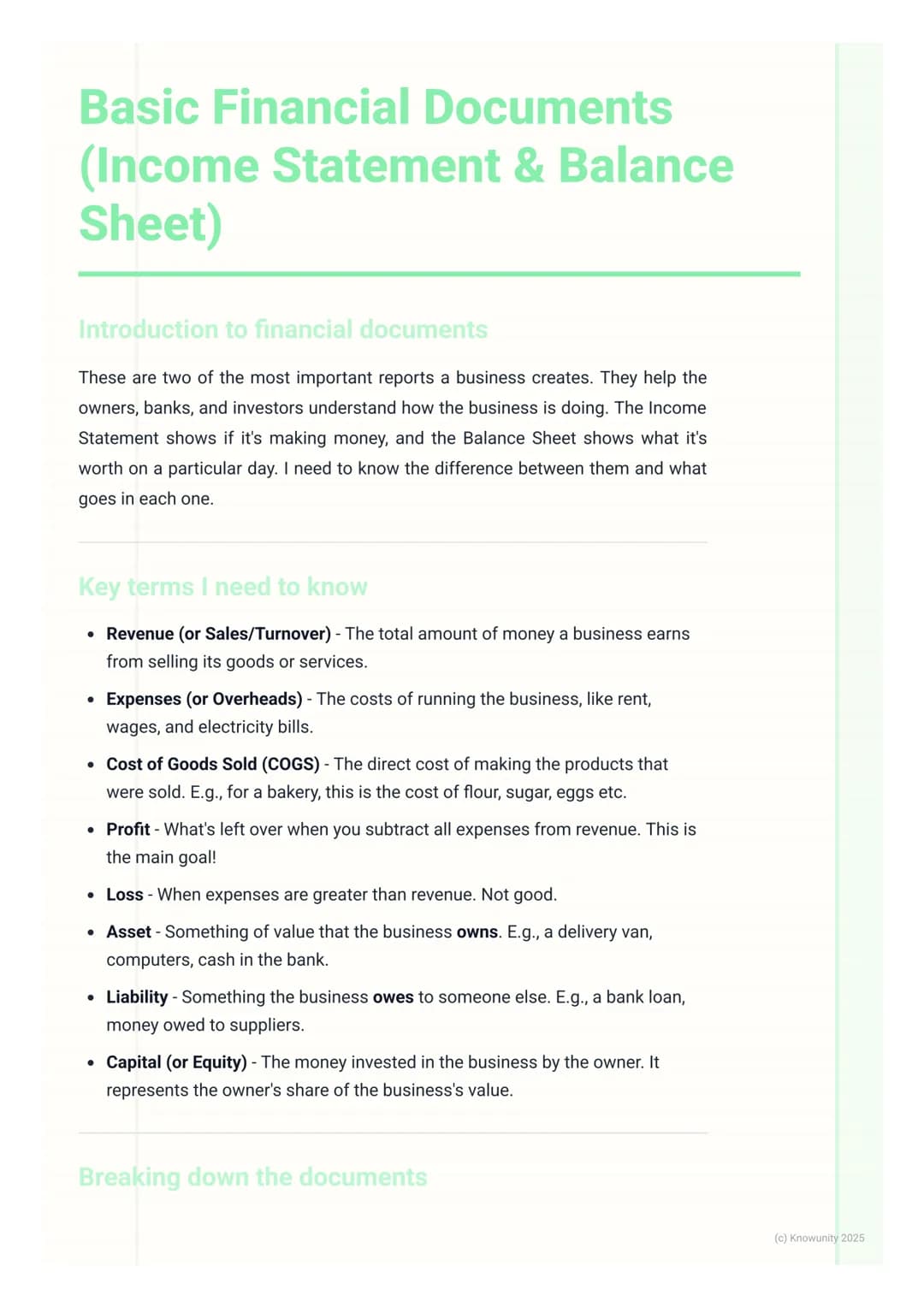
Basic Financial Documents
Understanding financial documents is like learning to read a business's health check. These reports help everyone from business owners to banks figure out if a company is worth investing in or lending money to.
Revenue (also called sales or turnover) is simply all the money a business earns from selling stuff. Expenses are all the costs of keeping the business running - things like rent, wages, and electricity bills. When you subtract expenses from revenue, you get profit (the good outcome) or loss (not so good).
On the flip side, assets are valuable things the business owns like delivery vans or cash in the bank. Liabilities are debts the business owes to others, whilst capital represents the owner's stake in the business.
Quick Tip: Think of assets as "what we have" and liabilities as "what we owe" - this makes the concepts much easier to remember!
2
of 7
The Income Statement
This document works like a business video - it shows performance over a specific time period, whether that's a month or a full year. Its main job is dead simple: calculate whether the business made money or lost it.
The income statement follows a straightforward formula: Revenue minus Expenses equals Net Profit (or Loss). You start with all the sales revenue, subtract the cost of goods sold (COGS), and this gives you gross profit. Then you subtract all other running costs to reach your final net profit.
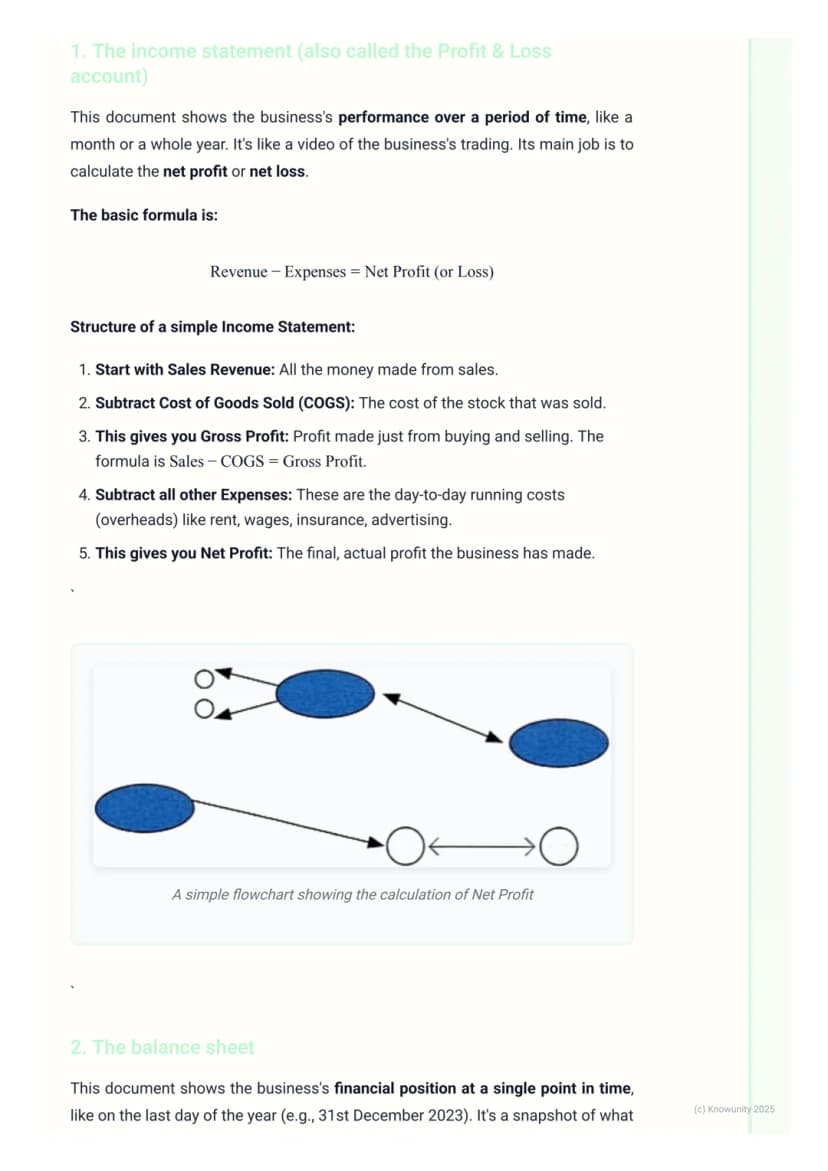
Here's the flow: Sales → minus COGS → equals Gross Profit → minus other expenses → equals Net Profit. It's basically asking "did we make more than we spent?"
Remember: The income statement is all about performance over time - it's the "how did we do?" document.
3
of 7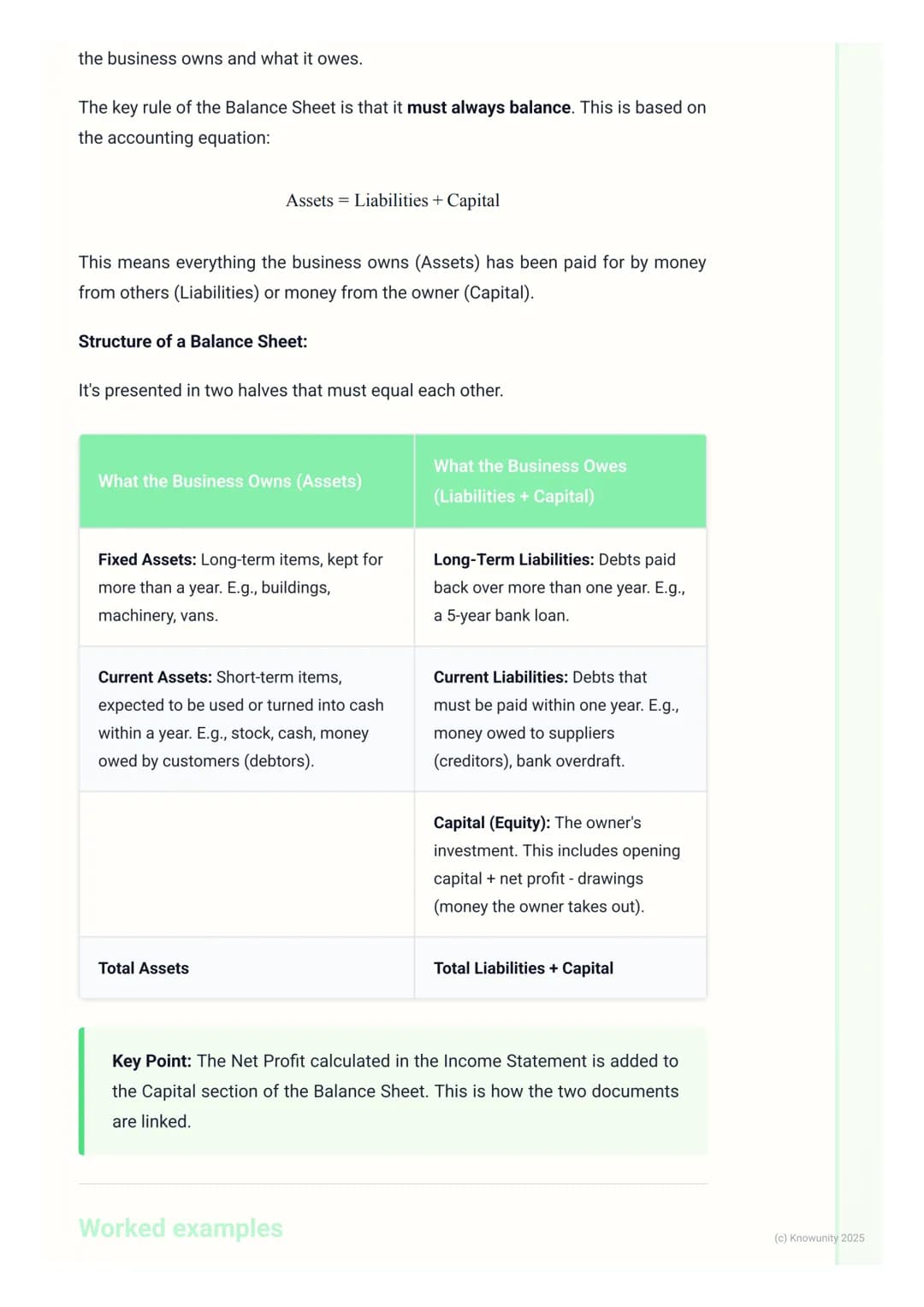
The Balance Sheet
Unlike the income statement's video approach, the balance sheet works like a photograph - it captures the business's financial position at one exact moment in time. Think of it as a snapshot taken on a specific date, like 31st December.
The magic rule of balance sheets is that they must always balance perfectly. This follows the accounting equation: Assets = Liabilities + Capital. Everything the business owns has been paid for either by borrowing money (liabilities) or using the owner's money (capital).
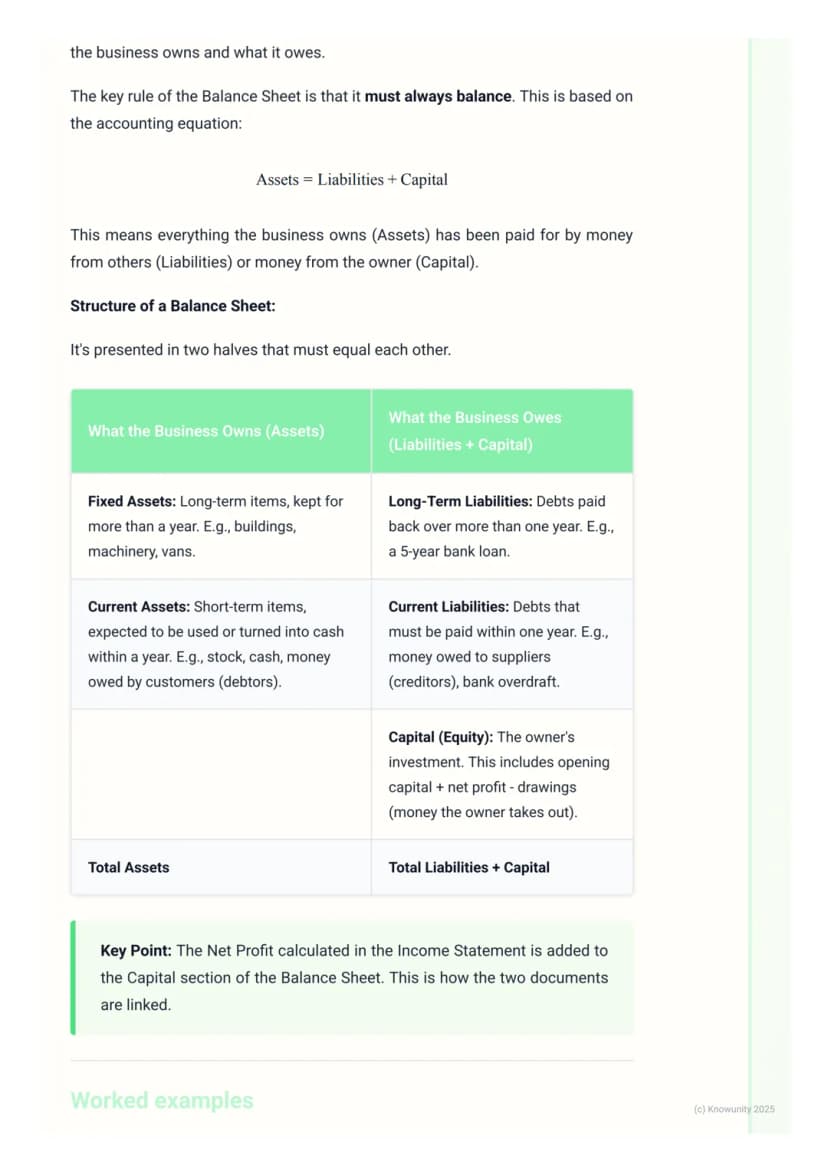
Fixed assets are long-term items kept for over a year (buildings, machinery), whilst current assets are short-term items like stock or cash. Similarly, liabilities split into long-term debts and current debts due within a year.
The clever bit is how the net profit from your income statement gets added to the capital section of your balance sheet - this is how the two documents connect together.
Key Point: If your balance sheet doesn't balance, you've definitely made a calculation error somewhere!
4
of 7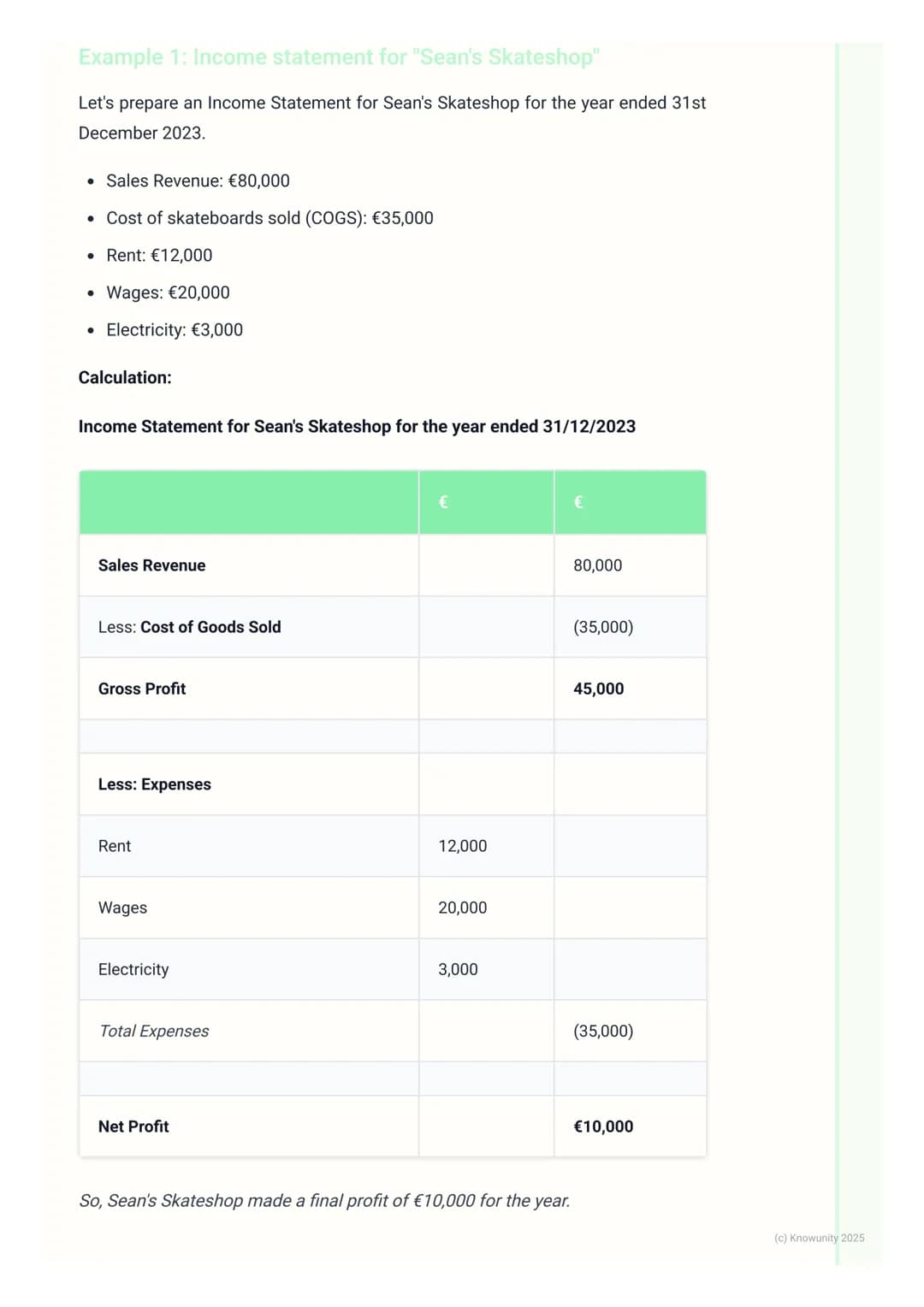
Worked Example - Sean's Skateshop Income Statement
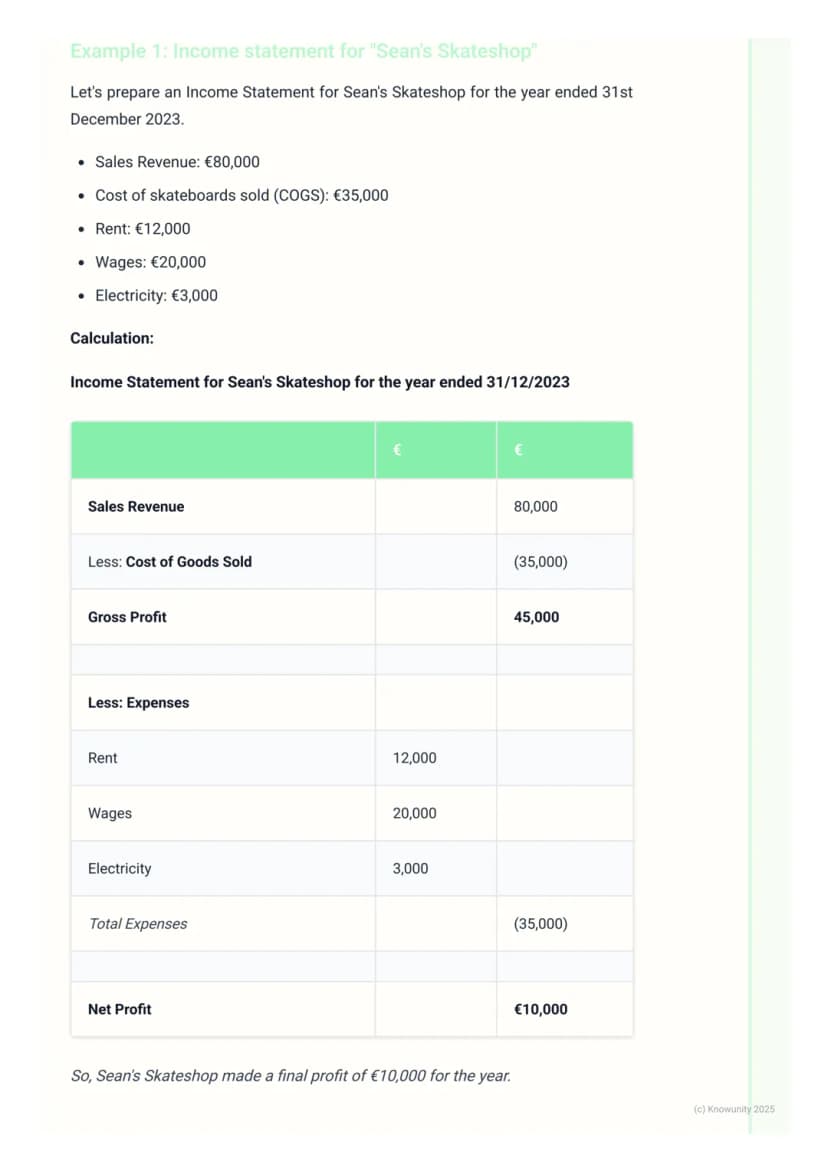
Let's see how this works in practice with Sean's Skateshop for the year ending 31st December 2023. Sean had sales of €80,000, but his skateboards cost him €35,000 to buy (his COGS).
After subtracting the €35,000 COGS from his €80,000 sales, Sean's gross profit was €45,000. Not bad! But he still had running costs: €12,000 rent, €20,000 wages, and €3,000 electricity bills.
When Sean subtracts his total expenses of €35,000 from his gross profit of €45,000, he ends up with a net profit of €10,000. This means after paying for everything, Sean actually made €10,000 for the year.
Pro Tip: Always double-check your arithmetic - small calculation errors can throw off your entire financial statement!
5
of 7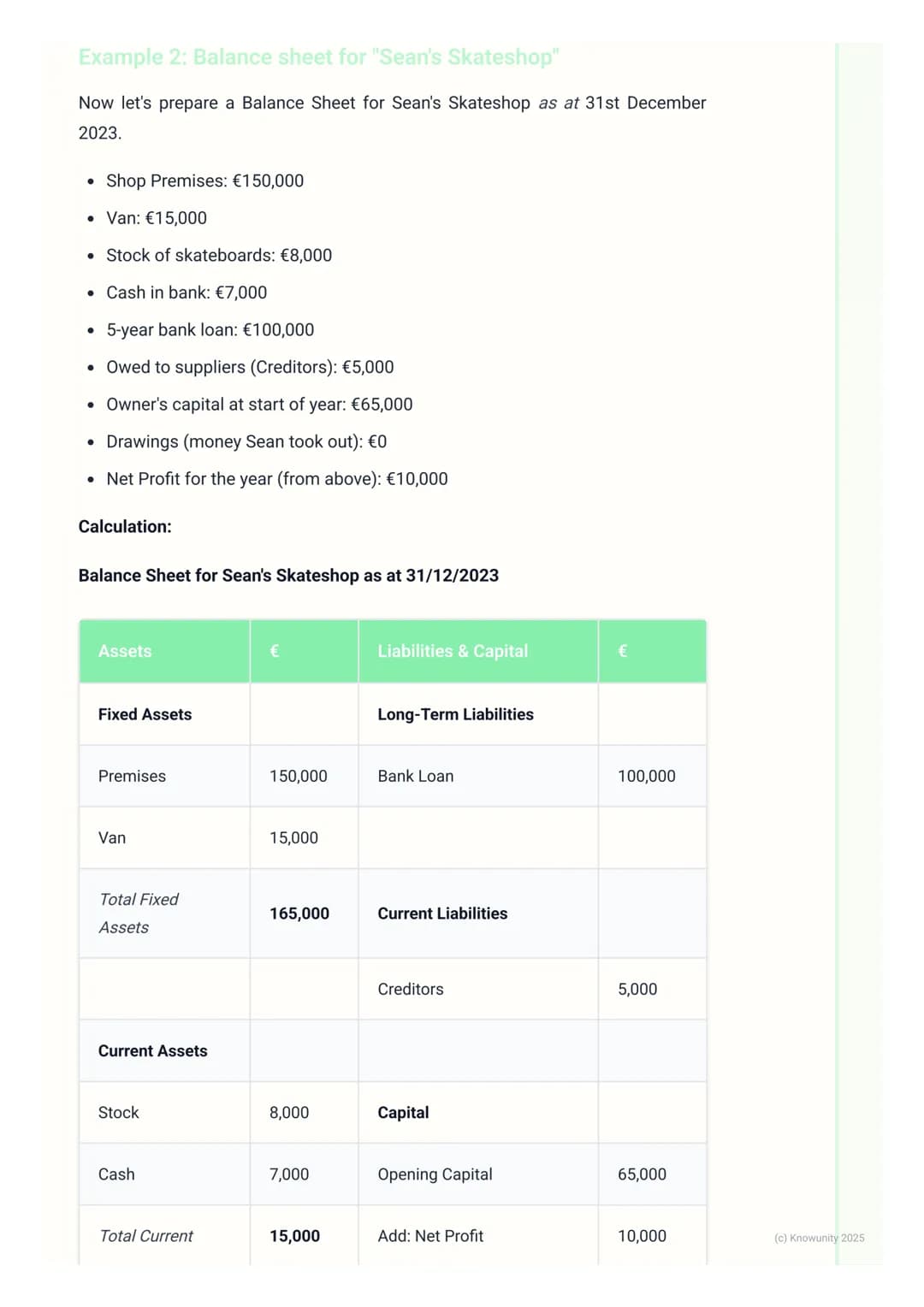
Worked Example - Sean's Skateshop Balance Sheet
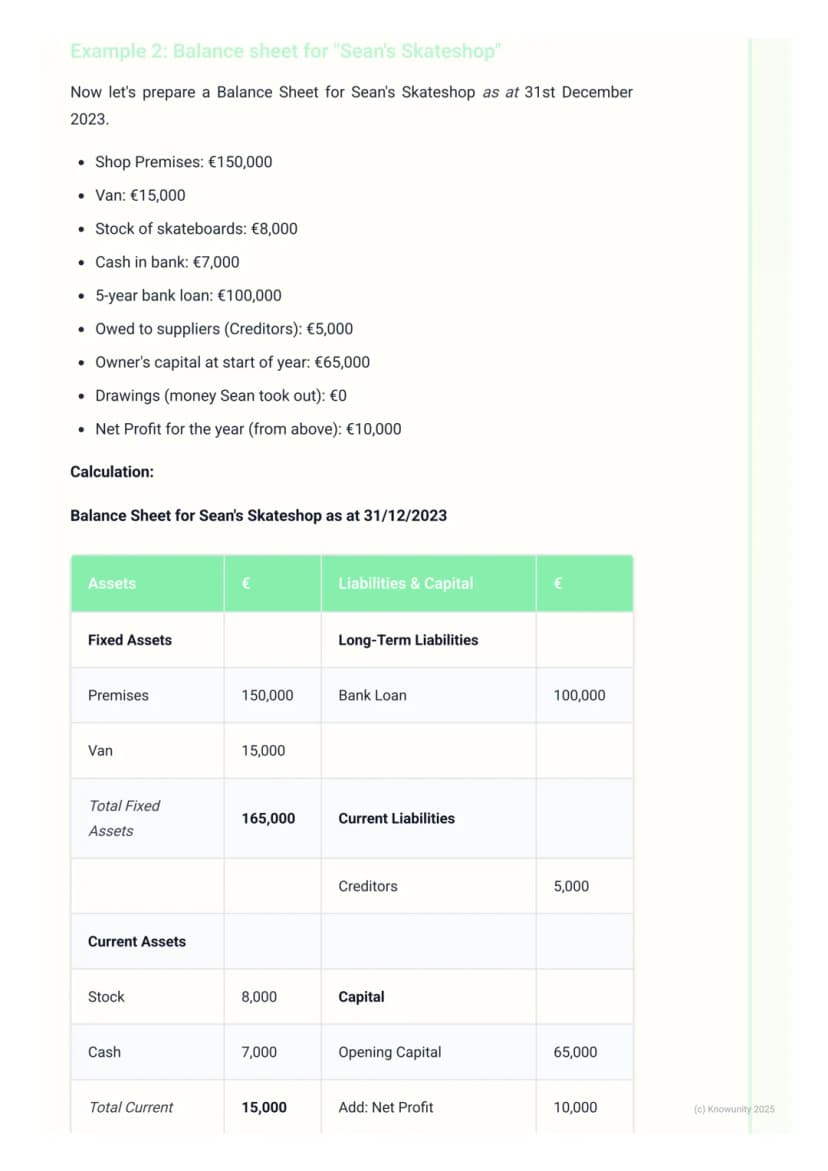
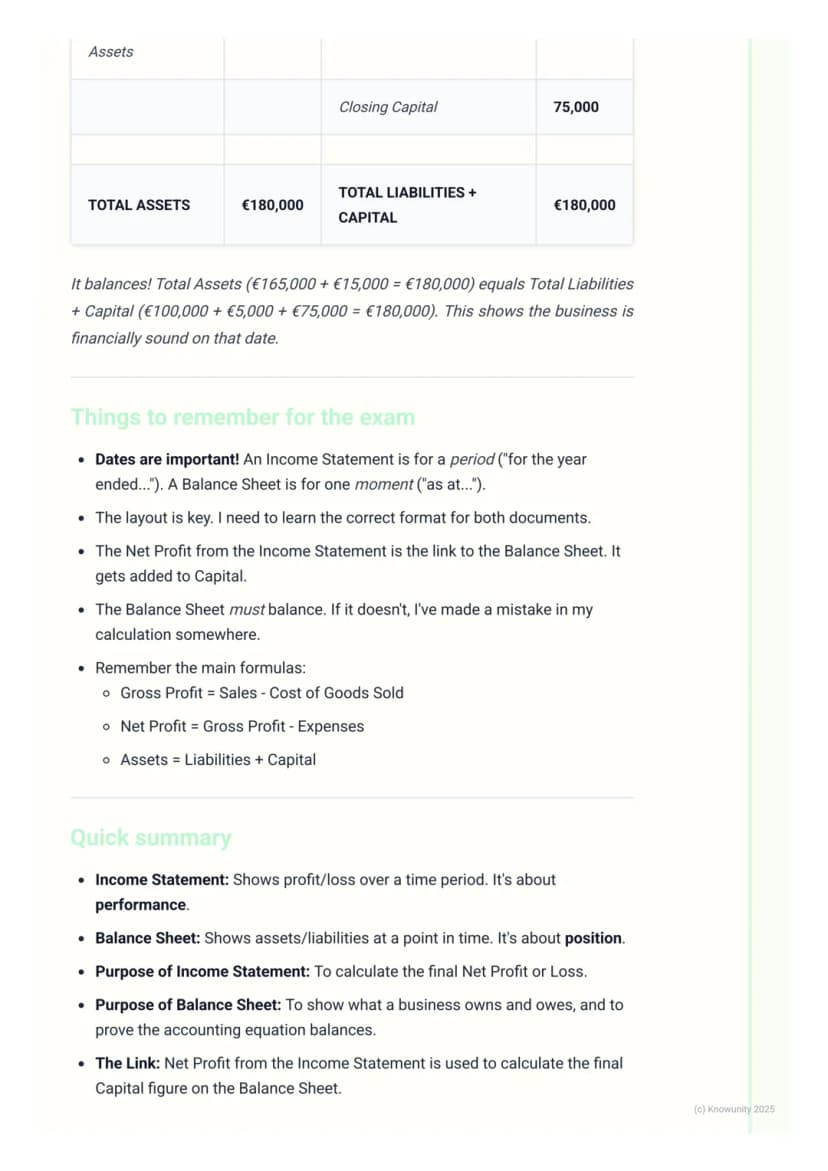
Now let's create Sean's balance sheet as at 31st December 2023. On the assets side, Sean owns shop premises worth €150,000, a van worth €15,000, stock worth €8,000, and has €7,000 cash in the bank.
His liabilities include a €100,000 five-year bank loan and €5,000 owed to suppliers. Sean started the year with €65,000 capital, didn't take any money out (drawings), and made that €10,000 profit we calculated earlier.
Adding the €10,000 net profit to his original €65,000 capital gives Sean €75,000 total capital. When we check the balance: total assets (€180,000) equals total liabilities plus capital (€180,000). Perfect!
Success Check: When your balance sheet balances perfectly, you know you've got all the numbers right!
6
of 7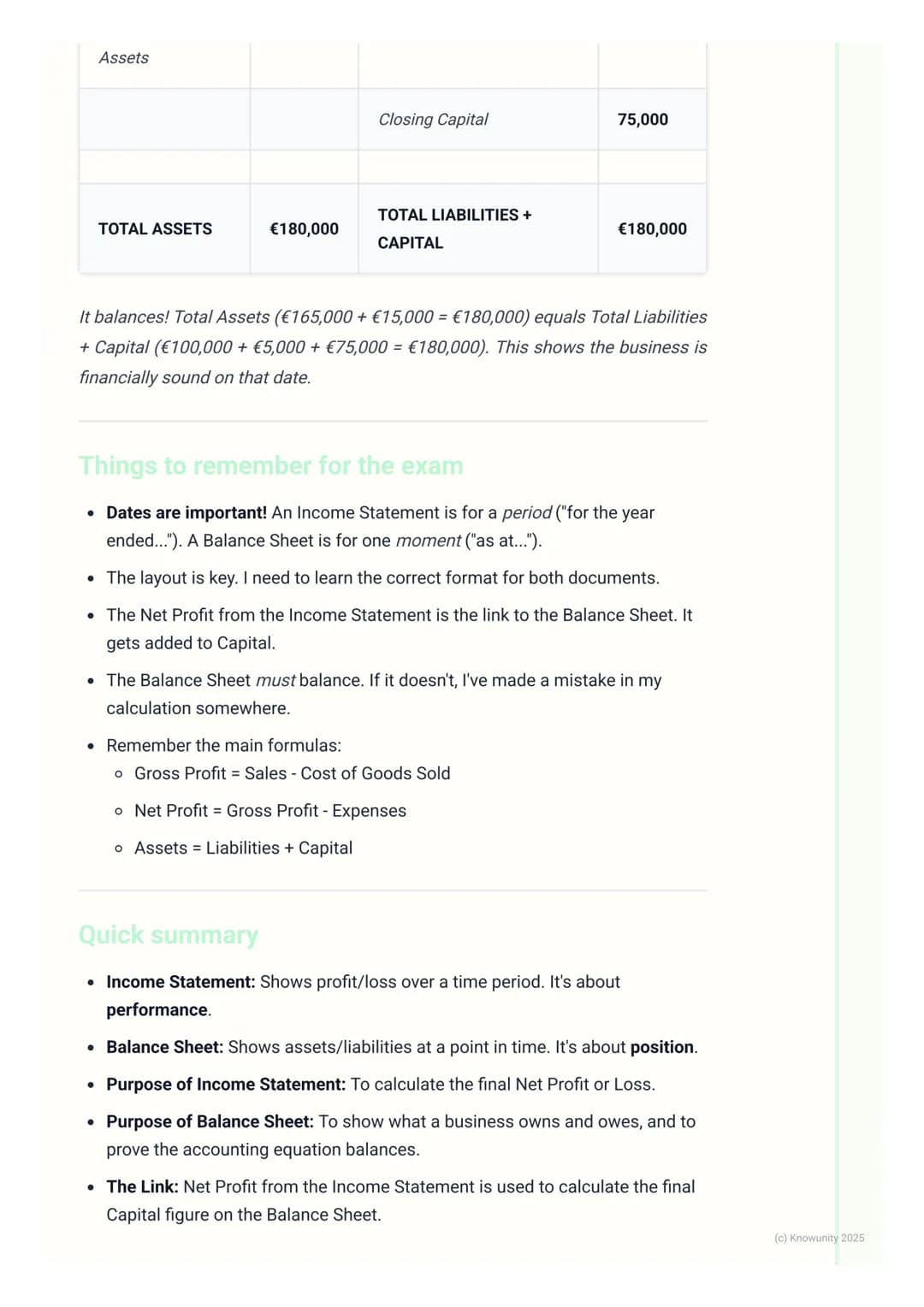
Exam Tips and Key Formulas
Getting the dates right is absolutely crucial for exams. Income statements cover a time period ("for the year ended...") whilst balance sheets capture a single moment ("as at..."). Mix these up and you'll lose marks instantly.
The layout matters just as much as the numbers. Learn the correct format for both documents and practise writing them out properly. Remember that net profit from your income statement must appear in the capital section of your balance sheet - this connection often comes up in exam questions.
Master these essential formulas: Gross Profit = Sales minus Cost of Goods Sold, Net Profit = Gross Profit minus Expenses, and Assets = Liabilities + Capital. If your balance sheet doesn't balance, work backwards through your calculations to find the mistake.
Exam Success: Think of the income statement as showing performance (how did we do?) and the balance sheet as showing position (what do we have?).
7
of 7
そんなこと聞いてくれるのを待ってたよ...
KnowunityのAIコンパニオンとは?
KnowunityのAIコンパニオンは学生向けに設計されたAIツールで、単なる答えを提供するだけではありません。数百万のKnowunityリソースを基に構築され、関連する情報、個別の学習プラン、クイズ、コンテンツをチャット内で直接提供し、あなたの個別の学習過程に適応します。
Knowunityアプリはどこでダウンロードできますか?
Google Play StoreとApple App Storeからアプリをダウンロードできます。
Knowunityは本当に無料ですか?
その通り!学習コンテンツへの無料アクセス、仲間の学生とのつながり、そして即座のサポートを手のひらで楽しもう。
Businessの人気コンテンツ
3人気コンテンツ
9 Irish
IrishIrish oral questions and answers
Questions and answers for the leaving cert oral
5th Year4264
 English
Key Quotes : Sive
Key Quotes and explanations: Sive
6th Year2842
IrishIrish oral questions
Outline of oral questions
5th Year2055
IrishIníon- le hÁine Durkin
Aine Durkin’s poem, Iníon: Themes & summary
5th Year890
IrishIrish poetry 2027
Iníon + Dínit an Bhróin
5th Year1153
IrishLC HL notes- Iníon (poem)
Includes poem in English and Irish, theme, key words & phrases
5th Year2304
EnglishCultural Context : Shawshank Redemption : Sive : Small Things Like These
Comparative Study : Cultural Context : Shawshank Redemption, Sive and Small Things Like These
6th Year1430
IrishMo Ghrá-sa (Idir Lúibíní)
Notes on mo ghrá-sa
5th Year380
IrishAn Gaeilge Aiste
Irish Language essay
6th Year1320
探しているものが見つからない?他の教科も見てみよう。
生徒たちが愛用中 — あなたもきっと気に入るはず。
4.6/5App Store
4.7/5Google Play
このアプリはとても使いやすくて、デザインも良いです。今のところ探していたものは全て見つかったし、プレゼン資料からもたくさん学べました!絶対に課題でも使いたいと思います!もちろん、アイデアを得るのにもすごく役立ちます。
Stefan SiOSユーザー
このアプリは本当に素晴らしいです。学習ノートやサポート資料がとても豊富で[...]。例えば、私の苦手科目はフランス語なんですが、このアプリにはサポートオプションがたくさんあります。このアプリのおかげでフランス語が上達しました。誰にでもおすすめしたいです。
Samantha KlichAndroidユーザー
すごい、本当に驚いた。広告で何度も見かけたからアプリを試してみたら、めちゃくちゃ感動した。このアプリは学校で欲しかった「まさにこれ!」って感じのサポートで、特に練習問題や要点まとめみたいな機能がたくさんあって、個人的にすごく助かってる。
AnnaiOSユーザー
Business2 閲覧数·更新日 Jun 11, 2026·7 ページOverview of Key Financial Statements: Income Statement and Balance Sheet
Every business creates two crucial financial documents that tell the story of how it's performing - think of them as the business's report card and bank statement rolled into one. The Income Statement shows whether a company is actually making...
1
of 7
サインアップしてコンテンツを見よう。無料だよ!
- 全ドキュメントへのアクセス
- 成績アップ
- 数百万人の学生と一緒に学習
Basic Financial Documents
Understanding financial documents is like learning to read a business's health check. These reports help everyone from business owners to banks figure out if a company is worth investing in or lending money to.
Revenue (also called sales or turnover) is simply all the money a business earns from selling stuff. Expenses are all the costs of keeping the business running - things like rent, wages, and electricity bills. When you subtract expenses from revenue, you get profit (the good outcome) or loss (not so good).
On the flip side, assets are valuable things the business owns like delivery vans or cash in the bank. Liabilities are debts the business owes to others, whilst capital represents the owner's stake in the business.
Quick Tip: Think of assets as "what we have" and liabilities as "what we owe" - this makes the concepts much easier to remember!
2
of 7サインアップしてコンテンツを見よう。無料だよ!
- 全ドキュメントへのアクセス
- 成績アップ
- 数百万人の学生と一緒に学習
The Income Statement
This document works like a business video - it shows performance over a specific time period, whether that's a month or a full year. Its main job is dead simple: calculate whether the business made money or lost it.
The income statement follows a straightforward formula: Revenue minus Expenses equals Net Profit (or Loss). You start with all the sales revenue, subtract the cost of goods sold (COGS), and this gives you gross profit. Then you subtract all other running costs to reach your final net profit.
Here's the flow: Sales → minus COGS → equals Gross Profit → minus other expenses → equals Net Profit. It's basically asking "did we make more than we spent?"
Remember: The income statement is all about performance over time - it's the "how did we do?" document.
3
of 7サインアップしてコンテンツを見よう。無料だよ!
- 全ドキュメントへのアクセス
- 成績アップ
- 数百万人の学生と一緒に学習
The Balance Sheet
Unlike the income statement's video approach, the balance sheet works like a photograph - it captures the business's financial position at one exact moment in time. Think of it as a snapshot taken on a specific date, like 31st December.
The magic rule of balance sheets is that they must always balance perfectly. This follows the accounting equation: Assets = Liabilities + Capital. Everything the business owns has been paid for either by borrowing money (liabilities) or using the owner's money (capital).
Fixed assets are long-term items kept for over a year (buildings, machinery), whilst current assets are short-term items like stock or cash. Similarly, liabilities split into long-term debts and current debts due within a year.
The clever bit is how the net profit from your income statement gets added to the capital section of your balance sheet - this is how the two documents connect together.
Key Point: If your balance sheet doesn't balance, you've definitely made a calculation error somewhere!
4
of 7サインアップしてコンテンツを見よう。無料だよ!
- 全ドキュメントへのアクセス
- 成績アップ
- 数百万人の学生と一緒に学習
Worked Example - Sean's Skateshop Income Statement
Let's see how this works in practice with Sean's Skateshop for the year ending 31st December 2023. Sean had sales of €80,000, but his skateboards cost him €35,000 to buy (his COGS).
After subtracting the €35,000 COGS from his €80,000 sales, Sean's gross profit was €45,000. Not bad! But he still had running costs: €12,000 rent, €20,000 wages, and €3,000 electricity bills.
When Sean subtracts his total expenses of €35,000 from his gross profit of €45,000, he ends up with a net profit of €10,000. This means after paying for everything, Sean actually made €10,000 for the year.
Pro Tip: Always double-check your arithmetic - small calculation errors can throw off your entire financial statement!
5
of 7サインアップしてコンテンツを見よう。無料だよ!
- 全ドキュメントへのアクセス
- 成績アップ
- 数百万人の学生と一緒に学習
Worked Example - Sean's Skateshop Balance Sheet
Now let's create Sean's balance sheet as at 31st December 2023. On the assets side, Sean owns shop premises worth €150,000, a van worth €15,000, stock worth €8,000, and has €7,000 cash in the bank.
His liabilities include a €100,000 five-year bank loan and €5,000 owed to suppliers. Sean started the year with €65,000 capital, didn't take any money out (drawings), and made that €10,000 profit we calculated earlier.
Adding the €10,000 net profit to his original €65,000 capital gives Sean €75,000 total capital. When we check the balance: total assets (€180,000) equals total liabilities plus capital (€180,000). Perfect!
Success Check: When your balance sheet balances perfectly, you know you've got all the numbers right!
6
of 7サインアップしてコンテンツを見よう。無料だよ!
- 全ドキュメントへのアクセス
- 成績アップ
- 数百万人の学生と一緒に学習
Exam Tips and Key Formulas
Getting the dates right is absolutely crucial for exams. Income statements cover a time period ("for the year ended...") whilst balance sheets capture a single moment ("as at..."). Mix these up and you'll lose marks instantly.
The layout matters just as much as the numbers. Learn the correct format for both documents and practise writing them out properly. Remember that net profit from your income statement must appear in the capital section of your balance sheet - this connection often comes up in exam questions.
Master these essential formulas: Gross Profit = Sales minus Cost of Goods Sold, Net Profit = Gross Profit minus Expenses, and Assets = Liabilities + Capital. If your balance sheet doesn't balance, work backwards through your calculations to find the mistake.
Exam Success: Think of the income statement as showing performance (how did we do?) and the balance sheet as showing position (what do we have?).
7
of 7サインアップしてコンテンツを見よう。無料だよ!
- 全ドキュメントへのアクセス
- 成績アップ
- 数百万人の学生と一緒に学習
そんなこと聞いてくれるのを待ってたよ...
KnowunityのAIコンパニオンとは?
KnowunityのAIコンパニオンは学生向けに設計されたAIツールで、単なる答えを提供するだけではありません。数百万のKnowunityリソースを基に構築され、関連する情報、個別の学習プラン、クイズ、コンテンツをチャット内で直接提供し、あなたの個別の学習過程に適応します。
Knowunityアプリはどこでダウンロードできますか?
Google Play StoreとApple App Storeからアプリをダウンロードできます。
Knowunityは本当に無料ですか?
その通り!学習コンテンツへの無料アクセス、仲間の学生とのつながり、そして即座のサポートを手のひらで楽しもう。
Businessの人気コンテンツ
3人気コンテンツ
9IrishIrish oral questions and answers
Questions and answers for the leaving cert oral
5th Year4264
EnglishKey Quotes : Sive
Key Quotes and explanations: Sive
6th Year2842
IrishIrish oral questions
Outline of oral questions
5th Year2055
IrishIníon- le hÁine Durkin
Aine Durkin’s poem, Iníon: Themes & summary
5th Year890
IrishIrish poetry 2027
Iníon + Dínit an Bhróin
5th Year1153
IrishLC HL notes- Iníon (poem)
Includes poem in English and Irish, theme, key words & phrases
5th Year2304
EnglishCultural Context : Shawshank Redemption : Sive : Small Things Like These
Comparative Study : Cultural Context : Shawshank Redemption, Sive and Small Things Like These
6th Year1430
IrishMo Ghrá-sa (Idir Lúibíní)
Notes on mo ghrá-sa
5th Year380
IrishAn Gaeilge Aiste
Irish Language essay
6th Year1320
探しているものが見つからない?他の教科も見てみよう。
生徒たちが愛用中 — あなたもきっと気に入るはず。
4.6/5App Store
4.7/5Google Play
このアプリはとても使いやすくて、デザインも良いです。今のところ探していたものは全て見つかったし、プレゼン資料からもたくさん学べました!絶対に課題でも使いたいと思います!もちろん、アイデアを得るのにもすごく役立ちます。
Stefan SiOSユーザー
このアプリは本当に素晴らしいです。学習ノートやサポート資料がとても豊富で[...]。例えば、私の苦手科目はフランス語なんですが、このアプリにはサポートオプションがたくさんあります。このアプリのおかげでフランス語が上達しました。誰にでもおすすめしたいです。
Samantha KlichAndroidユーザー
すごい、本当に驚いた。広告で何度も見かけたからアプリを試してみたら、めちゃくちゃ感動した。このアプリは学校で欲しかった「まさにこれ!」って感じのサポートで、特に練習問題や要点まとめみたいな機能がたくさんあって、個人的にすごく助かってる。
AnnaiOSユーザー