
Ever wonder why plants on your windowsill always lean towards...
 Biology1 閲覧数·更新日 Jun 11, 2026·7 ページ
Exploring Plant Growth and Environmental Responses

1 / 7
1
of 7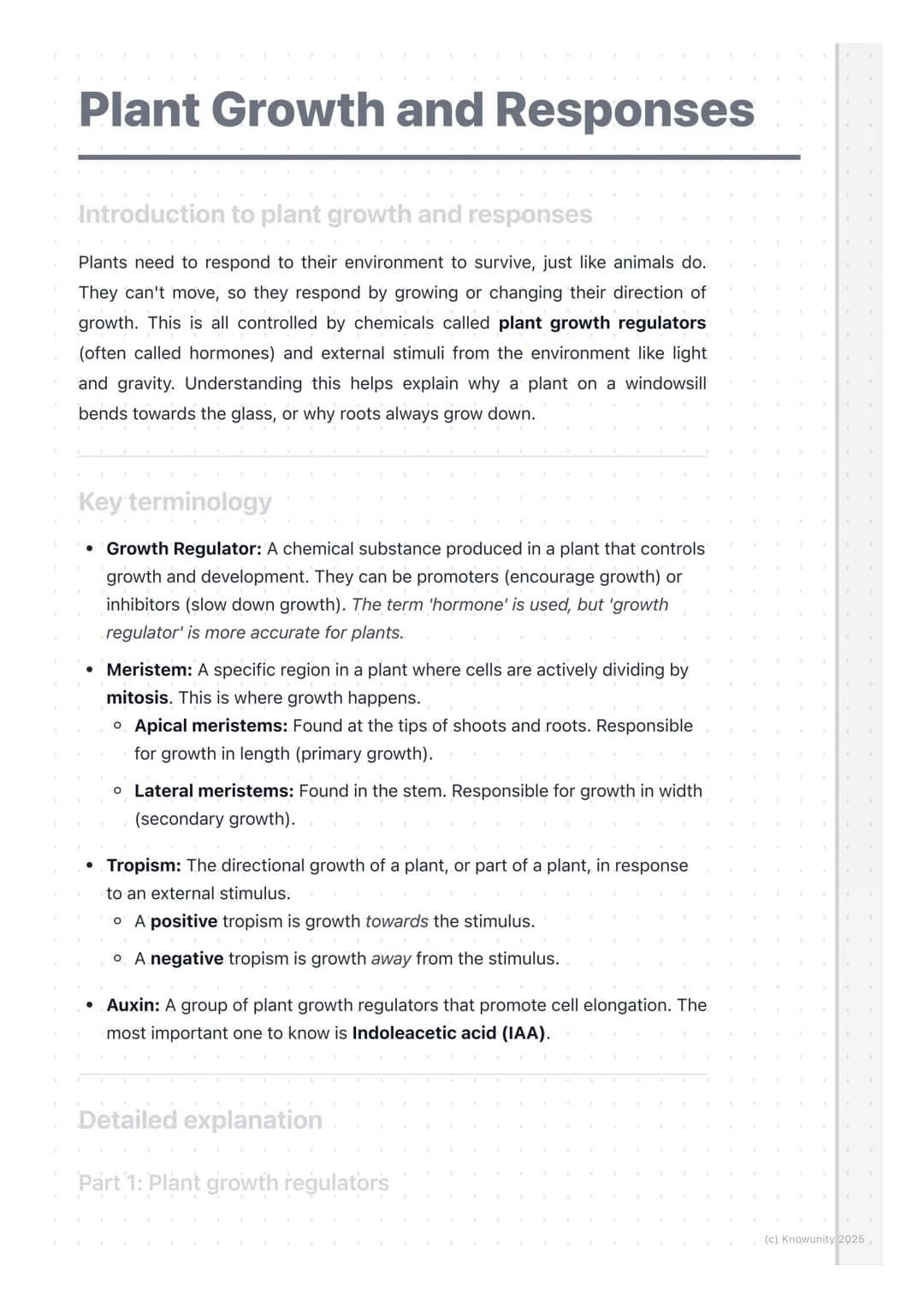
Plant Growth Basics
Plants are basically chemical communication systems that use growth regulators (often called hormones) to control everything from which direction to grow to when to sprout. These chemicals work at specific locations called meristems - think of them as plant growth factories where cells are constantly dividing.
Apical meristems sit at the tips of shoots and roots, making plants grow longer. Lateral meristems run along stems and make them thicker. When plants detect environmental signals like light or gravity, they create directional growth responses called tropisms.
The star player here is auxin (especially one called IAA), which controls how cells stretch and elongate. This single chemical is responsible for most of the clever growth tricks plants pull off.
Key Point: A positive tropism means growing towards something, whilst negative tropism means growing away from it.
2
of 7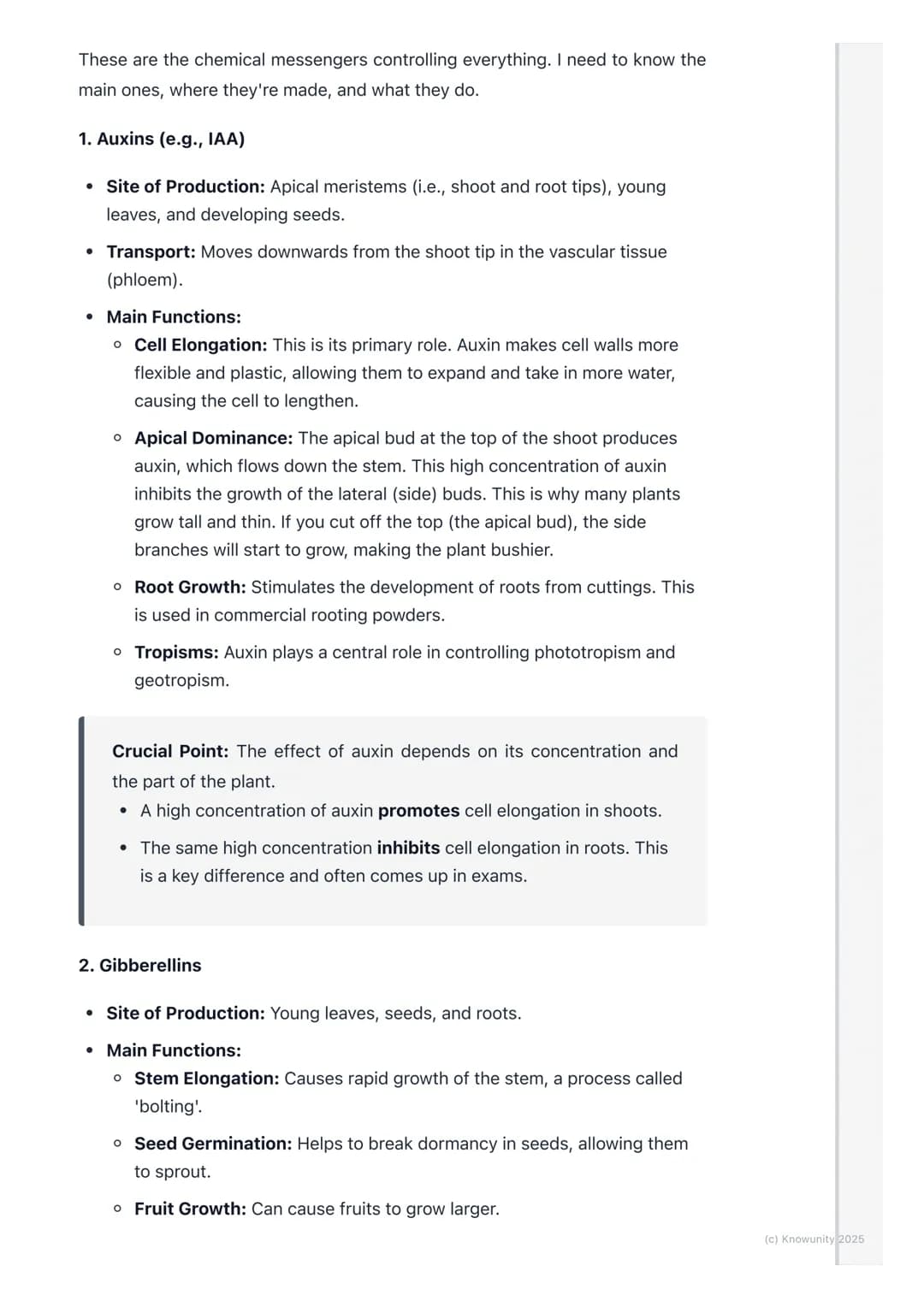
Auxins - The Master Controllers
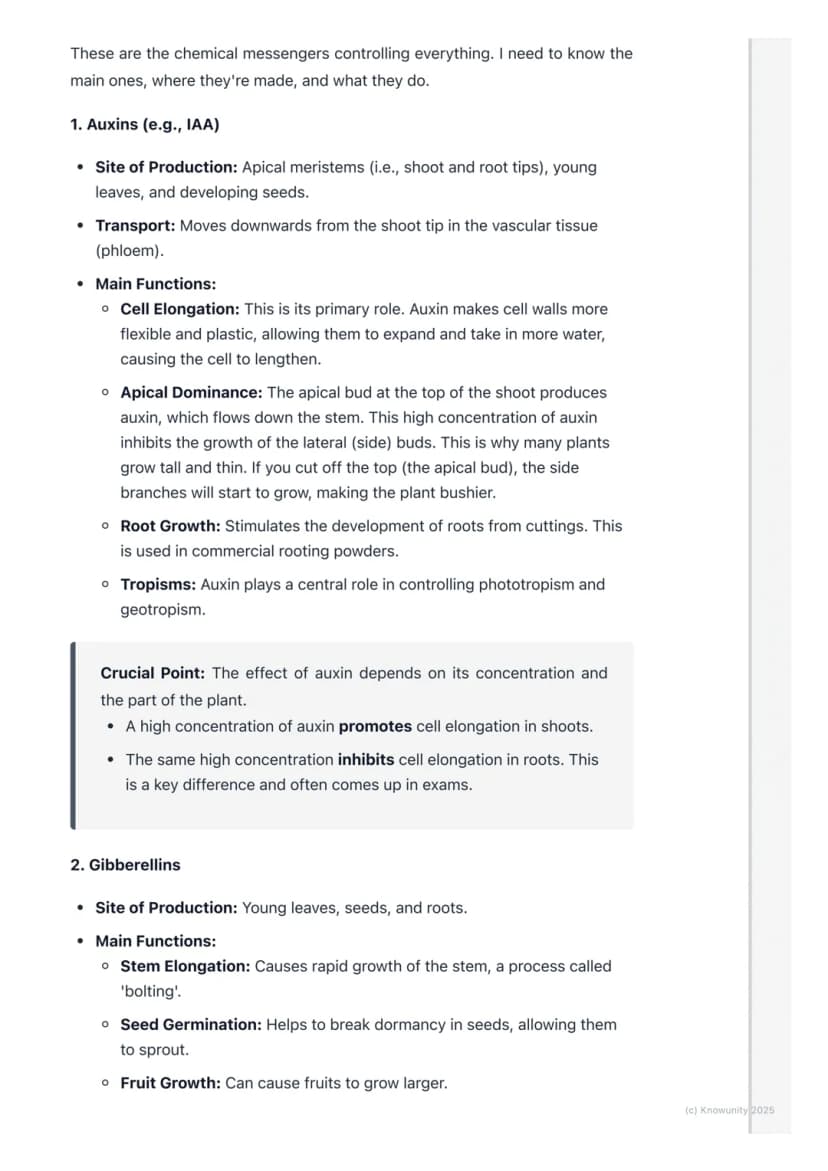
Auxin is basically the plant world's multitool, produced in shoot tips, young leaves, and developing seeds. It travels downward through the plant's vascular system, but here's where it gets interesting - auxin has completely opposite effects depending on where it is.
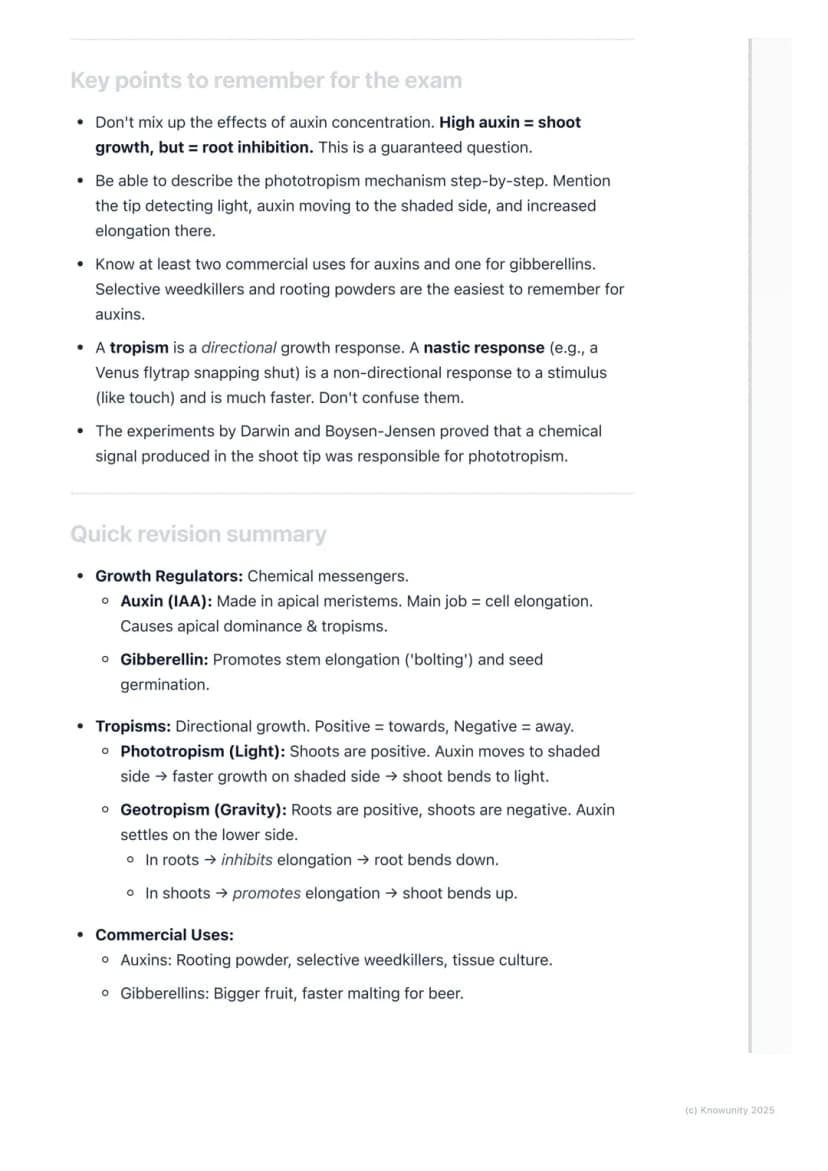
In shoots, high concentrations of auxin promote cell elongation, making stems stretch towards light. But in roots, that same high concentration actually inhibits growth. This difference is crucial for exams and explains why plants can coordinate complex responses.
Auxin also controls apical dominance - the reason many plants grow tall and thin rather than bushy. The main shoot tip pumps out auxin that travels down and tells side buds to stay dormant. Cut off that top shoot (like when pruning), and suddenly those side branches spring to life.
Exam Tip: Remember the golden rule - high auxin concentration promotes shoot growth but inhibits root growth. This concept appears in nearly every plant biology exam.
3
of 7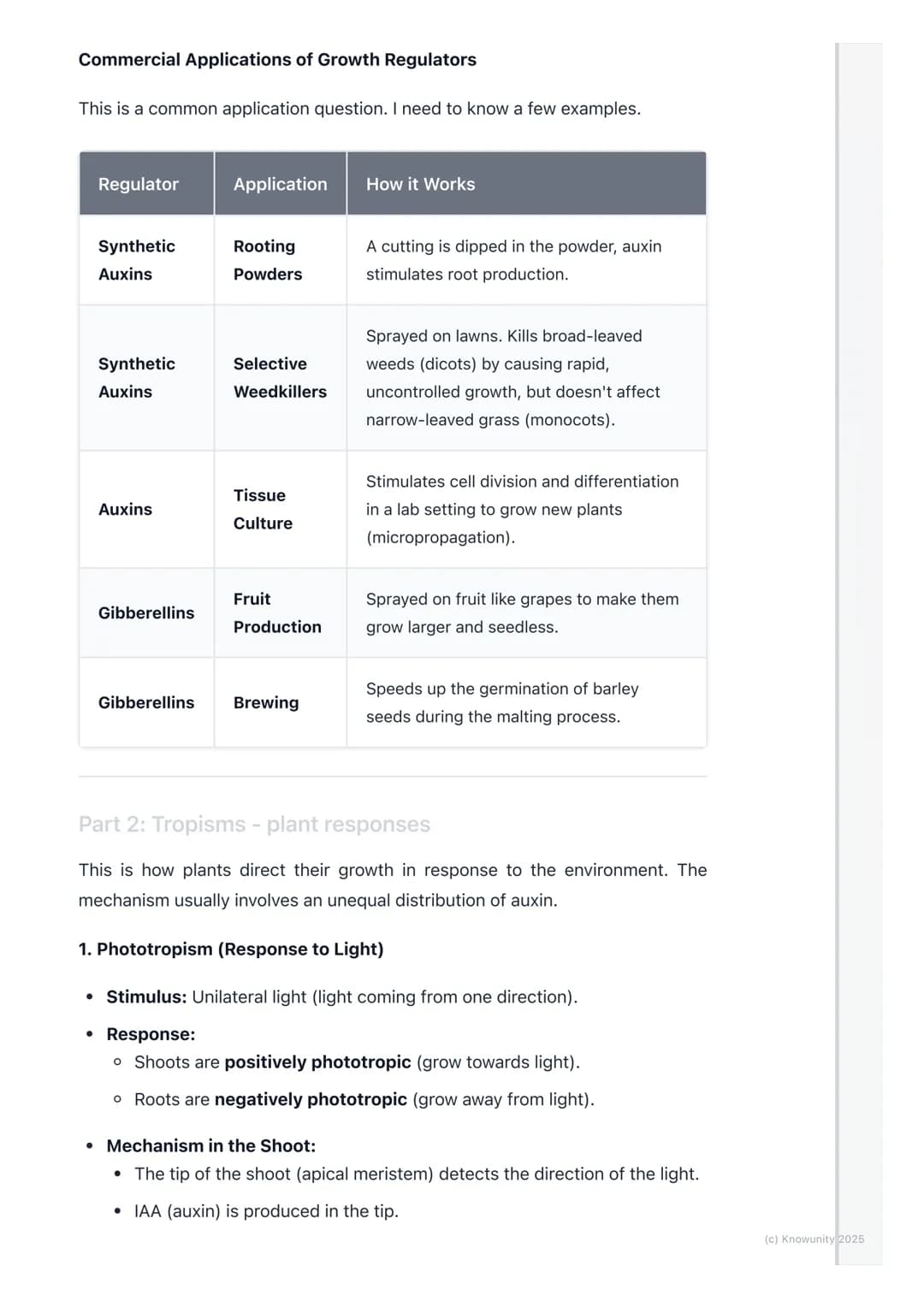
Commercial Applications
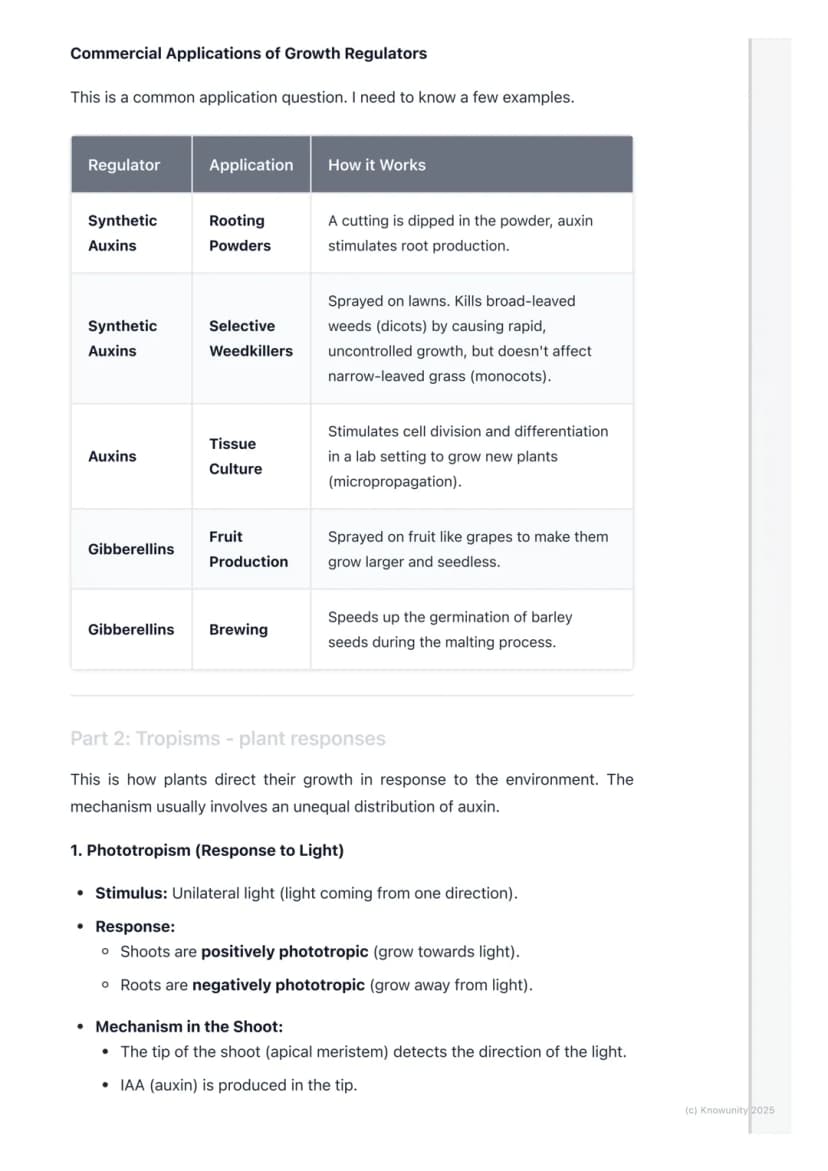
Plant growth regulators aren't just academic theory - they're big business. Synthetic auxins in rooting powders help gardeners grow new plants from cuttings by stimulating root development. The same chemicals become selective weedkillers when sprayed on lawns, causing broad-leaved weeds to grow themselves to death whilst leaving grass unharmed.
Gibberellins are the other major player, causing rapid stem elongation (called 'bolting') and breaking seed dormancy. Fruit growers spray them on grapes to create those massive, seedless varieties you see in shops. Breweries use them to speed up barley germination during the malting process.
In tissue culture labs, precise combinations of auxins and gibberellins can trick plant cells into growing entire new plants in test tubes. This micropropagation technique produces millions of identical plants commercially.
Real-World Connection: That rooting hormone powder at the garden centre? It's synthetic auxin doing exactly what natural plant hormones do, just more reliably.
4
of 7
Phototropism - Chasing the Light
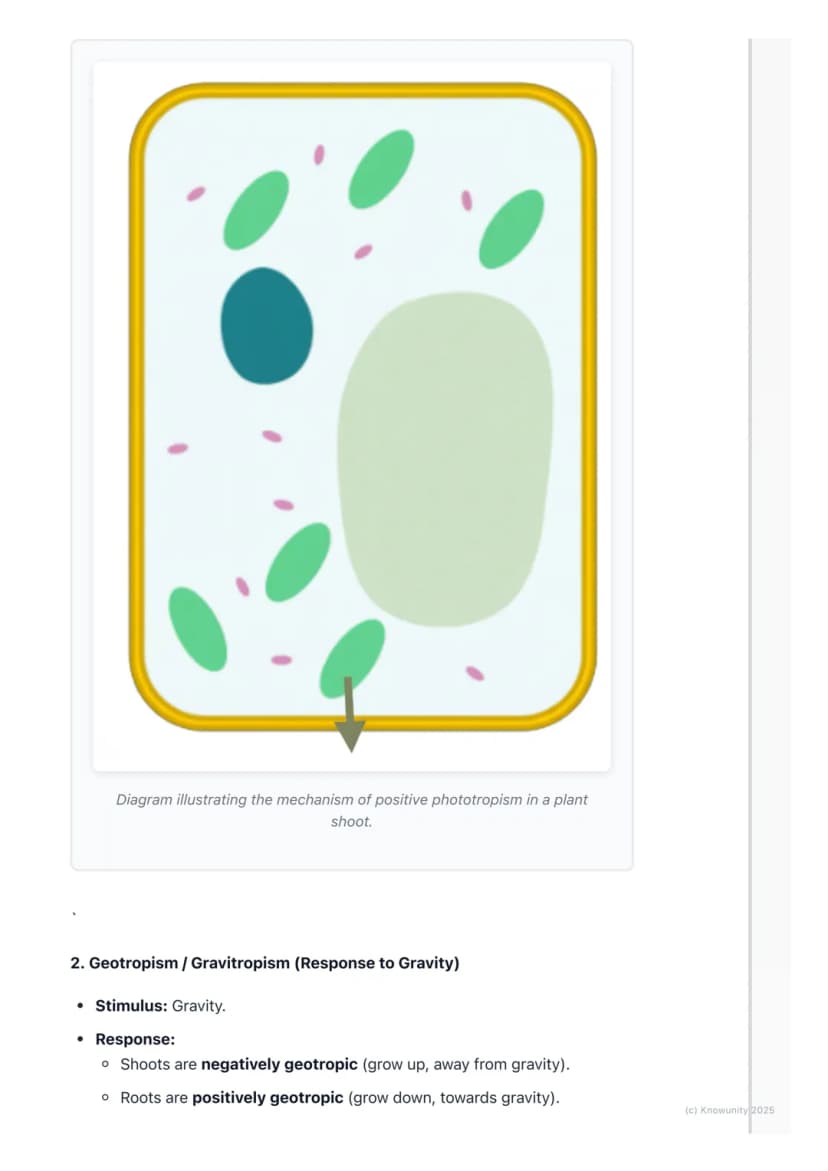
When light hits a plant from one side, you're watching phototropism in action. The shoot tip detects the light direction and immediately starts redistributing IAA (auxin) away from the bright side towards the shaded side.
This creates an unequal distribution of auxin - more on the shaded side means faster cell elongation there. Since one side grows quicker than the other, the shoot bends towards the light source. It's like having a biological GPS system that always points towards maximum photosynthesis potential.
Roots do the opposite, showing negative phototropism by growing away from light. This makes perfect sense - shoots need light for photosynthesis, whilst roots need to head into dark soil to find water and nutrients.
Memory Trick: Think "shade side grows faster" - the auxin moves to the shaded side and makes those cells stretch more, bending the plant towards light.
5
of 7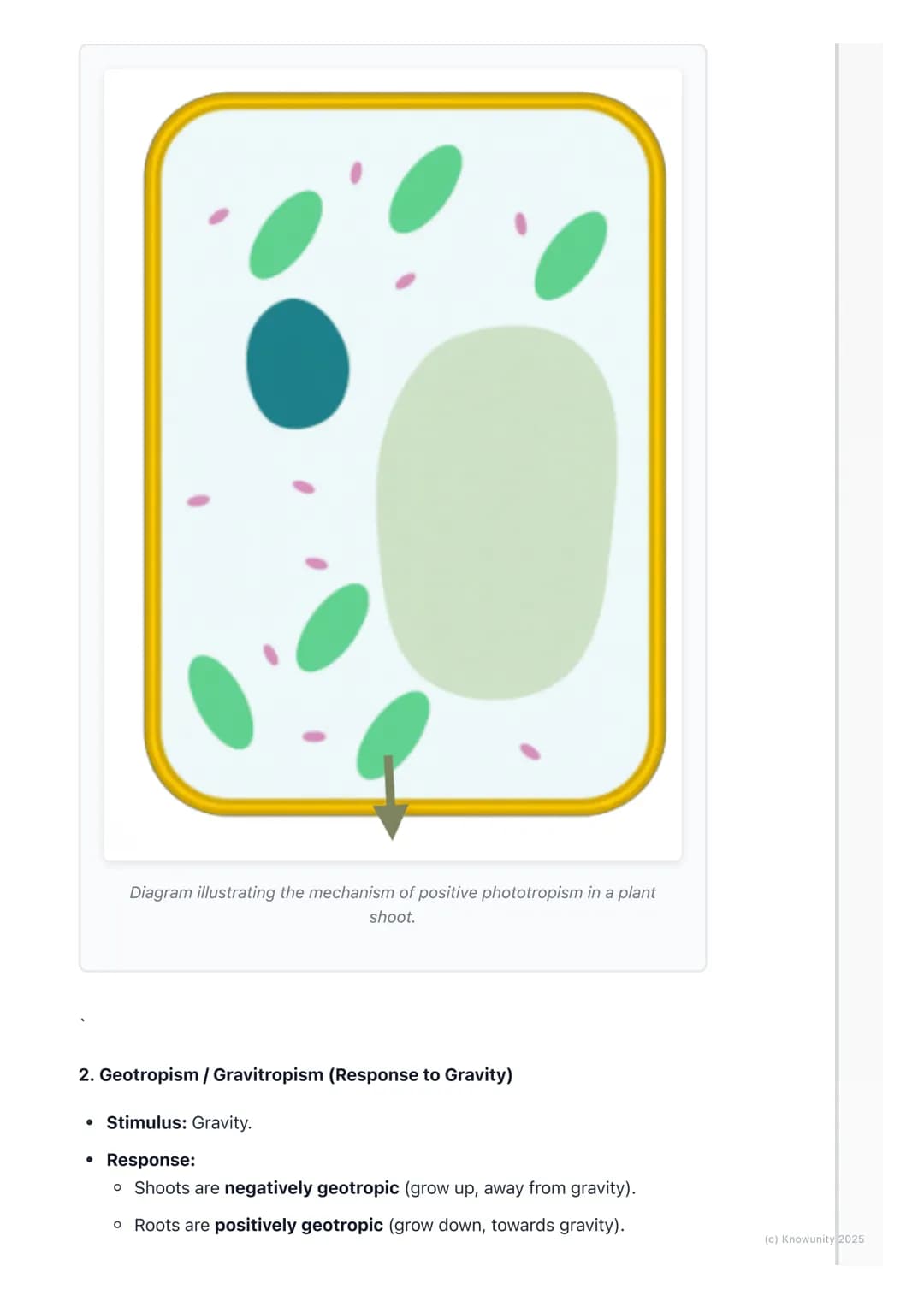
Geotropism - Feeling the Pull
Geotropism (also called gravitropism) is how plants use gravity as their compass. Place a seed on its side, and the emerging shoot will still grow up whilst the root grows down, regardless of how you planted it.
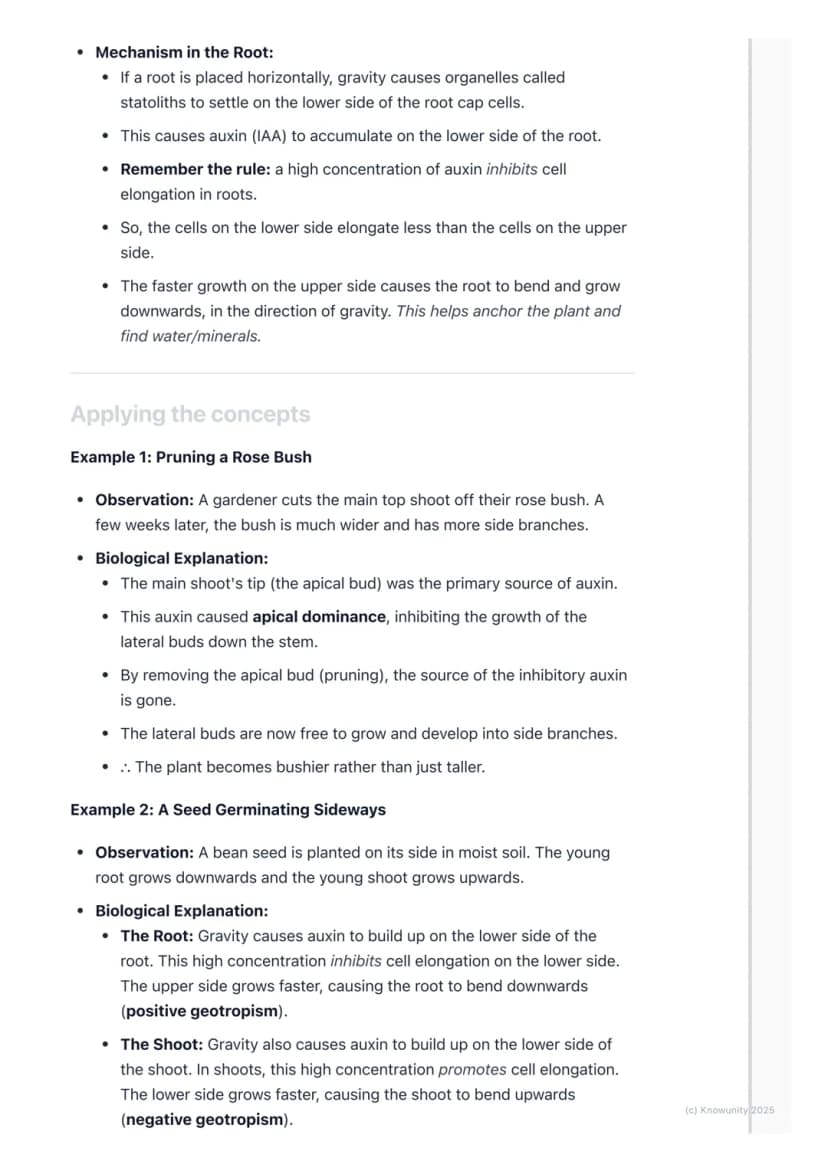
The mechanism involves tiny organelles called statoliths that act like biological ball bearings. In roots, gravity pulls these statoliths to the lower side of cells, triggering auxin accumulation there. Since high auxin concentrations inhibit root cell elongation, the lower side grows slower.
This means the upper side of the root grows faster, causing the root to curve downward towards gravity. Meanwhile, shoots use the same auxin redistribution but with opposite effects - high auxin promotes shoot elongation, so the shoot curves upward against gravity.
Quick Check: Positive geotropism = growing with gravity (roots down), negative geotropism = growing against gravity (shoots up).
6
of 7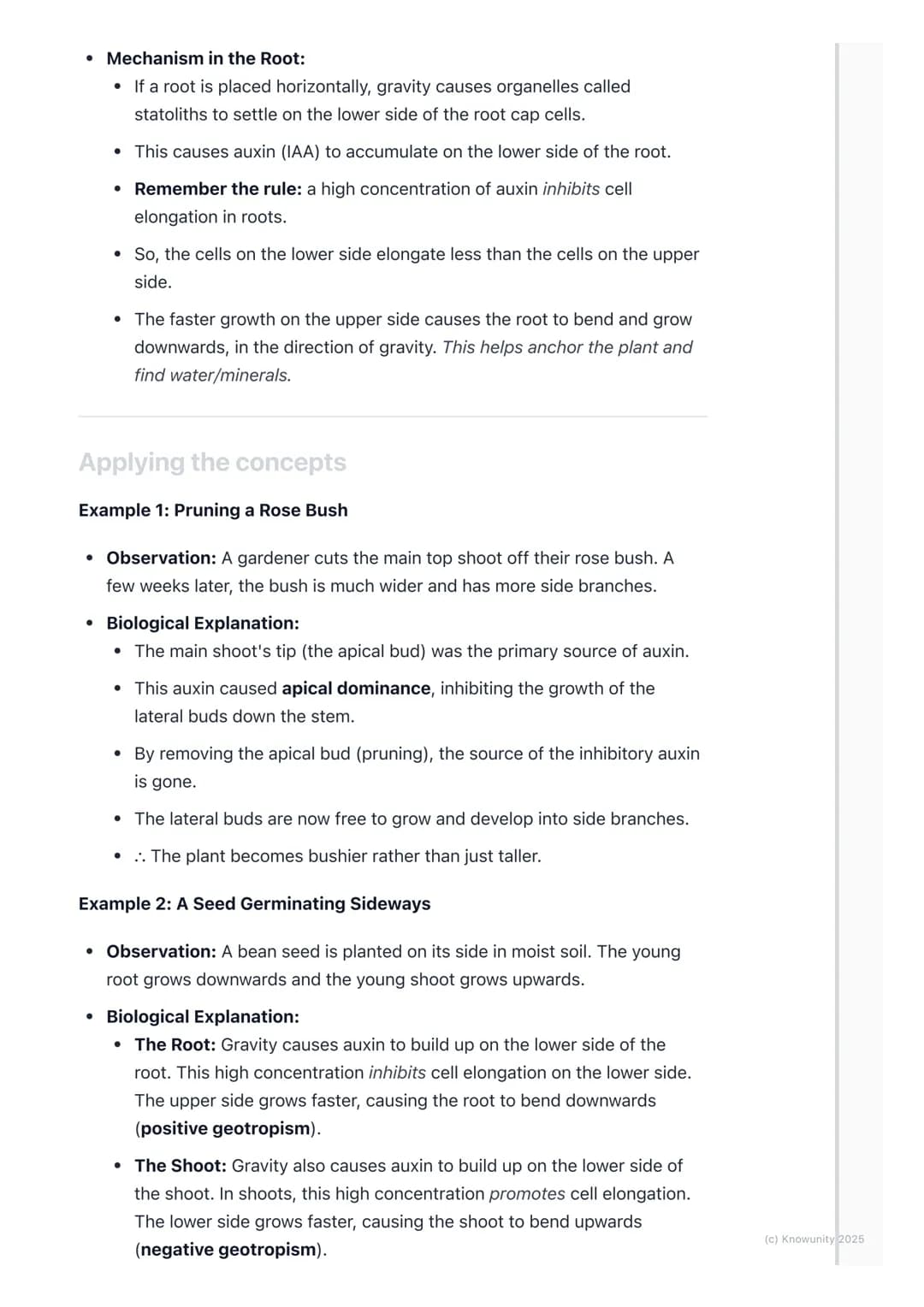
Putting It All Together
Understanding these concepts helps explain everyday plant behaviour. When you prune a rose bush by cutting the main shoot, you're removing the source of apical dominance. Without that steady stream of auxin from the tip, lateral buds burst into growth, creating a bushier plant.
Similarly, when a seed germinates sideways, both phototropism and geotropism work together. The root uses gravity to find "down" whilst the shoot uses both gravity and light to find "up", ensuring the plant establishes itself correctly regardless of how it lands.
These responses happen because plants have evolved sophisticated chemical communication systems that let them respond to environmental cues without a nervous system. Every bend, every growth spurt, every directional change is the result of auxin redistribution and cellular responses.
Exam Success: Focus on understanding the mechanisms rather than memorising facts. If you grasp how auxin moves and where it acts, you can work out most plant responses logically.
7
of 7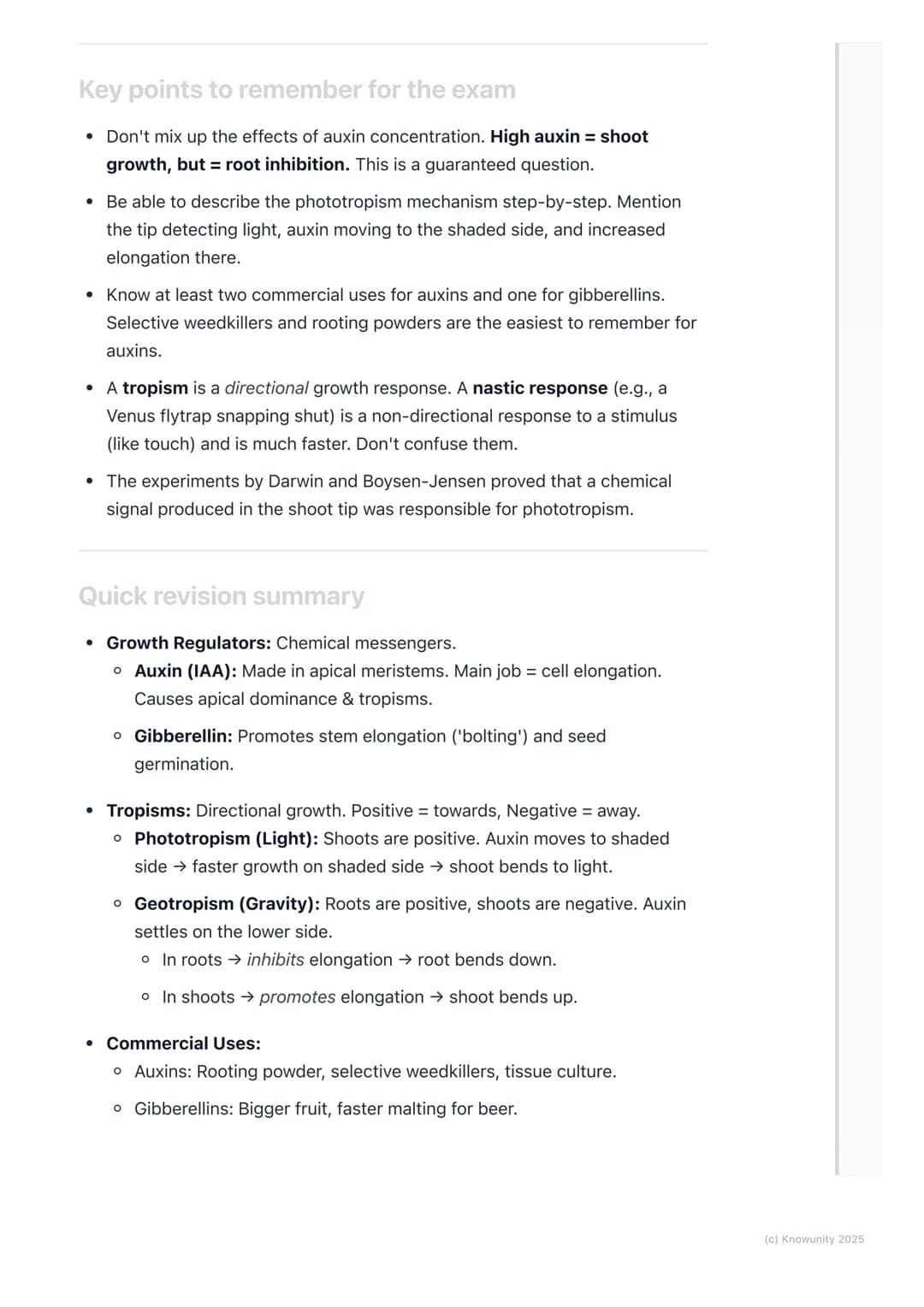
そんなこと聞いてくれるのを待ってたよ...
KnowunityのAIコンパニオンとは?
KnowunityのAIコンパニオンは学生向けに設計されたAIツールで、単なる答えを提供するだけではありません。数百万のKnowunityリソースを基に構築され、関連する情報、個別の学習プラン、クイズ、コンテンツをチャット内で直接提供し、あなたの個別の学習過程に適応します。
Knowunityアプリはどこでダウンロードできますか?
Google Play StoreとApple App Storeからアプリをダウンロードできます。
Knowunityは本当に無料ですか?
その通り!学習コンテンツへの無料アクセス、仲間の学生とのつながり、そして即座のサポートを手のひらで楽しもう。
Biologyの人気コンテンツ
8BiologyEcology introduction notes!
Start of the leaving cert ecology chapter
6th Year131
BiologyDNA & RNA
All notes on DNA & RNA including protein synthesis which is a HL topic
5th Year250
BiologyVertebrates and Invertebrates
Students will distinguish between animals that have a backbone (vertebrates) and those that do not (invertebrates), identifying examples of each.
2nd Year240
BiologyBiomolecules: chapter 8
Summary and easily understandable notes to revise chapter 8 biomolecules. Includes good labelled diagrams for visual learners
5th Year210
BiologyCirculatory System
Students will learn about the heart, blood, and blood vessels, and how this system transports oxygen, nutrients, and waste products around the body.
3rd Year140
BiologyRespiration
All respiration notes including simple diagrams and glycolysis and the Krebs cycle
5th Year120
BiologyPhotosynthesis : Biology
Photosynthesis
6th Year371
BiologyPlant Cells
Learning about the unique structures found in plant cells, such as the cell wall, chloroplasts, and large vacuole, and how they differ from animal cells.
1st Year80
人気コンテンツ
9 Irish
IrishIrish oral questions and answers
Questions and answers for the leaving cert oral
5th Year4264
 English
Key Quotes : Sive
Key Quotes and explanations: Sive
6th Year2842
IrishIrish oral questions
Outline of oral questions
5th Year2055
IrishIníon- le hÁine Durkin
Aine Durkin’s poem, Iníon: Themes & summary
5th Year850
IrishIrish poetry 2027
Iníon + Dínit an Bhróin
5th Year1133
IrishLC HL notes- Iníon (poem)
Includes poem in English and Irish, theme, key words & phrases
5th Year2284
EnglishCultural Context : Shawshank Redemption : Sive : Small Things Like These
Comparative Study : Cultural Context : Shawshank Redemption, Sive and Small Things Like These
6th Year1430
IrishMo Ghrá-sa (Idir Lúibíní)
Notes on mo ghrá-sa
5th Year380
IrishAn Gaeilge Aiste
Irish Language essay
6th Year1320
探しているものが見つからない?他の教科も見てみよう。
生徒たちが愛用中 — あなたもきっと気に入るはず。
4.6/5App Store
4.7/5Google Play
このアプリはとても使いやすくて、デザインも良いです。今のところ探していたものは全て見つかったし、プレゼン資料からもたくさん学べました!絶対に課題でも使いたいと思います!もちろん、アイデアを得るのにもすごく役立ちます。
Stefan SiOSユーザー
このアプリは本当に素晴らしいです。学習ノートやサポート資料がとても豊富で[...]。例えば、私の苦手科目はフランス語なんですが、このアプリにはサポートオプションがたくさんあります。このアプリのおかげでフランス語が上達しました。誰にでもおすすめしたいです。
Samantha KlichAndroidユーザー
すごい、本当に驚いた。広告で何度も見かけたからアプリを試してみたら、めちゃくちゃ感動した。このアプリは学校で欲しかった「まさにこれ!」って感じのサポートで、特に練習問題や要点まとめみたいな機能がたくさんあって、個人的にすごく助かってる。
AnnaiOSユーザー
Biology1 閲覧数·更新日 Jun 11, 2026·7 ページExploring Plant Growth and Environmental Responses
Ever wonder why plants on your windowsill always lean towards the glass, or how roots know to grow downwards? Plants can't move like animals, but they're constantly responding to their environment through clever growth patterns controlled by chemical messengers called ...
1
of 7
サインアップしてコンテンツを見よう。無料だよ!
- 全ドキュメントへのアクセス
- 成績アップ
- 数百万人の学生と一緒に学習
Plant Growth Basics
Plants are basically chemical communication systems that use growth regulators (often called hormones) to control everything from which direction to grow to when to sprout. These chemicals work at specific locations called meristems - think of them as plant growth factories where cells are constantly dividing.
Apical meristems sit at the tips of shoots and roots, making plants grow longer. Lateral meristems run along stems and make them thicker. When plants detect environmental signals like light or gravity, they create directional growth responses called tropisms.
The star player here is auxin (especially one called IAA), which controls how cells stretch and elongate. This single chemical is responsible for most of the clever growth tricks plants pull off.
Key Point: A positive tropism means growing towards something, whilst negative tropism means growing away from it.
2
of 7サインアップしてコンテンツを見よう。無料だよ!
- 全ドキュメントへのアクセス
- 成績アップ
- 数百万人の学生と一緒に学習
Auxins - The Master Controllers
Auxin is basically the plant world's multitool, produced in shoot tips, young leaves, and developing seeds. It travels downward through the plant's vascular system, but here's where it gets interesting - auxin has completely opposite effects depending on where it is.
In shoots, high concentrations of auxin promote cell elongation, making stems stretch towards light. But in roots, that same high concentration actually inhibits growth. This difference is crucial for exams and explains why plants can coordinate complex responses.
Auxin also controls apical dominance - the reason many plants grow tall and thin rather than bushy. The main shoot tip pumps out auxin that travels down and tells side buds to stay dormant. Cut off that top shoot (like when pruning), and suddenly those side branches spring to life.
Exam Tip: Remember the golden rule - high auxin concentration promotes shoot growth but inhibits root growth. This concept appears in nearly every plant biology exam.
3
of 7サインアップしてコンテンツを見よう。無料だよ!
- 全ドキュメントへのアクセス
- 成績アップ
- 数百万人の学生と一緒に学習
Commercial Applications
Plant growth regulators aren't just academic theory - they're big business. Synthetic auxins in rooting powders help gardeners grow new plants from cuttings by stimulating root development. The same chemicals become selective weedkillers when sprayed on lawns, causing broad-leaved weeds to grow themselves to death whilst leaving grass unharmed.
Gibberellins are the other major player, causing rapid stem elongation (called 'bolting') and breaking seed dormancy. Fruit growers spray them on grapes to create those massive, seedless varieties you see in shops. Breweries use them to speed up barley germination during the malting process.
In tissue culture labs, precise combinations of auxins and gibberellins can trick plant cells into growing entire new plants in test tubes. This micropropagation technique produces millions of identical plants commercially.
Real-World Connection: That rooting hormone powder at the garden centre? It's synthetic auxin doing exactly what natural plant hormones do, just more reliably.
4
of 7サインアップしてコンテンツを見よう。無料だよ!
- 全ドキュメントへのアクセス
- 成績アップ
- 数百万人の学生と一緒に学習
Phototropism - Chasing the Light
When light hits a plant from one side, you're watching phototropism in action. The shoot tip detects the light direction and immediately starts redistributing IAA (auxin) away from the bright side towards the shaded side.
This creates an unequal distribution of auxin - more on the shaded side means faster cell elongation there. Since one side grows quicker than the other, the shoot bends towards the light source. It's like having a biological GPS system that always points towards maximum photosynthesis potential.
Roots do the opposite, showing negative phototropism by growing away from light. This makes perfect sense - shoots need light for photosynthesis, whilst roots need to head into dark soil to find water and nutrients.
Memory Trick: Think "shade side grows faster" - the auxin moves to the shaded side and makes those cells stretch more, bending the plant towards light.
5
of 7サインアップしてコンテンツを見よう。無料だよ!
- 全ドキュメントへのアクセス
- 成績アップ
- 数百万人の学生と一緒に学習
Geotropism - Feeling the Pull
Geotropism (also called gravitropism) is how plants use gravity as their compass. Place a seed on its side, and the emerging shoot will still grow up whilst the root grows down, regardless of how you planted it.
The mechanism involves tiny organelles called statoliths that act like biological ball bearings. In roots, gravity pulls these statoliths to the lower side of cells, triggering auxin accumulation there. Since high auxin concentrations inhibit root cell elongation, the lower side grows slower.
This means the upper side of the root grows faster, causing the root to curve downward towards gravity. Meanwhile, shoots use the same auxin redistribution but with opposite effects - high auxin promotes shoot elongation, so the shoot curves upward against gravity.
Quick Check: Positive geotropism = growing with gravity (roots down), negative geotropism = growing against gravity (shoots up).
6
of 7サインアップしてコンテンツを見よう。無料だよ!
- 全ドキュメントへのアクセス
- 成績アップ
- 数百万人の学生と一緒に学習
Putting It All Together
Understanding these concepts helps explain everyday plant behaviour. When you prune a rose bush by cutting the main shoot, you're removing the source of apical dominance. Without that steady stream of auxin from the tip, lateral buds burst into growth, creating a bushier plant.
Similarly, when a seed germinates sideways, both phototropism and geotropism work together. The root uses gravity to find "down" whilst the shoot uses both gravity and light to find "up", ensuring the plant establishes itself correctly regardless of how it lands.
These responses happen because plants have evolved sophisticated chemical communication systems that let them respond to environmental cues without a nervous system. Every bend, every growth spurt, every directional change is the result of auxin redistribution and cellular responses.
Exam Success: Focus on understanding the mechanisms rather than memorising facts. If you grasp how auxin moves and where it acts, you can work out most plant responses logically.
7
of 7サインアップしてコンテンツを見よう。無料だよ!
- 全ドキュメントへのアクセス
- 成績アップ
- 数百万人の学生と一緒に学習
そんなこと聞いてくれるのを待ってたよ...
KnowunityのAIコンパニオンとは?
KnowunityのAIコンパニオンは学生向けに設計されたAIツールで、単なる答えを提供するだけではありません。数百万のKnowunityリソースを基に構築され、関連する情報、個別の学習プラン、クイズ、コンテンツをチャット内で直接提供し、あなたの個別の学習過程に適応します。
Knowunityアプリはどこでダウンロードできますか?
Google Play StoreとApple App Storeからアプリをダウンロードできます。
Knowunityは本当に無料ですか?
その通り!学習コンテンツへの無料アクセス、仲間の学生とのつながり、そして即座のサポートを手のひらで楽しもう。
Biologyの人気コンテンツ
8BiologyEcology introduction notes!
Start of the leaving cert ecology chapter
6th Year131
BiologyDNA & RNA
All notes on DNA & RNA including protein synthesis which is a HL topic
5th Year250
BiologyVertebrates and Invertebrates
Students will distinguish between animals that have a backbone (vertebrates) and those that do not (invertebrates), identifying examples of each.
2nd Year240
BiologyBiomolecules: chapter 8
Summary and easily understandable notes to revise chapter 8 biomolecules. Includes good labelled diagrams for visual learners
5th Year210
BiologyCirculatory System
Students will learn about the heart, blood, and blood vessels, and how this system transports oxygen, nutrients, and waste products around the body.
3rd Year140
BiologyRespiration
All respiration notes including simple diagrams and glycolysis and the Krebs cycle
5th Year120
BiologyPhotosynthesis : Biology
Photosynthesis
6th Year371
BiologyPlant Cells
Learning about the unique structures found in plant cells, such as the cell wall, chloroplasts, and large vacuole, and how they differ from animal cells.
1st Year80
人気コンテンツ
9IrishIrish oral questions and answers
Questions and answers for the leaving cert oral
5th Year4264
EnglishKey Quotes : Sive
Key Quotes and explanations: Sive
6th Year2842
IrishIrish oral questions
Outline of oral questions
5th Year2055
IrishIníon- le hÁine Durkin
Aine Durkin’s poem, Iníon: Themes & summary
5th Year850
IrishIrish poetry 2027
Iníon + Dínit an Bhróin
5th Year1133
IrishLC HL notes- Iníon (poem)
Includes poem in English and Irish, theme, key words & phrases
5th Year2284
EnglishCultural Context : Shawshank Redemption : Sive : Small Things Like These
Comparative Study : Cultural Context : Shawshank Redemption, Sive and Small Things Like These
6th Year1430
IrishMo Ghrá-sa (Idir Lúibíní)
Notes on mo ghrá-sa
5th Year380
IrishAn Gaeilge Aiste
Irish Language essay
6th Year1320
探しているものが見つからない?他の教科も見てみよう。
生徒たちが愛用中 — あなたもきっと気に入るはず。
4.6/5App Store
4.7/5Google Play
このアプリはとても使いやすくて、デザインも良いです。今のところ探していたものは全て見つかったし、プレゼン資料からもたくさん学べました!絶対に課題でも使いたいと思います!もちろん、アイデアを得るのにもすごく役立ちます。
Stefan SiOSユーザー
このアプリは本当に素晴らしいです。学習ノートやサポート資料がとても豊富で[...]。例えば、私の苦手科目はフランス語なんですが、このアプリにはサポートオプションがたくさんあります。このアプリのおかげでフランス語が上達しました。誰にでもおすすめしたいです。
Samantha KlichAndroidユーザー
すごい、本当に驚いた。広告で何度も見かけたからアプリを試してみたら、めちゃくちゃ感動した。このアプリは学校で欲しかった「まさにこれ!」って感じのサポートで、特に練習問題や要点まとめみたいな機能がたくさんあって、個人的にすごく助かってる。
AnnaiOSユーザー