
Ever wondered how your phone, computer, or even a simple...
 Applied Technology1 閲覧数·更新日 Jun 19, 2026·7 ページ
Understanding Basic Electronic Components

1 / 7
1
of 7
Electronic Components Basics
Electronic components are literally everywhere in your daily life - from your gaming console to your car's engine management system. They're the fundamental pieces that control how electricity flows through circuits.
Here's what you absolutely need to know: a circuit is just a complete path that lets electricity flow. Picture it like a race track - you need a starting point (battery), the track itself (wires), and some obstacles or features along the way (the components).
Current flows like water through a pipe, measured in Amperes (A). Voltage is the electrical pressure pushing that current along, measured in Volts (V). Resistance acts like a narrow section in the pipe that slows things down, measured in Ohms (Ω).
Remember This: Ohm's Law is your best friend: V = I × R. Master this formula and you'll ace most electronics calculations!
2
of 7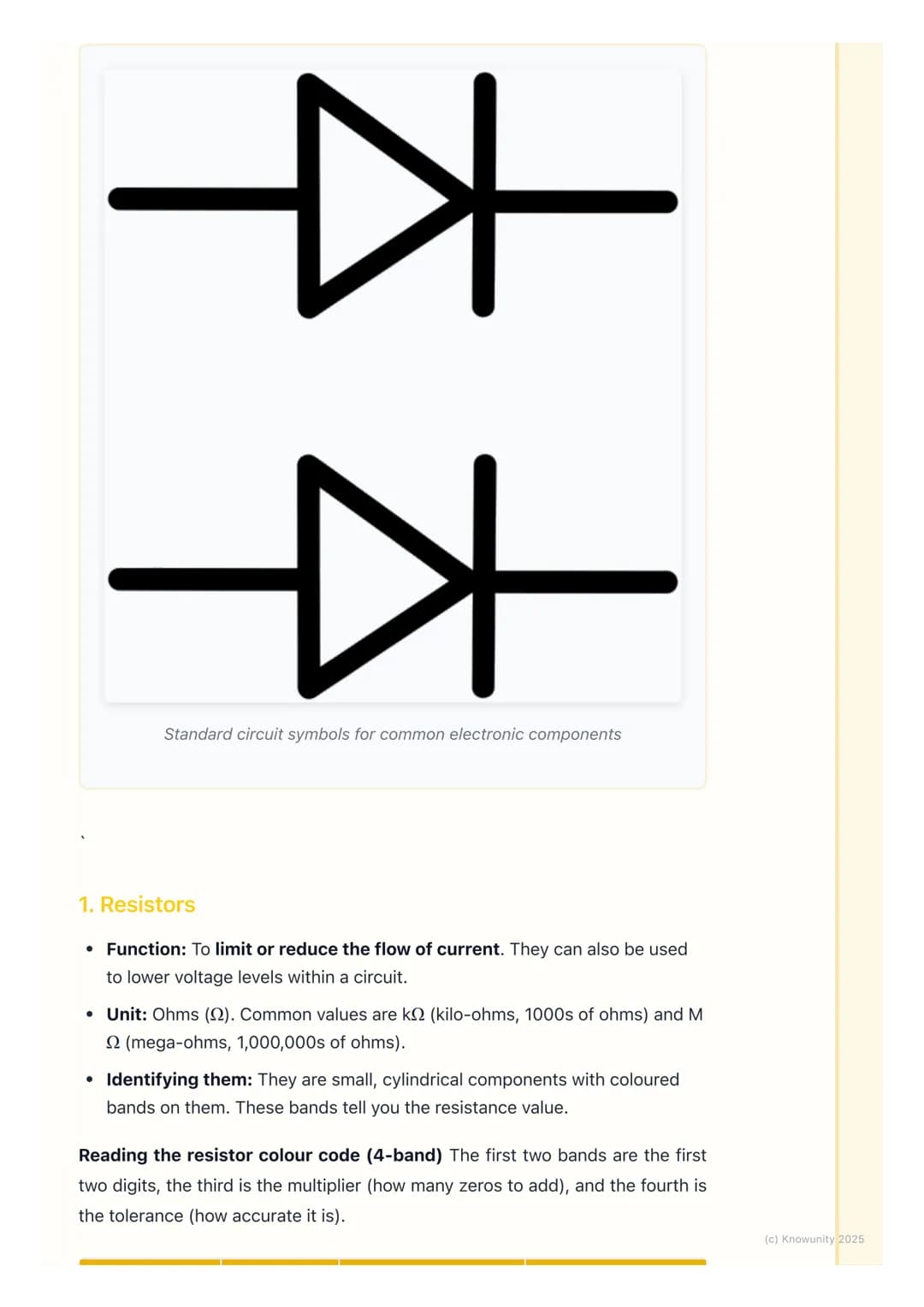
Resistors - The Current Controllers
Resistors are probably the most common components you'll encounter. Their job is simple: limit the flow of current to protect other components from getting fried.
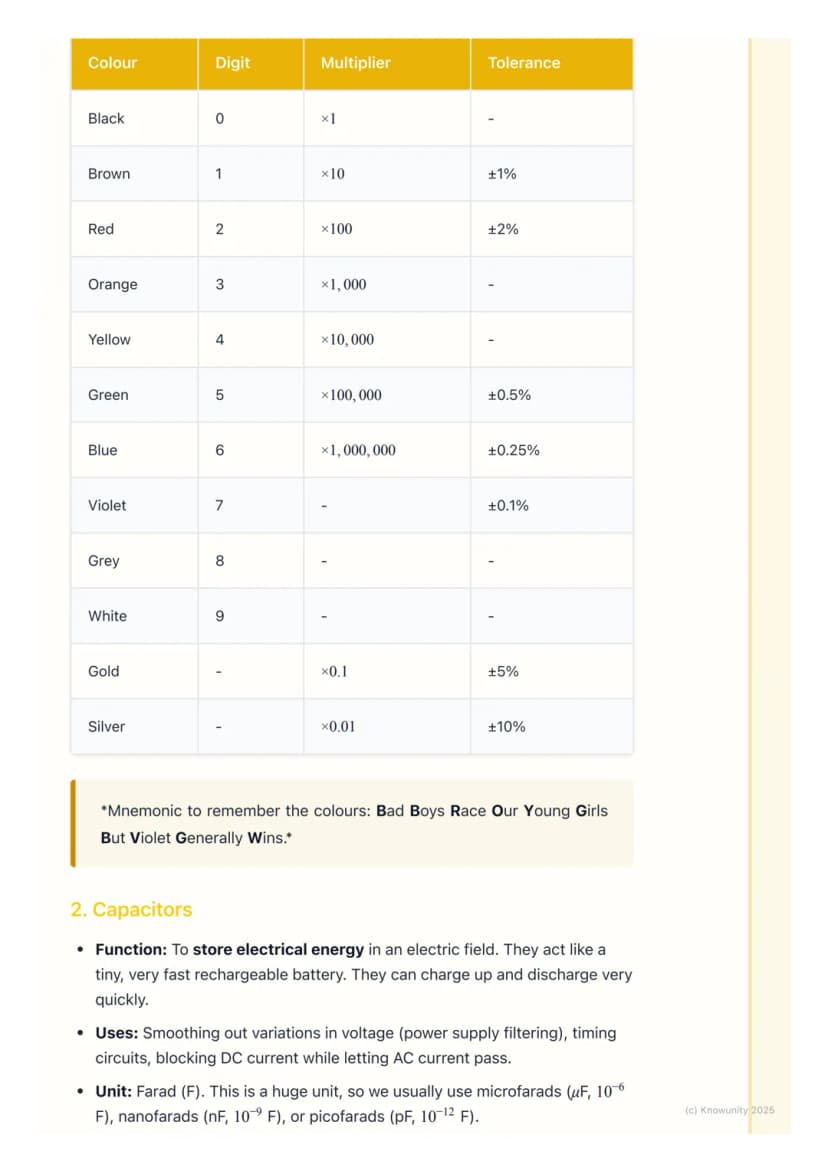
You'll recognise them by their coloured bands - it's like a secret code that tells you their value. The resistor colour code uses the first two bands for digits, the third as a multiplier (how many zeros to add), and the fourth shows tolerance (how accurate the value is).
Here's a memory trick that actually works: "Bad Boys Race Our Young Girls But Violet Generally Wins" for Black, Brown, Red, Orange, Yellow, Green, Blue, Violet, Grey, White. The colours represent numbers 0-9 in that order.
Pro Tip: When you're unsure about a resistor's value, use a multimeter to double-check. It's way faster than squinting at tiny colour bands!
3
of 7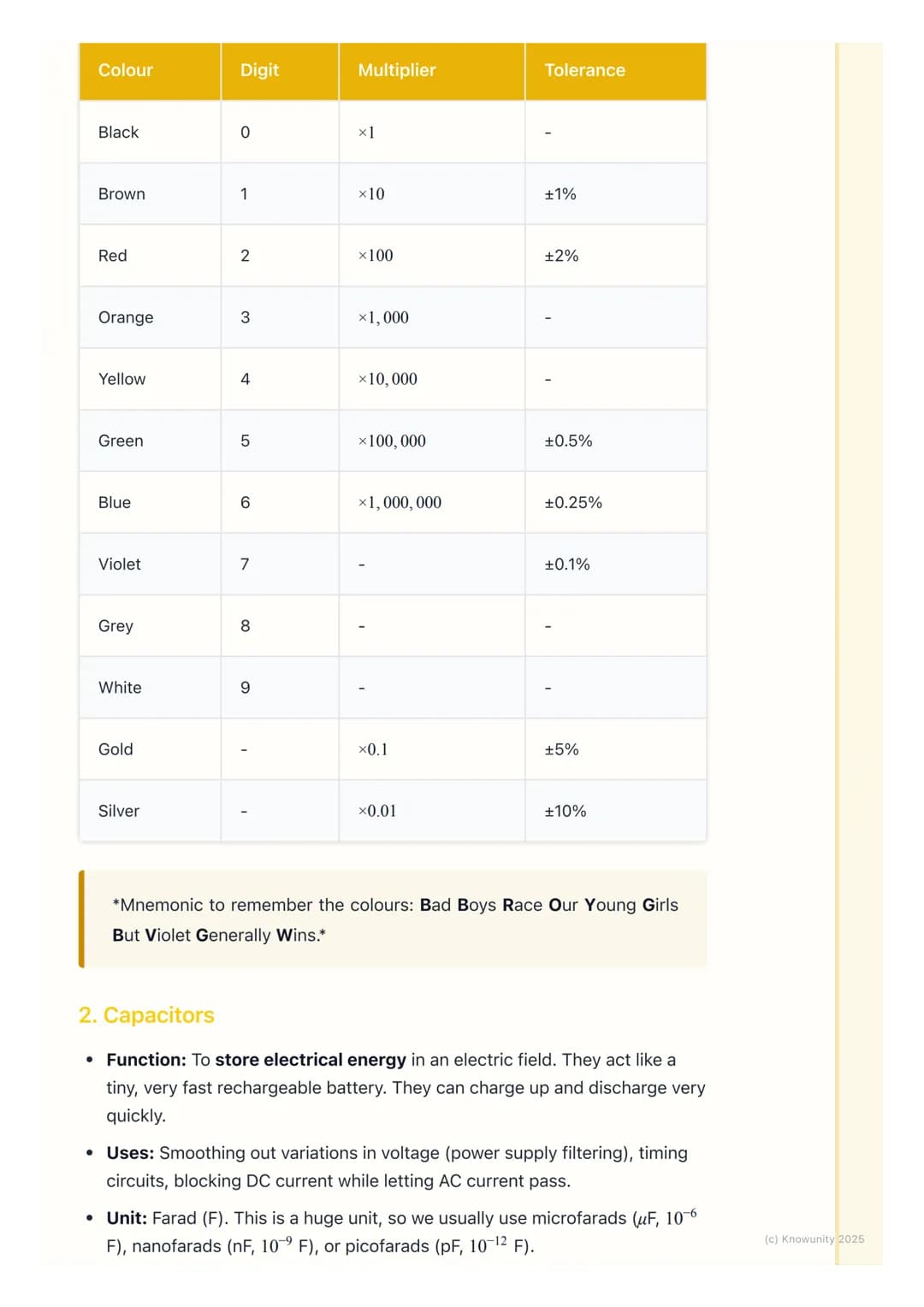
Capacitors and Diodes - Energy Storage and One-Way Streets
Capacitors are like tiny, super-fast rechargeable batteries. They store electrical energy and release it when needed. You'll find them smoothing out power supplies and creating timing circuits in everything from camera flashes to computer motherboards.
Watch out for electrolytic capacitors - they're polarised, meaning they have a positive and negative side. Connect them backwards and they'll literally explode (well, pop quite dramatically).
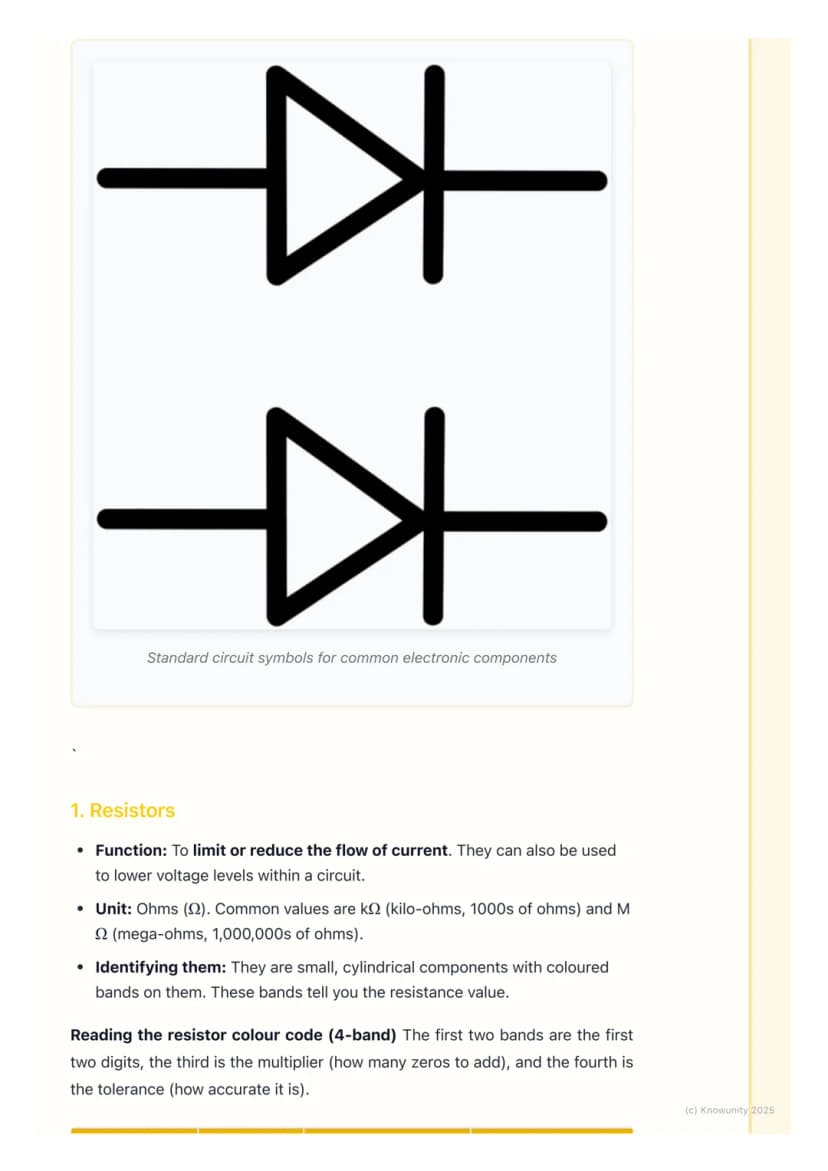
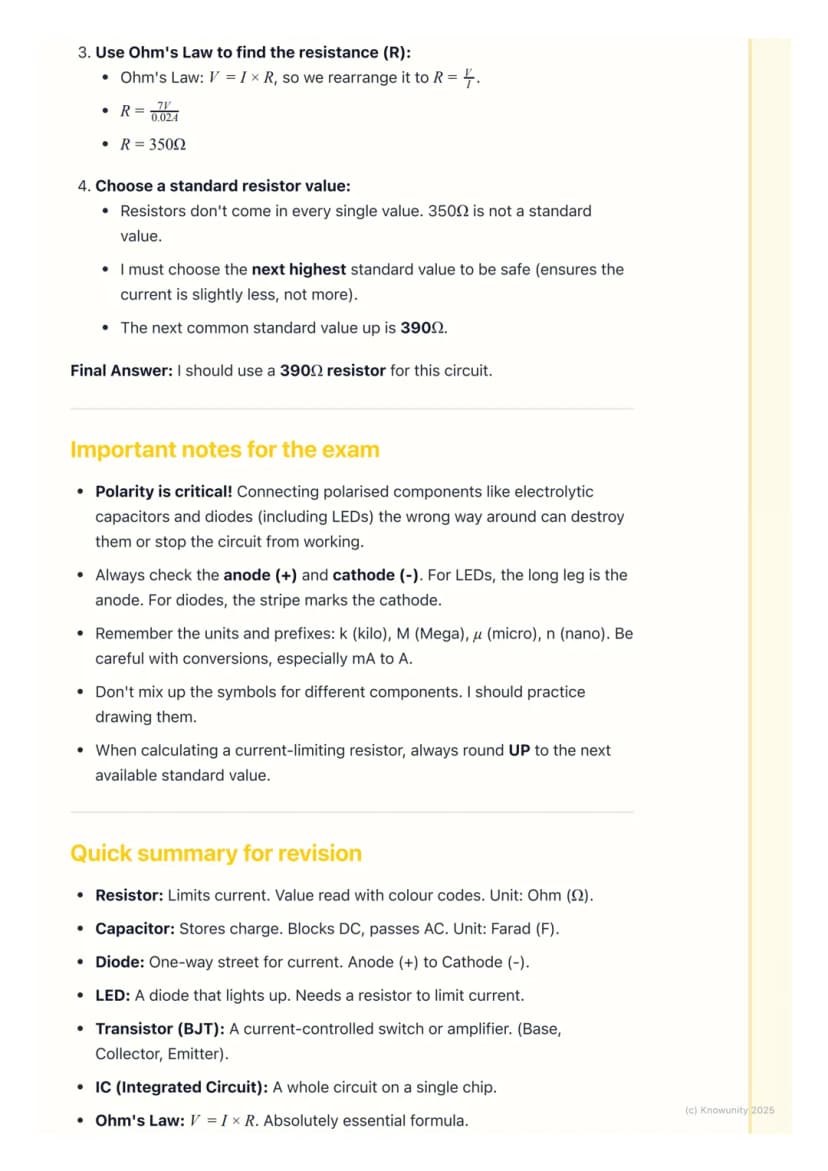
Diodes are the one-way streets of electronics. Current flows from the anode (+) to the cathode (-) and absolutely nowhere else. The stripe on a diode's body always marks the cathode side.
LEDs are special diodes that light up when current flows through them. The longer leg is always positive. Just remember - they need a current-limiting resistor or they'll burn out instantly.
Watch Out: Polarity matters! Getting the positive and negative connections wrong can destroy components or make circuits fail completely.
4
of 7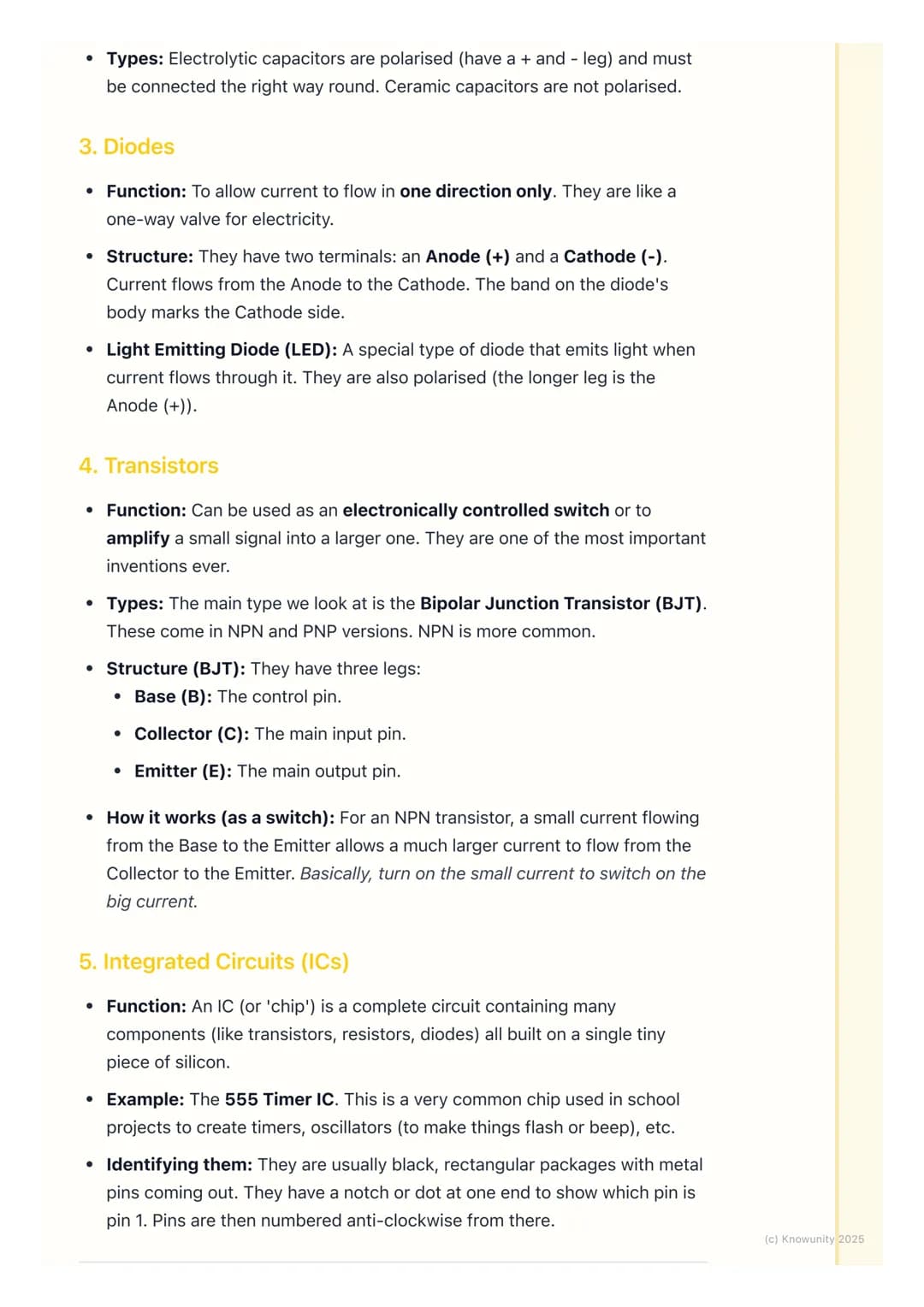
Transistors and Integrated Circuits - The Smart Stuff
Transistors are absolutely revolutionary - they're either electronic switches or amplifiers, depending on how you use them. Think of them as taps that can be turned on or off by applying a small signal to the base, which then controls a much larger current between the collector and emitter.
NPN transistors are the most common type. A small current from base to emitter allows a massive current to flow from collector to emitter. It's like using a tiny key to open a huge floodgate.
Integrated Circuits (ICs) are complete circuits shrunk down onto a single chip. The 555 timer IC is legendary in electronics - it's used in thousands of projects to create timers, flashers, and sound generators.
ICs have a notch or dot marking pin 1, then you count anti-clockwise from there. Get this wrong and your circuit definitely won't work.
Key Insight: Transistors are the foundation of all modern computing - your smartphone has billions of them working together!
5
of 7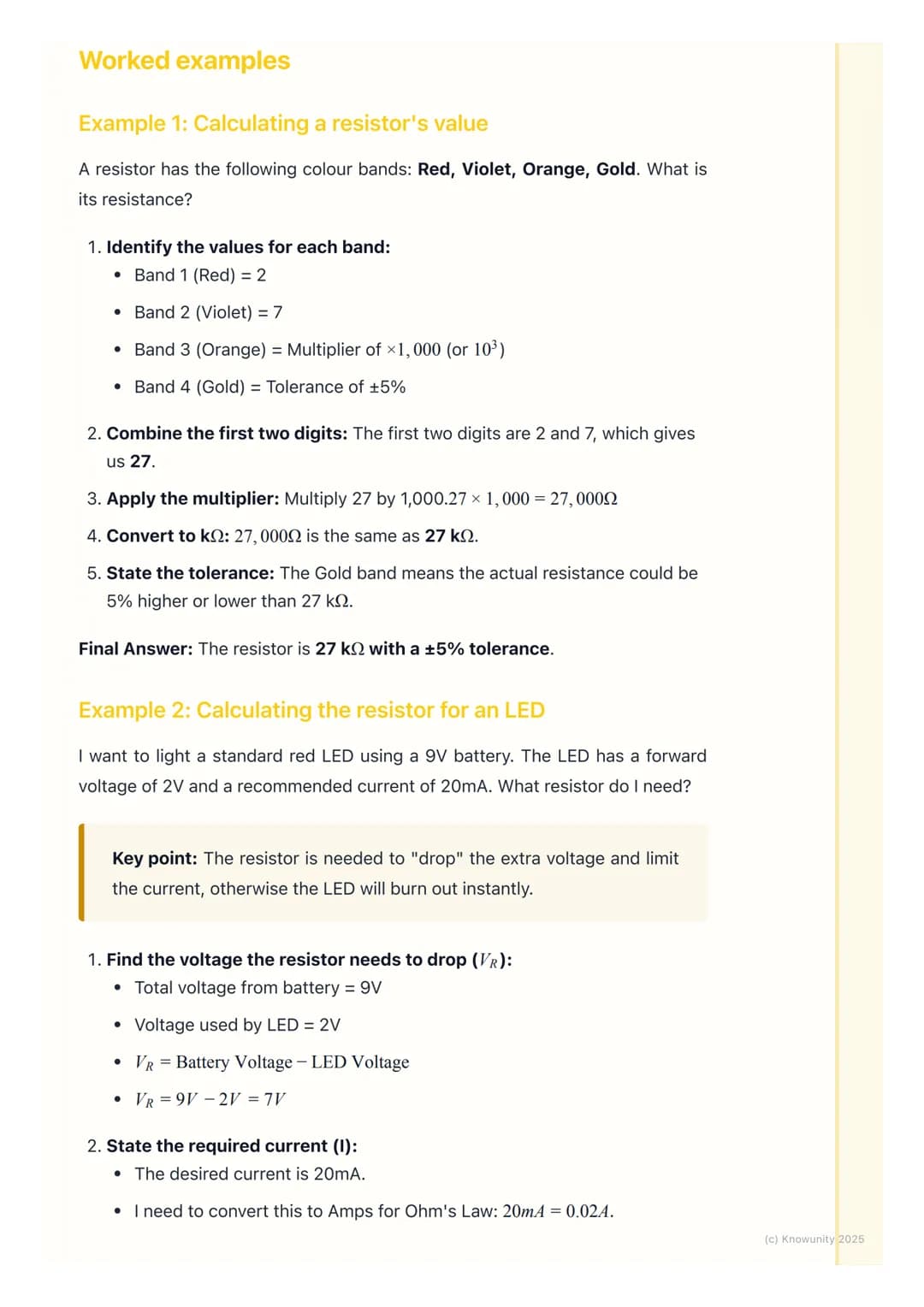
Practical Calculations - Making It Work
Let's crack some real problems you'll face in exams and projects. Resistor colour codes might seem tricky, but they follow a logical pattern.
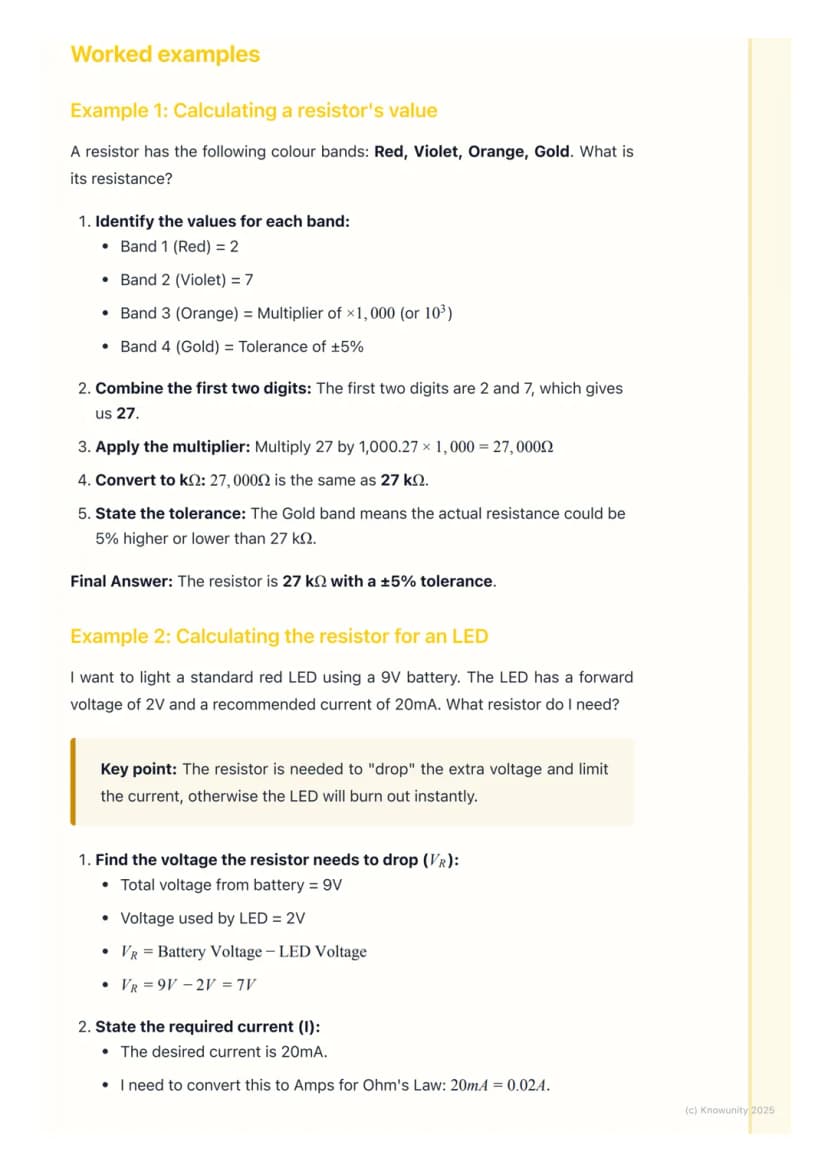
For a resistor with Red, Violet, Orange, Gold bands: Red (2) + Violet (7) gives 27, Orange means ×1,000, so 27,000Ω or 27kΩ. Gold means ±5% tolerance.
LED circuits need careful calculation. If you're powering a 2V LED from a 9V battery, the resistor must drop 7V. With 20mA current required, use Ohm's Law: R = V/I = 7V/0.02A = 350Ω.
Always choose the next highest standard value (390Ω in this case) to ensure your LED doesn't get too much current and burn out.
Exam Success: Convert mA to A by dividing by 1,000. It's a common mistake that costs marks - 20mA = 0.02A, not 20A!
6
of 7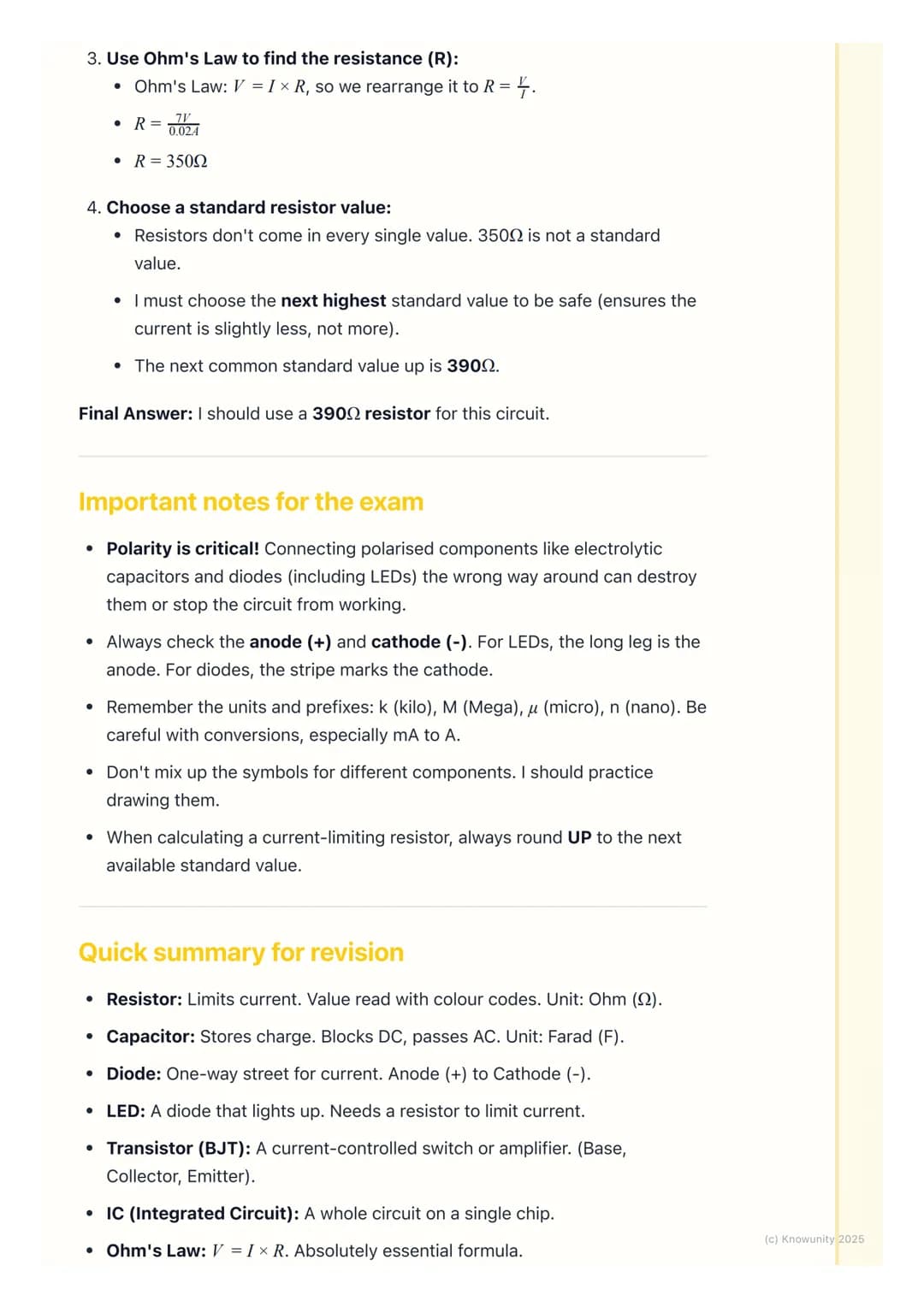
Exam Essentials and Quick Review
Polarity is everything in electronics. LEDs, diodes, and electrolytic capacitors must be connected correctly. For LEDs, long leg = positive. For diodes, the stripe marks negative (cathode).
Unit prefixes will trip you up if you're not careful: k , M , μ , n . Practice converting between them.
When designing circuits, safety first - always calculate resistor values to limit current. Round UP to the next available standard value to protect components.
Your revision checklist: Resistors limit current (Ω), Capacitors store charge (F), Diodes are one-way (anode to cathode), Transistors switch/amplify , ICs are complete circuits on chips.
Final Reminder: Ohm's Law solves most problems. Learn it, love it, use it constantly!
7
of 7
そんなこと聞いてくれるのを待ってたよ...
KnowunityのAIコンパニオンとは?
KnowunityのAIコンパニオンは学生向けに設計されたAIツールで、単なる答えを提供するだけではありません。数百万のKnowunityリソースを基に構築され、関連する情報、個別の学習プラン、クイズ、コンテンツをチャット内で直接提供し、あなたの個別の学習過程に適応します。
Knowunityアプリはどこでダウンロードできますか?
Google Play StoreとApple App Storeからアプリをダウンロードできます。
Knowunityは本当に無料ですか?
その通り!学習コンテンツへの無料アクセス、仲間の学生とのつながり、そして即座のサポートを手のひらで楽しもう。
人気コンテンツ
9 Irish
IrishIrish oral questions and answers
Questions and answers for the leaving cert oral
5th Year4264
 English
Key Quotes : Sive
Key Quotes and explanations: Sive
6th Year2842
IrishIrish oral questions
Outline of oral questions
5th Year2055
IrishIníon- le hÁine Durkin
Aine Durkin’s poem, Iníon: Themes & summary
5th Year890
IrishIrish poetry 2027
Iníon + Dínit an Bhróin
5th Year1153
IrishLC HL notes- Iníon (poem)
Includes poem in English and Irish, theme, key words & phrases
5th Year2304
EnglishCultural Context : Shawshank Redemption : Sive : Small Things Like These
Comparative Study : Cultural Context : Shawshank Redemption, Sive and Small Things Like These
6th Year1430
IrishMo Ghrá-sa (Idir Lúibíní)
Notes on mo ghrá-sa
5th Year380
IrishAn Gaeilge Aiste
Irish Language essay
6th Year1320
探しているものが見つからない?他の教科も見てみよう。
生徒たちが愛用中 — あなたもきっと気に入るはず。
4.6/5App Store
4.7/5Google Play
このアプリはとても使いやすくて、デザインも良いです。今のところ探していたものは全て見つかったし、プレゼン資料からもたくさん学べました!絶対に課題でも使いたいと思います!もちろん、アイデアを得るのにもすごく役立ちます。
Stefan SiOSユーザー
このアプリは本当に素晴らしいです。学習ノートやサポート資料がとても豊富で[...]。例えば、私の苦手科目はフランス語なんですが、このアプリにはサポートオプションがたくさんあります。このアプリのおかげでフランス語が上達しました。誰にでもおすすめしたいです。
Samantha KlichAndroidユーザー
すごい、本当に驚いた。広告で何度も見かけたからアプリを試してみたら、めちゃくちゃ感動した。このアプリは学校で欲しかった「まさにこれ!」って感じのサポートで、特に練習問題や要点まとめみたいな機能がたくさんあって、個人的にすごく助かってる。
AnnaiOSユーザー
Applied Technology1 閲覧数·更新日 Jun 19, 2026·7 ページUnderstanding Basic Electronic Components
Ever wondered how your phone, computer, or even a simple torch actually works? It all comes down to electronic components - the tiny building blocks that make every electronic device tick. Think of them as the Lego bricks of the...
1
of 7
サインアップしてコンテンツを見よう。無料だよ!
- 全ドキュメントへのアクセス
- 成績アップ
- 数百万人の学生と一緒に学習
Electronic Components Basics
Electronic components are literally everywhere in your daily life - from your gaming console to your car's engine management system. They're the fundamental pieces that control how electricity flows through circuits.
Here's what you absolutely need to know: a circuit is just a complete path that lets electricity flow. Picture it like a race track - you need a starting point (battery), the track itself (wires), and some obstacles or features along the way (the components).
Current flows like water through a pipe, measured in Amperes (A). Voltage is the electrical pressure pushing that current along, measured in Volts (V). Resistance acts like a narrow section in the pipe that slows things down, measured in Ohms (Ω).
Remember This: Ohm's Law is your best friend: V = I × R. Master this formula and you'll ace most electronics calculations!
2
of 7サインアップしてコンテンツを見よう。無料だよ!
- 全ドキュメントへのアクセス
- 成績アップ
- 数百万人の学生と一緒に学習
Resistors - The Current Controllers
Resistors are probably the most common components you'll encounter. Their job is simple: limit the flow of current to protect other components from getting fried.
You'll recognise them by their coloured bands - it's like a secret code that tells you their value. The resistor colour code uses the first two bands for digits, the third as a multiplier (how many zeros to add), and the fourth shows tolerance (how accurate the value is).
Here's a memory trick that actually works: "Bad Boys Race Our Young Girls But Violet Generally Wins" for Black, Brown, Red, Orange, Yellow, Green, Blue, Violet, Grey, White. The colours represent numbers 0-9 in that order.
Pro Tip: When you're unsure about a resistor's value, use a multimeter to double-check. It's way faster than squinting at tiny colour bands!
3
of 7サインアップしてコンテンツを見よう。無料だよ!
- 全ドキュメントへのアクセス
- 成績アップ
- 数百万人の学生と一緒に学習
Capacitors and Diodes - Energy Storage and One-Way Streets
Capacitors are like tiny, super-fast rechargeable batteries. They store electrical energy and release it when needed. You'll find them smoothing out power supplies and creating timing circuits in everything from camera flashes to computer motherboards.
Watch out for electrolytic capacitors - they're polarised, meaning they have a positive and negative side. Connect them backwards and they'll literally explode (well, pop quite dramatically).
Diodes are the one-way streets of electronics. Current flows from the anode (+) to the cathode (-) and absolutely nowhere else. The stripe on a diode's body always marks the cathode side.
LEDs are special diodes that light up when current flows through them. The longer leg is always positive. Just remember - they need a current-limiting resistor or they'll burn out instantly.
Watch Out: Polarity matters! Getting the positive and negative connections wrong can destroy components or make circuits fail completely.
4
of 7サインアップしてコンテンツを見よう。無料だよ!
- 全ドキュメントへのアクセス
- 成績アップ
- 数百万人の学生と一緒に学習
Transistors and Integrated Circuits - The Smart Stuff
Transistors are absolutely revolutionary - they're either electronic switches or amplifiers, depending on how you use them. Think of them as taps that can be turned on or off by applying a small signal to the base, which then controls a much larger current between the collector and emitter.
NPN transistors are the most common type. A small current from base to emitter allows a massive current to flow from collector to emitter. It's like using a tiny key to open a huge floodgate.
Integrated Circuits (ICs) are complete circuits shrunk down onto a single chip. The 555 timer IC is legendary in electronics - it's used in thousands of projects to create timers, flashers, and sound generators.
ICs have a notch or dot marking pin 1, then you count anti-clockwise from there. Get this wrong and your circuit definitely won't work.
Key Insight: Transistors are the foundation of all modern computing - your smartphone has billions of them working together!
5
of 7サインアップしてコンテンツを見よう。無料だよ!
- 全ドキュメントへのアクセス
- 成績アップ
- 数百万人の学生と一緒に学習
Practical Calculations - Making It Work
Let's crack some real problems you'll face in exams and projects. Resistor colour codes might seem tricky, but they follow a logical pattern.
For a resistor with Red, Violet, Orange, Gold bands: Red (2) + Violet (7) gives 27, Orange means ×1,000, so 27,000Ω or 27kΩ. Gold means ±5% tolerance.
LED circuits need careful calculation. If you're powering a 2V LED from a 9V battery, the resistor must drop 7V. With 20mA current required, use Ohm's Law: R = V/I = 7V/0.02A = 350Ω.
Always choose the next highest standard value (390Ω in this case) to ensure your LED doesn't get too much current and burn out.
Exam Success: Convert mA to A by dividing by 1,000. It's a common mistake that costs marks - 20mA = 0.02A, not 20A!
6
of 7サインアップしてコンテンツを見よう。無料だよ!
- 全ドキュメントへのアクセス
- 成績アップ
- 数百万人の学生と一緒に学習
Exam Essentials and Quick Review
Polarity is everything in electronics. LEDs, diodes, and electrolytic capacitors must be connected correctly. For LEDs, long leg = positive. For diodes, the stripe marks negative (cathode).
Unit prefixes will trip you up if you're not careful: k , M , μ , n . Practice converting between them.
When designing circuits, safety first - always calculate resistor values to limit current. Round UP to the next available standard value to protect components.
Your revision checklist: Resistors limit current (Ω), Capacitors store charge (F), Diodes are one-way (anode to cathode), Transistors switch/amplify , ICs are complete circuits on chips.
Final Reminder: Ohm's Law solves most problems. Learn it, love it, use it constantly!
7
of 7サインアップしてコンテンツを見よう。無料だよ!
- 全ドキュメントへのアクセス
- 成績アップ
- 数百万人の学生と一緒に学習
そんなこと聞いてくれるのを待ってたよ...
KnowunityのAIコンパニオンとは?
KnowunityのAIコンパニオンは学生向けに設計されたAIツールで、単なる答えを提供するだけではありません。数百万のKnowunityリソースを基に構築され、関連する情報、個別の学習プラン、クイズ、コンテンツをチャット内で直接提供し、あなたの個別の学習過程に適応します。
Knowunityアプリはどこでダウンロードできますか?
Google Play StoreとApple App Storeからアプリをダウンロードできます。
Knowunityは本当に無料ですか?
その通り!学習コンテンツへの無料アクセス、仲間の学生とのつながり、そして即座のサポートを手のひらで楽しもう。
人気コンテンツ
9IrishIrish oral questions and answers
Questions and answers for the leaving cert oral
5th Year4264
EnglishKey Quotes : Sive
Key Quotes and explanations: Sive
6th Year2842
IrishIrish oral questions
Outline of oral questions
5th Year2055
IrishIníon- le hÁine Durkin
Aine Durkin’s poem, Iníon: Themes & summary
5th Year890
IrishIrish poetry 2027
Iníon + Dínit an Bhróin
5th Year1153
IrishLC HL notes- Iníon (poem)
Includes poem in English and Irish, theme, key words & phrases
5th Year2304
EnglishCultural Context : Shawshank Redemption : Sive : Small Things Like These
Comparative Study : Cultural Context : Shawshank Redemption, Sive and Small Things Like These
6th Year1430
IrishMo Ghrá-sa (Idir Lúibíní)
Notes on mo ghrá-sa
5th Year380
IrishAn Gaeilge Aiste
Irish Language essay
6th Year1320
探しているものが見つからない?他の教科も見てみよう。
生徒たちが愛用中 — あなたもきっと気に入るはず。
4.6/5App Store
4.7/5Google Play
このアプリはとても使いやすくて、デザインも良いです。今のところ探していたものは全て見つかったし、プレゼン資料からもたくさん学べました!絶対に課題でも使いたいと思います!もちろん、アイデアを得るのにもすごく役立ちます。
Stefan SiOSユーザー
このアプリは本当に素晴らしいです。学習ノートやサポート資料がとても豊富で[...]。例えば、私の苦手科目はフランス語なんですが、このアプリにはサポートオプションがたくさんあります。このアプリのおかげでフランス語が上達しました。誰にでもおすすめしたいです。
Samantha KlichAndroidユーザー
すごい、本当に驚いた。広告で何度も見かけたからアプリを試してみたら、めちゃくちゃ感動した。このアプリは学校で欲しかった「まさにこれ!」って感じのサポートで、特に練習問題や要点まとめみたいな機能がたくさんあって、個人的にすごく助かってる。
AnnaiOSユーザー