
Applied Mathematics is basically using the maths you learn in...
 Applied Mathematics11 閲覧数·更新日 Jun 22, 2026·6 ページ
Exploring Applied Mathematics: Tools for Real-World Problems
1 / 6
1
of 6
What is Applied Mathematics?
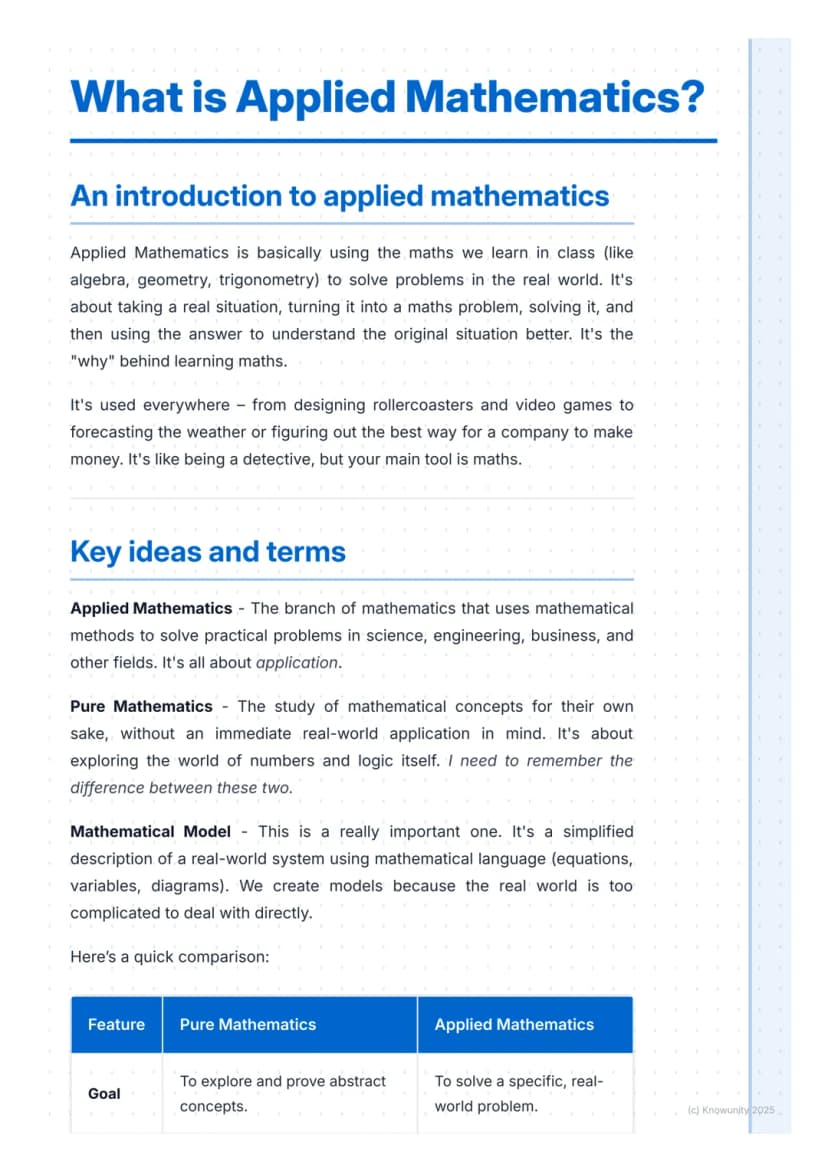
Ever wondered why you're learning algebra or trigonometry? Applied Mathematics is the answer - it's about taking those classroom concepts and using them to solve actual problems in the real world.
Unlike Pure Mathematics (which explores mathematical concepts just for the sake of it), applied maths has a clear goal: solve something practical. Whether it's figuring out the best angle for a football free kick or helping companies make more profit, you're always working towards a real solution.
The secret weapon in applied maths is the mathematical model - basically a simplified maths version of a complex real-world situation. Since the real world is incredibly messy and complicated, we create these models using equations and variables to make problems manageable.
Remember: Pure maths asks "What if?" whilst applied maths asks "How can we fix this?"
2
of 6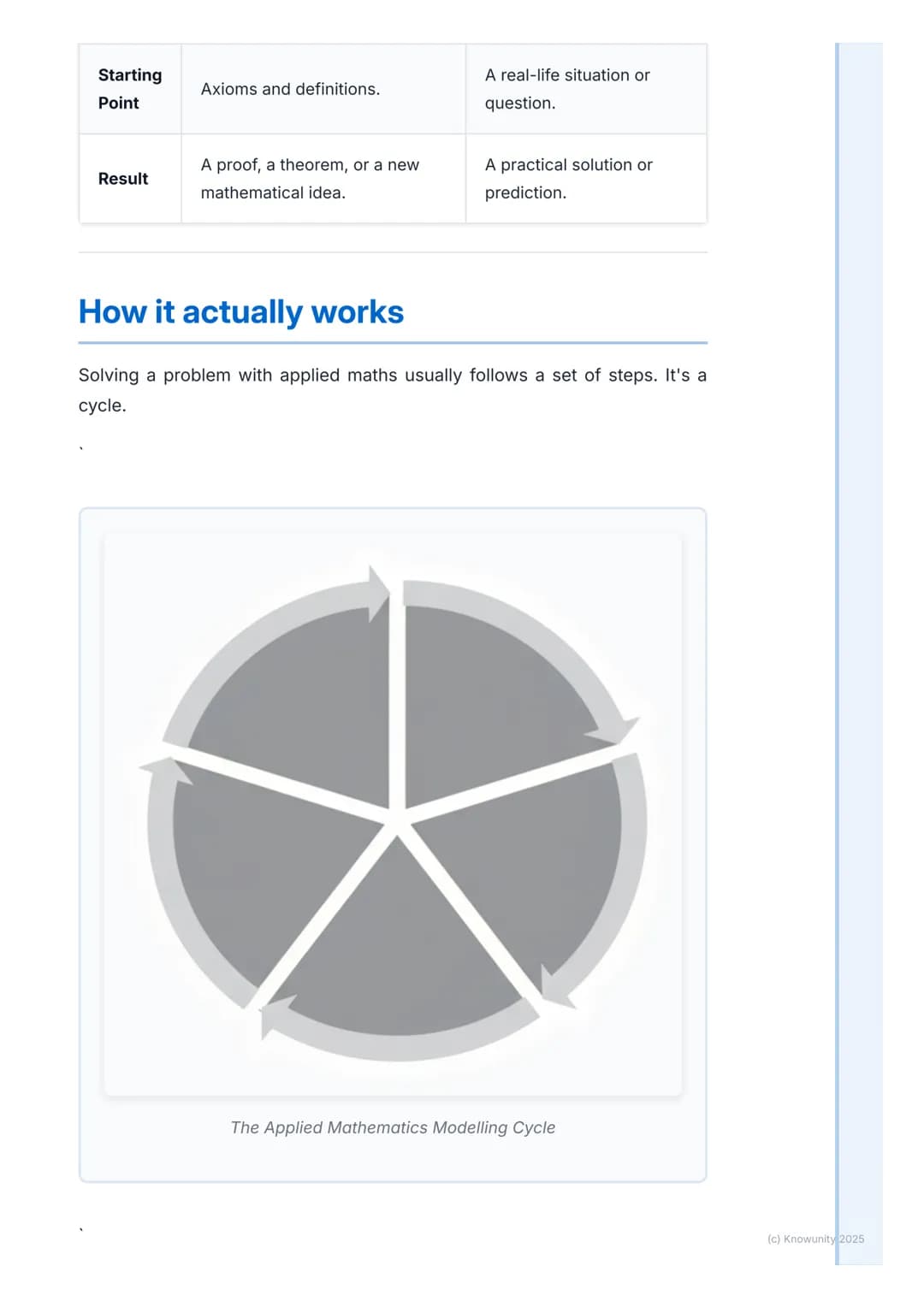
The Applied Mathematics Process
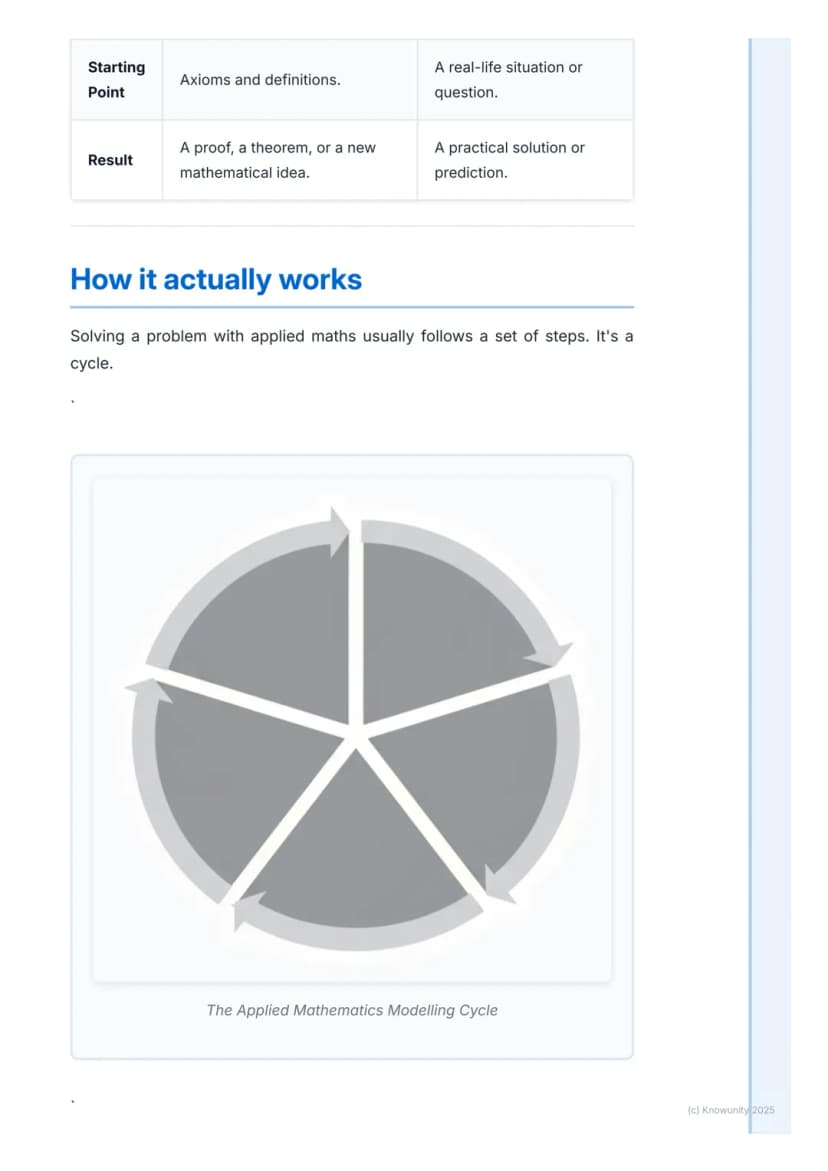
Solving problems with applied mathematics follows a clear cycle that you'll use again and again. It's like having a recipe for tackling any real-world challenge.
The process starts with a real-world problem and moves through several stages: making assumptions, creating a mathematical model, solving it, and interpreting your results. Think of it as translating between two languages - from real life to maths, then back to real life.
This modelling cycle is crucial because it shows that applied maths isn't just about getting the right answer. It's about understanding whether that answer actually makes sense in the original situation.
Key insight: The cycle often repeats - if your answer seems wrong, you go back and refine your model!
3
of 6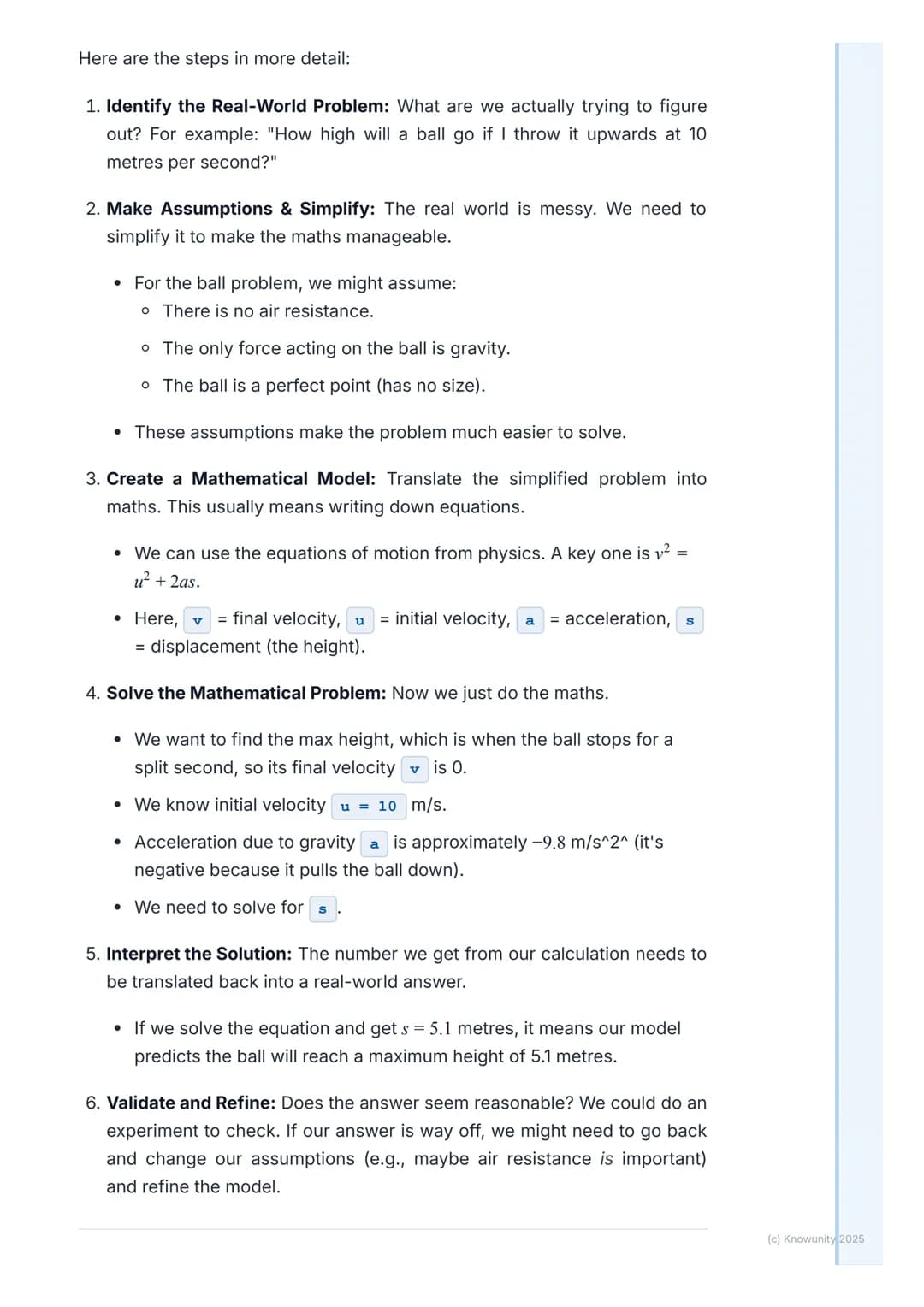
Breaking Down the Steps
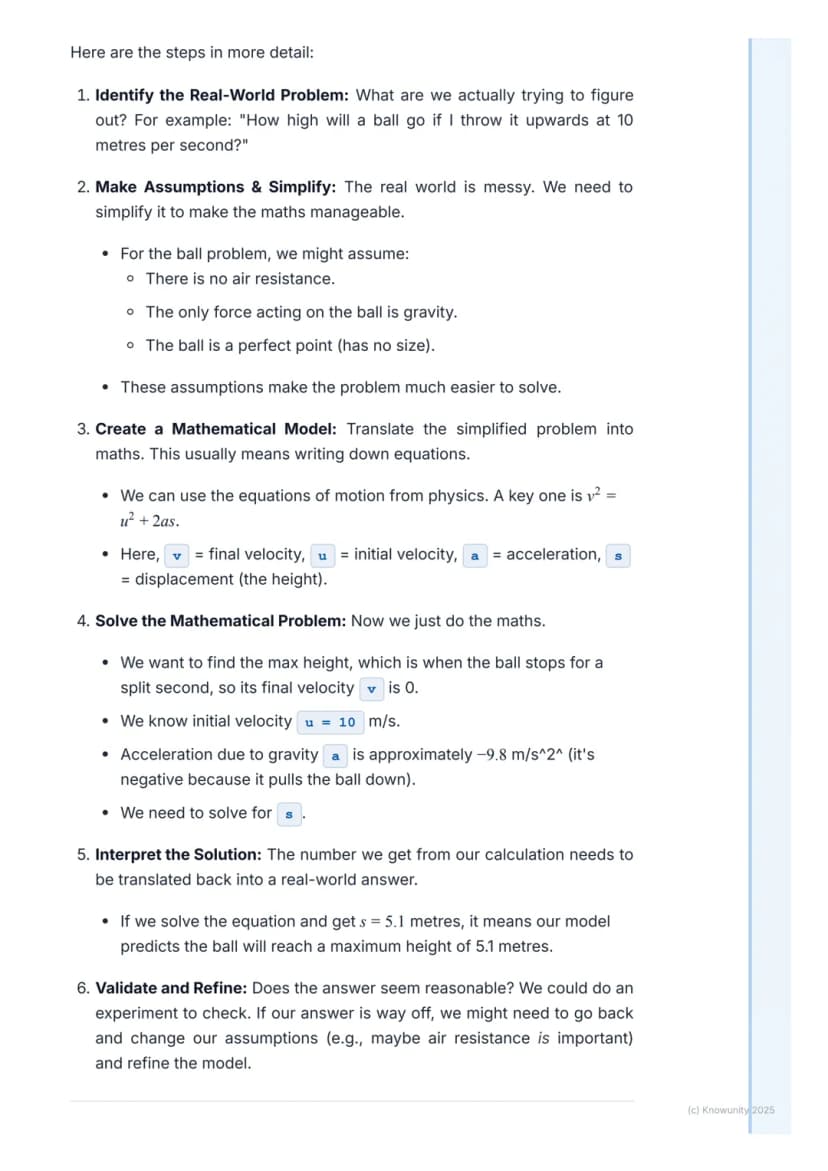
Let's follow the mathematical modelling process with a simple example: "How high will a ball go if I throw it upwards at 10 metres per second?"
First, you identify the problem clearly. Then comes the crucial step of making assumptions - this is where you simplify reality. For our ball, we'll ignore air resistance and assume only gravity affects it.
Next, you create a mathematical model using equations. Here, we'd use physics equations like v² = u² + 2as, where the letters represent velocity, acceleration, and displacement. After solving the maths (plugging in numbers and calculating), you get a numerical answer.
The final steps are interpreting your solution and validating it . If something seems off, you might need to revisit your assumptions.
Pro tip: Always state your assumptions clearly in exams - it shows you understand that you're simplifying a complex problem!
4
of 6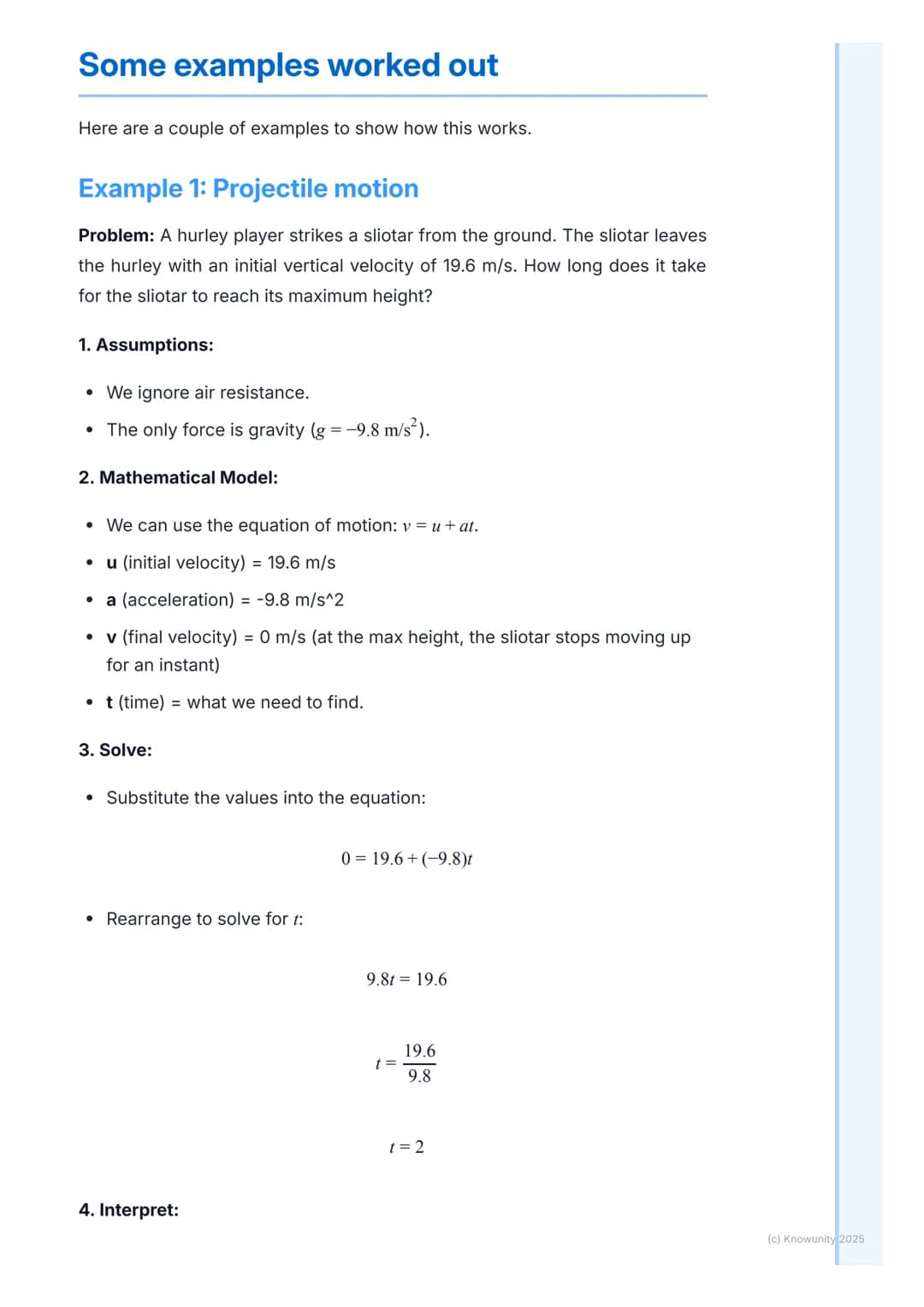
Worked Example: Hurling Physics
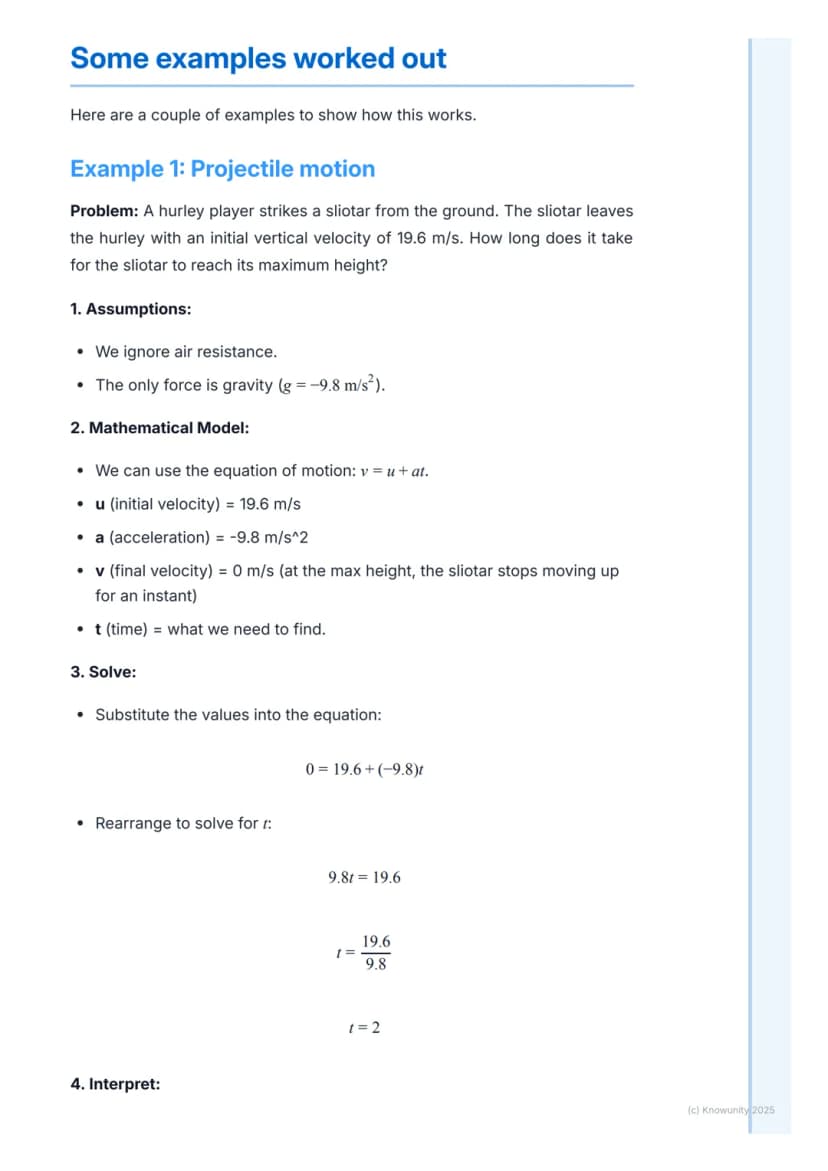
Here's how applied mathematics works with a proper Irish example: A hurler strikes a sliotar with an initial vertical velocity of 19.6 m/s. How long until it reaches maximum height?
Starting with assumptions: we ignore air resistance and only consider gravity . Our mathematical model uses the equation v = u + at, where v (final velocity) = 0 at maximum height, u (initial velocity) = 19.6 m/s, and a (acceleration) = -9.8 m/s².
Solving the equation: 0 = 19.6 + (-9.8)t, which rearranges to t = 19.6/9.8 = 2. The interpretation is straightforward: the sliotar takes 2 seconds to reach its maximum height.
This demonstrates how mathematical modelling transforms a sports scenario into a solvable equation, then translates the numerical result back into practical knowledge.
Reality check: Does 2 seconds seem reasonable for a sliotar to reach its peak? Trust your instincts!
5
of 6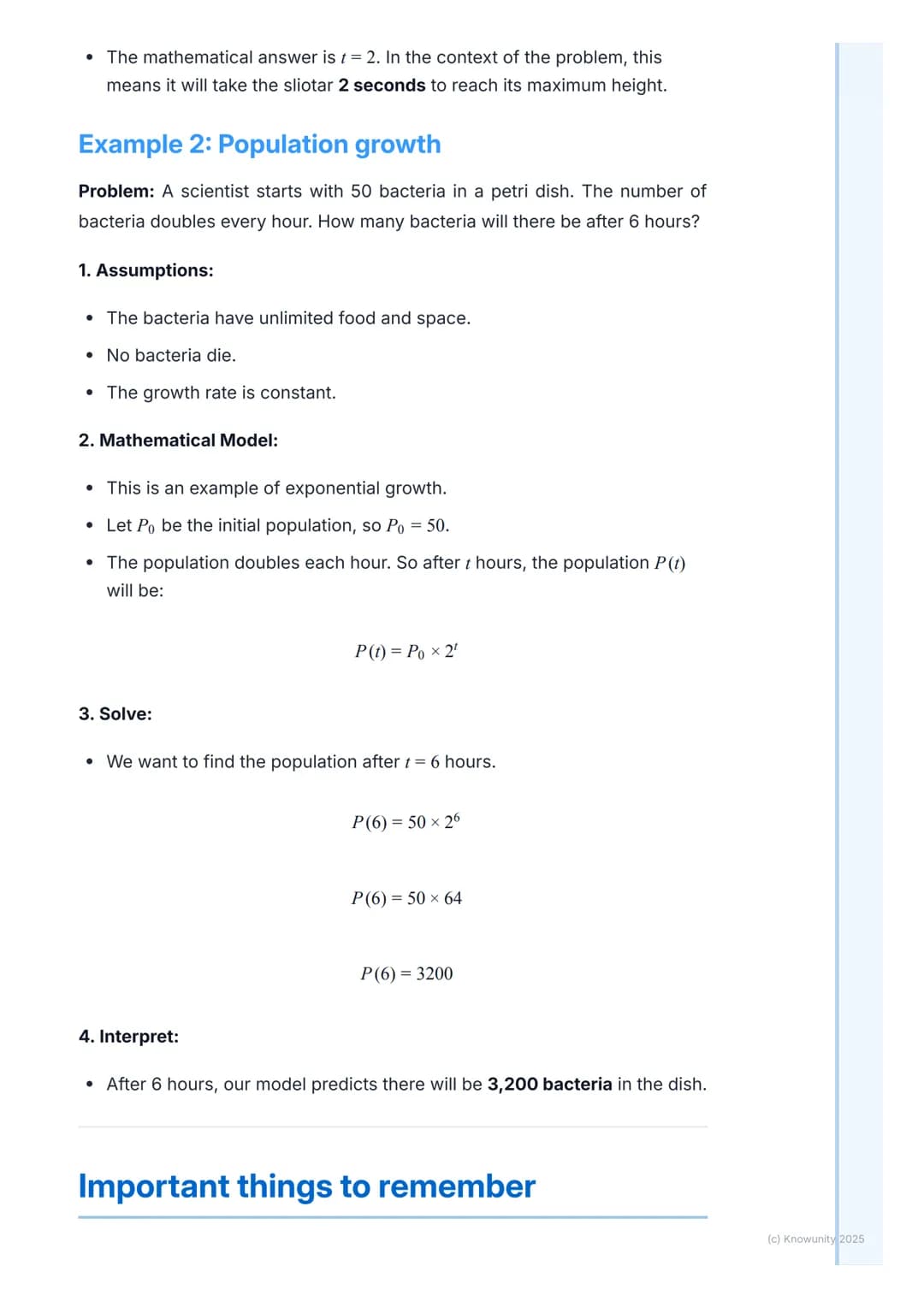
Population Growth Example
Applied mathematics also tackles biological problems brilliantly. Consider: 50 bacteria double every hour - how many after 6 hours?
Our assumptions include unlimited food, no deaths, and constant growth rate. The mathematical model for this exponential growth is P(t) = P₀ × 2ᵗ, where P₀ = 50 bacteria and t = time in hours.
Solving: P(6) = 50 × 2⁶ = 50 × 64 = 3,200 bacteria. The interpretation shows how quickly bacterial populations can explode under ideal conditions.
This example demonstrates how mathematical modelling applies across different fields - from sports physics to biological sciences. The same systematic approach works whether you're dealing with projectiles or populations.
Important: Notice how different real-world situations need completely different mathematical models!
6
of 6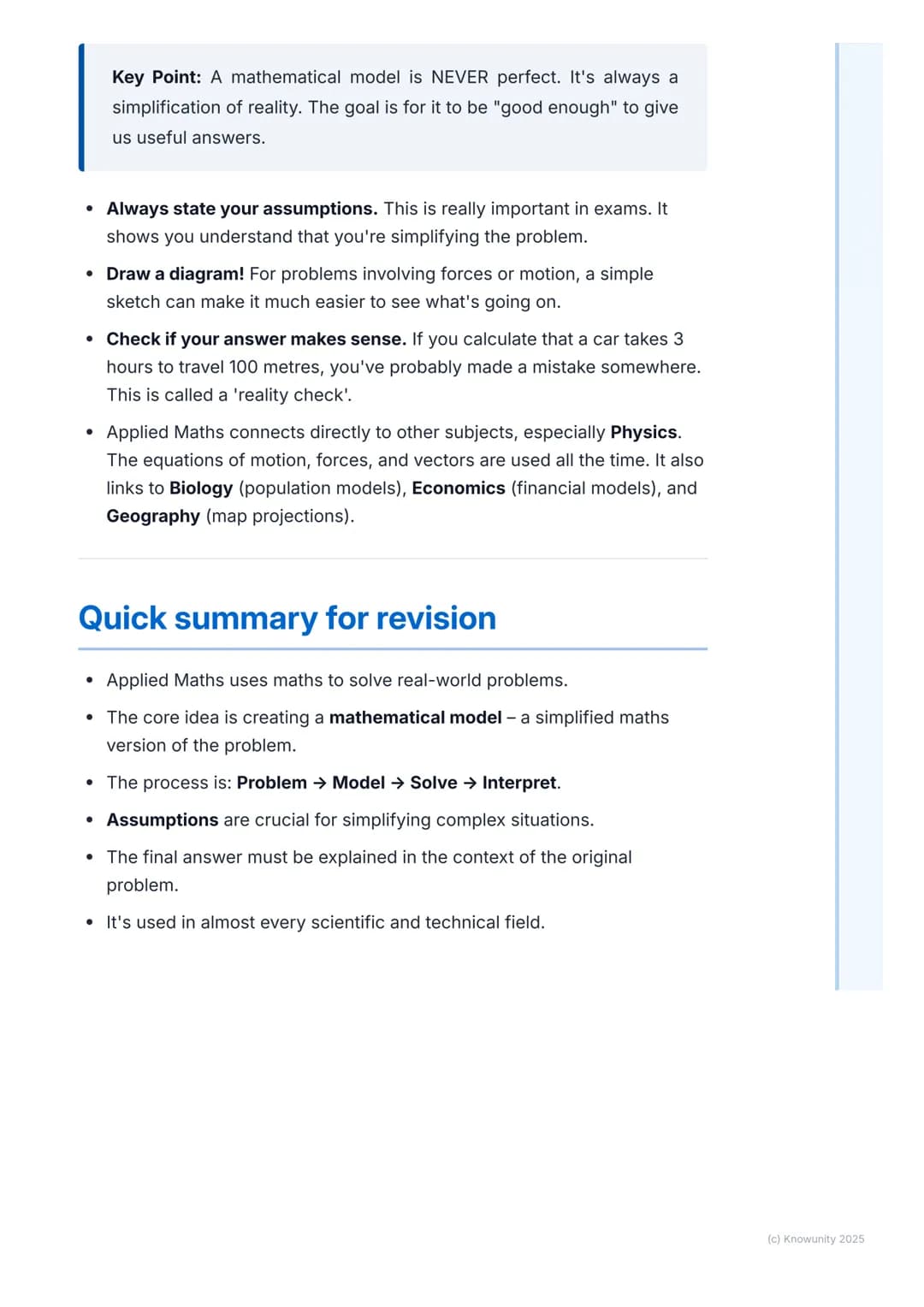
Key Points for Success
Remember that mathematical models are never perfect - they're always simplified versions of reality. The goal is making them "good enough" to provide useful answers, not to capture every tiny detail.
Always state your assumptions clearly and draw diagrams for physics problems. Your applied mathematics solutions should pass the reality check - if a car supposedly takes 3 hours to travel 100 metres, something's gone wrong!
Applied mathematics connects directly to Physics (motion and forces), Biology (population models), Economics (financial planning), and Geography (map projections). It's the bridge between classroom maths and real-world problem-solving.
The core process remains constant: Problem → Model → Solve → Interpret. Master this cycle, and you'll be able to tackle everything from engineering challenges to environmental predictions.
Exam success tip: Always explain your final answer in the context of the original problem - numbers alone aren't enough!
そんなこと聞いてくれるのを待ってたよ...
KnowunityのAIコンパニオンとは?
KnowunityのAIコンパニオンは学生向けに設計されたAIツールで、単なる答えを提供するだけではありません。数百万のKnowunityリソースを基に構築され、関連する情報、個別の学習プラン、クイズ、コンテンツをチャット内で直接提供し、あなたの個別の学習過程に適応します。
Knowunityアプリはどこでダウンロードできますか?
Google Play StoreとApple App Storeからアプリをダウンロードできます。
Knowunityは本当に無料ですか?
その通り!学習コンテンツへの無料アクセス、仲間の学生とのつながり、そして即座のサポートを手のひらで楽しもう。
人気コンテンツ
9 English
Key Quotes : Sive
Key Quotes and explanations: Sive
6th Year2842
 Irish
IrishIrish oral questions and answers
Questions and answers for the leaving cert oral
5th Year4264
 Physics
Balanced and Unbalanced Forces
Students will explore how balanced forces result in no change in motion, while unbalanced forces cause an object to accelerate or change direction.
2nd Year542
IrishIníon- le hÁine Durkin
Aine Durkin’s poem, Iníon: Themes & summary
5th Year890
EnglishCultural Context : Shawshank Redemption : Sive : Small Things Like These
Comparative Study : Cultural Context : Shawshank Redemption, Sive and Small Things Like These
6th Year1430
IrishLC HL notes- Iníon (poem)
Includes poem in English and Irish, theme, key words & phrases
5th Year2304
IrishIrish oral questions
Outline of oral questions
5th Year2055
IrishMo Ghrá-sa (Idir Lúibíní)
Notes on mo ghrá-sa
5th Year380
IrishAn Gaeilge Aiste
Irish Language essay
6th Year1320
探しているものが見つからない?他の教科も見てみよう。
生徒たちが愛用中 — あなたもきっと気に入るはず。
4.6/5App Store
4.7/5Google Play
このアプリはとても使いやすくて、デザインも良いです。今のところ探していたものは全て見つかったし、プレゼン資料からもたくさん学べました!絶対に課題でも使いたいと思います!もちろん、アイデアを得るのにもすごく役立ちます。
Stefan SiOSユーザー
このアプリは本当に素晴らしいです。学習ノートやサポート資料がとても豊富で[...]。例えば、私の苦手科目はフランス語なんですが、このアプリにはサポートオプションがたくさんあります。このアプリのおかげでフランス語が上達しました。誰にでもおすすめしたいです。
Samantha KlichAndroidユーザー
すごい、本当に驚いた。広告で何度も見かけたからアプリを試してみたら、めちゃくちゃ感動した。このアプリは学校で欲しかった「まさにこれ!」って感じのサポートで、特に練習問題や要点まとめみたいな機能がたくさんあって、個人的にすごく助かってる。
AnnaiOSユーザー
Applied Mathematics11 閲覧数·更新日 Jun 22, 2026·6 ページExploring Applied Mathematics: Tools for Real-World Problems
Applied Mathematics is basically using the maths you learn in class to solve real-world problems - from designing rollercoasters to predicting weather patterns. Think of it as being a detective where your main tool is maths instead of a magnifying...
1
of 6
サインアップしてコンテンツを見よう。無料だよ!
- 全ドキュメントへのアクセス
- 成績アップ
- 数百万人の学生と一緒に学習
What is Applied Mathematics?
Ever wondered why you're learning algebra or trigonometry? Applied Mathematics is the answer - it's about taking those classroom concepts and using them to solve actual problems in the real world.
Unlike Pure Mathematics (which explores mathematical concepts just for the sake of it), applied maths has a clear goal: solve something practical. Whether it's figuring out the best angle for a football free kick or helping companies make more profit, you're always working towards a real solution.
The secret weapon in applied maths is the mathematical model - basically a simplified maths version of a complex real-world situation. Since the real world is incredibly messy and complicated, we create these models using equations and variables to make problems manageable.
Remember: Pure maths asks "What if?" whilst applied maths asks "How can we fix this?"
2
of 6サインアップしてコンテンツを見よう。無料だよ!
- 全ドキュメントへのアクセス
- 成績アップ
- 数百万人の学生と一緒に学習
The Applied Mathematics Process
Solving problems with applied mathematics follows a clear cycle that you'll use again and again. It's like having a recipe for tackling any real-world challenge.
The process starts with a real-world problem and moves through several stages: making assumptions, creating a mathematical model, solving it, and interpreting your results. Think of it as translating between two languages - from real life to maths, then back to real life.
This modelling cycle is crucial because it shows that applied maths isn't just about getting the right answer. It's about understanding whether that answer actually makes sense in the original situation.
Key insight: The cycle often repeats - if your answer seems wrong, you go back and refine your model!
3
of 6サインアップしてコンテンツを見よう。無料だよ!
- 全ドキュメントへのアクセス
- 成績アップ
- 数百万人の学生と一緒に学習
Breaking Down the Steps
Let's follow the mathematical modelling process with a simple example: "How high will a ball go if I throw it upwards at 10 metres per second?"
First, you identify the problem clearly. Then comes the crucial step of making assumptions - this is where you simplify reality. For our ball, we'll ignore air resistance and assume only gravity affects it.
Next, you create a mathematical model using equations. Here, we'd use physics equations like v² = u² + 2as, where the letters represent velocity, acceleration, and displacement. After solving the maths (plugging in numbers and calculating), you get a numerical answer.
The final steps are interpreting your solution and validating it . If something seems off, you might need to revisit your assumptions.
Pro tip: Always state your assumptions clearly in exams - it shows you understand that you're simplifying a complex problem!
4
of 6サインアップしてコンテンツを見よう。無料だよ!
- 全ドキュメントへのアクセス
- 成績アップ
- 数百万人の学生と一緒に学習
Worked Example: Hurling Physics
Here's how applied mathematics works with a proper Irish example: A hurler strikes a sliotar with an initial vertical velocity of 19.6 m/s. How long until it reaches maximum height?
Starting with assumptions: we ignore air resistance and only consider gravity . Our mathematical model uses the equation v = u + at, where v (final velocity) = 0 at maximum height, u (initial velocity) = 19.6 m/s, and a (acceleration) = -9.8 m/s².
Solving the equation: 0 = 19.6 + (-9.8)t, which rearranges to t = 19.6/9.8 = 2. The interpretation is straightforward: the sliotar takes 2 seconds to reach its maximum height.
This demonstrates how mathematical modelling transforms a sports scenario into a solvable equation, then translates the numerical result back into practical knowledge.
Reality check: Does 2 seconds seem reasonable for a sliotar to reach its peak? Trust your instincts!
5
of 6サインアップしてコンテンツを見よう。無料だよ!
- 全ドキュメントへのアクセス
- 成績アップ
- 数百万人の学生と一緒に学習
Population Growth Example
Applied mathematics also tackles biological problems brilliantly. Consider: 50 bacteria double every hour - how many after 6 hours?
Our assumptions include unlimited food, no deaths, and constant growth rate. The mathematical model for this exponential growth is P(t) = P₀ × 2ᵗ, where P₀ = 50 bacteria and t = time in hours.
Solving: P(6) = 50 × 2⁶ = 50 × 64 = 3,200 bacteria. The interpretation shows how quickly bacterial populations can explode under ideal conditions.
This example demonstrates how mathematical modelling applies across different fields - from sports physics to biological sciences. The same systematic approach works whether you're dealing with projectiles or populations.
Important: Notice how different real-world situations need completely different mathematical models!
6
of 6サインアップしてコンテンツを見よう。無料だよ!
- 全ドキュメントへのアクセス
- 成績アップ
- 数百万人の学生と一緒に学習
Key Points for Success
Remember that mathematical models are never perfect - they're always simplified versions of reality. The goal is making them "good enough" to provide useful answers, not to capture every tiny detail.
Always state your assumptions clearly and draw diagrams for physics problems. Your applied mathematics solutions should pass the reality check - if a car supposedly takes 3 hours to travel 100 metres, something's gone wrong!
Applied mathematics connects directly to Physics (motion and forces), Biology (population models), Economics (financial planning), and Geography (map projections). It's the bridge between classroom maths and real-world problem-solving.
The core process remains constant: Problem → Model → Solve → Interpret. Master this cycle, and you'll be able to tackle everything from engineering challenges to environmental predictions.
Exam success tip: Always explain your final answer in the context of the original problem - numbers alone aren't enough!
そんなこと聞いてくれるのを待ってたよ...
KnowunityのAIコンパニオンとは?
KnowunityのAIコンパニオンは学生向けに設計されたAIツールで、単なる答えを提供するだけではありません。数百万のKnowunityリソースを基に構築され、関連する情報、個別の学習プラン、クイズ、コンテンツをチャット内で直接提供し、あなたの個別の学習過程に適応します。
Knowunityアプリはどこでダウンロードできますか?
Google Play StoreとApple App Storeからアプリをダウンロードできます。
Knowunityは本当に無料ですか?
その通り!学習コンテンツへの無料アクセス、仲間の学生とのつながり、そして即座のサポートを手のひらで楽しもう。
人気コンテンツ
9EnglishKey Quotes : Sive
Key Quotes and explanations: Sive
6th Year2842
IrishIrish oral questions and answers
Questions and answers for the leaving cert oral
5th Year4264
PhysicsBalanced and Unbalanced Forces
Students will explore how balanced forces result in no change in motion, while unbalanced forces cause an object to accelerate or change direction.
2nd Year542
IrishIníon- le hÁine Durkin
Aine Durkin’s poem, Iníon: Themes & summary
5th Year890
EnglishCultural Context : Shawshank Redemption : Sive : Small Things Like These
Comparative Study : Cultural Context : Shawshank Redemption, Sive and Small Things Like These
6th Year1430
IrishLC HL notes- Iníon (poem)
Includes poem in English and Irish, theme, key words & phrases
5th Year2304
IrishIrish oral questions
Outline of oral questions
5th Year2055
IrishMo Ghrá-sa (Idir Lúibíní)
Notes on mo ghrá-sa
5th Year380
IrishAn Gaeilge Aiste
Irish Language essay
6th Year1320
探しているものが見つからない?他の教科も見てみよう。
生徒たちが愛用中 — あなたもきっと気に入るはず。
4.6/5App Store
4.7/5Google Play
このアプリはとても使いやすくて、デザインも良いです。今のところ探していたものは全て見つかったし、プレゼン資料からもたくさん学べました!絶対に課題でも使いたいと思います!もちろん、アイデアを得るのにもすごく役立ちます。
Stefan SiOSユーザー
このアプリは本当に素晴らしいです。学習ノートやサポート資料がとても豊富で[...]。例えば、私の苦手科目はフランス語なんですが、このアプリにはサポートオプションがたくさんあります。このアプリのおかげでフランス語が上達しました。誰にでもおすすめしたいです。
Samantha KlichAndroidユーザー
すごい、本当に驚いた。広告で何度も見かけたからアプリを試してみたら、めちゃくちゃ感動した。このアプリは学校で欲しかった「まさにこれ!」って感じのサポートで、特に練習問題や要点まとめみたいな機能がたくさんあって、個人的にすごく助かってる。
AnnaiOSユーザー